
Half a light-year from Sagittarius A*, in a region bathed in some of the most intense radiation anywhere in the Milky Way, astronomers just found something that shouldn’t be there: water. A study published this week shows a dying star is quietly seeding its surroundings with dust and molecules, even sitting almost on top of our galaxy’s supermassive black hole.
A Star Living on the Edge
The star in question, IRS 3, sits just 0.55 light-years from Sagittarius A*, the supermassive black hole anchoring the center of our galaxy. That’s an almost absurdly close address, for comparison, the nearest star to our own Sun sits over four light-years away. IRS 3 is one of the brightest mid-infrared sources in the entire galactic center, and it’s nearing the end of its life, puffing off huge amounts of gas and dust in what astronomers call the asymptotic giant branch phase.
Using Webb’s Mid-Infrared Instrument, a team led by Florian Peißker of the University of Cologne got the first continuous infrared spectrum ever collected for this star, and the results settled a decades-old question about what IRS 3 actually is. The data revealed clear signatures of oxygen-rich silicate dust, identifying the star as a genuinely different chemical type than previous studies had suggested.
Finding Water Where It Shouldn’t Survive
The bigger surprise came next. Buried in that same data, the team detected water in the star’s surrounding envelope, the first clear detection of its kind for this object. That’s genuinely unexpected, the environment around Sagittarius A* is dominated by intense radiation exactly the kind of conditions that should tear fragile molecules like water apart before they get a chance to form or survive.
“The detection of water is especially exciting because it shows that molecular material can survive in an environment dominated by intense radiation,” said co-author Macarena Garcia Marin of ESA. Modeling the star’s light against different envelope structures let the team map out a layered shell of dust stretching roughly 10,000 astronomical units outward, cooling from around 1,200 Kelvin near the star down to a relatively mild 100 Kelvin at the outer edge, cool enough for water to persist.
Why This Actually Matters
Dying stars like IRS 3 act as cosmic recycling plants, scattering the raw material that eventually goes into building new stars and planets. Whether that recycling process could still function this close to a supermassive black hole was a genuinely open question, one this discovery just answered. Researchers estimate IRS 3 weighs about six times the mass of our Sun and is roughly 72 million years old, still actively shedding material into an already crowded, hostile neighborhood.
“Galactic centres are among the most extreme environments, so understanding whether stars can continue enriching their surroundings there is an important question,” Peißker said. The answer, it turns out, is yes, even a black hole this extreme hasn’t shut down star death’s basic chemistry.
For more on the discovery, check out the full release from ESA/Webb and the published study in Astronomy & Astrophysics.
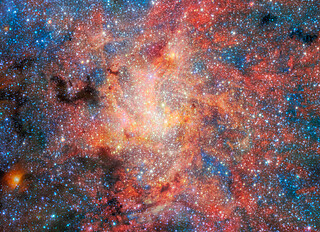 A combined NIRCam and MIRI view of the field surrounding IRS 3, an evolved star just 0.55 light-years from Sagittarius A. Webb’s infrared instruments revealed both oxygen-rich dust and, for the first time, water in the star’s surrounding envelope. (Image: ESA/Webb, NASA & CSA, F. Peißker, J. Lu, F. Yusef-Zadeh, N. B. Sabha, C. Chan)*