
Every galaxy you’ve ever seen a photo of falls into one of a small handful of basic shapes, a classification system astronomer Edwin Hubble worked out back in 1926. Nearly a century later, the same basic framework, now called the Hubble tuning fork, is still how astronomers sort galaxies today.
Spiral Galaxies: The Cosmic Pinwheels
Spiral galaxies are probably what most people picture when they think “galaxy,” a flat, rotating disk of stars with curving arms winding outward from a dense central bulge. Our own Milky Way belongs to this category, along with the nearby Andromeda Galaxy. Spirals are further sorted by how tightly their arms wind, Sa types have tightly wound arms and a prominent central bulge, while Sc types show looser, more open arms and a smaller bulge.
About two-thirds of all spiral galaxies, including both the Milky Way and Andromeda, actually belong to a subtype called barred spirals, where a straight bar of stars, gas, and dust cuts directly across the galaxy’s center before the spiral arms branch outward. Astronomers think the presence of that bar is a sign a galaxy has reached full structural maturity.
Elliptical Galaxies: Smooth, Round, and Quiet
Elliptical galaxies look almost nothing like spirals, they’re smooth, featureless blobs ranging from nearly perfect circles to elongated, cigar-like ovals, with no spiral arms or organized structure at all. Their stars orbit the galactic core in essentially random directions rather than following a neat rotating disk. Ellipticals also tend to contain very little gas and dust, which means very little new star formation, so their stars skew noticeably older than the young, blue stars found lighting up spiral arms.
Ellipticals range dramatically in size, some of the largest galaxies known are giant ellipticals sitting at the centers of massive galaxy clusters, while some of the smallest, dimmest galaxies in the universe are dwarf ellipticals.
Irregular Galaxies: When Nothing Quite Fits
Not every galaxy sorts neatly into a spiral or elliptical category, and that’s exactly what irregular galaxies are, a catch-all label for galaxies with no clear defined shape at all. Some irregulars show at least a hint of organized structure, like the Large and Small Magellanic Clouds, small satellite galaxies orbiting our own Milky Way, visible to the naked eye from the Southern Hemisphere. Others are almost completely disorganized, often the result of a past collision or close gravitational encounter with another galaxy that disrupted whatever structure they once had.
If you’re curious how galaxies like these compare in sheer scale to something like our own solar system, our explainer on the difference between a galaxy and a solar system breaks down exactly how enormous a single galaxy really is.
One More Category: Lenticular Galaxies
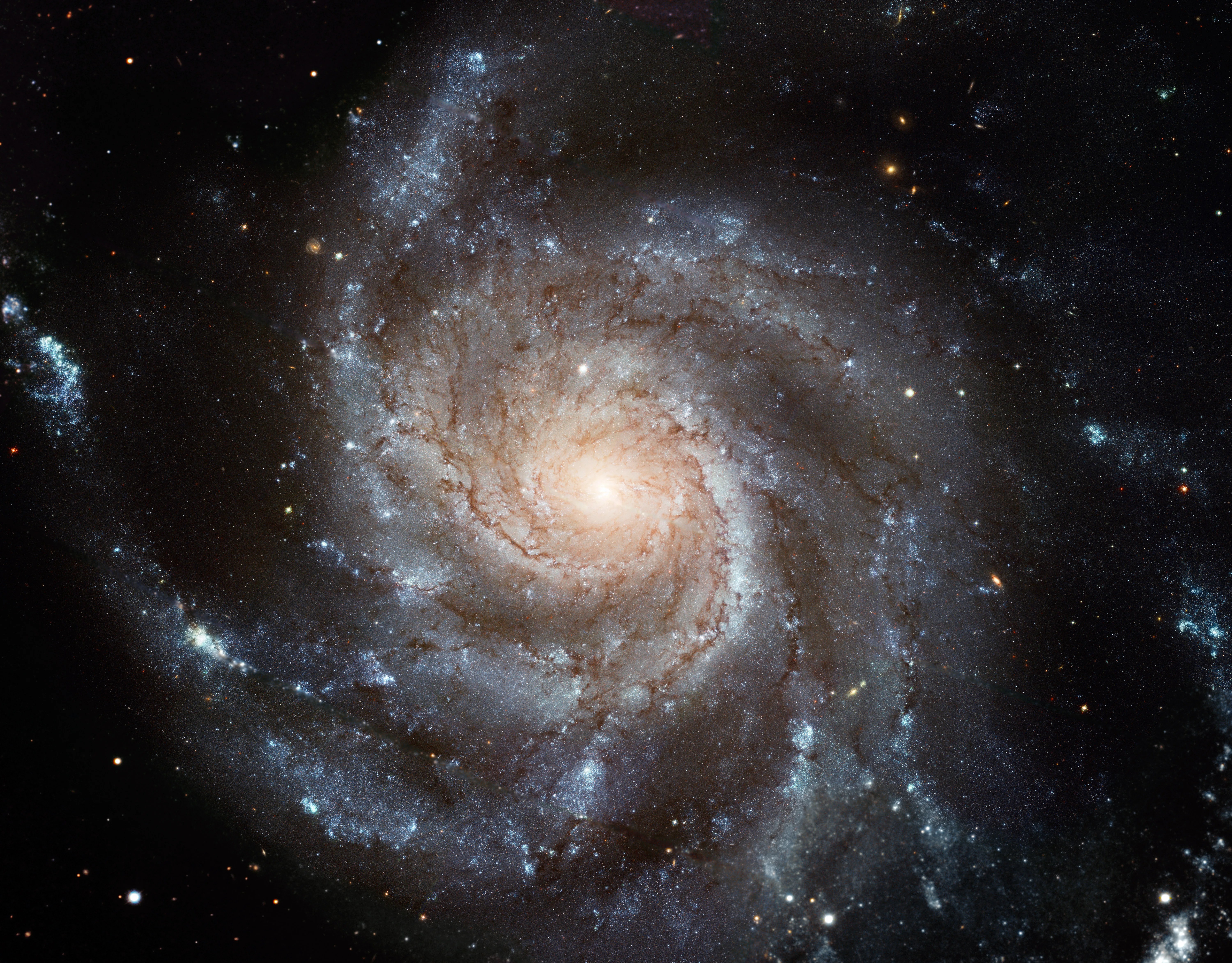 The Pinwheel Galaxy (M101), a classic example of a spiral galaxy, showing sweeping arms rich with gas, dust, and active star formation. (Image: NASA, ESA, K. Kuntz/JHU, F. Bresolin/University of Hawaii, J. Trauger/JPL, J. Mould/NOAO, Y.-H. Chu/University of Illinois, and STScI)
Hubble’s original scheme also included a fourth type, lenticular galaxies, sometimes labeled S0. These sit in a genuine transition zone between spirals and ellipticals, they have the flat disk and central bulge typical of a spiral galaxy, but no spiral arms at all. Like ellipticals, lenticular galaxies tend to host older star populations and show little ongoing star formation, making them something of a structural hybrid between the two main categories.
For more on galaxy classification and examples of each type, check out NASA’s overview of galaxy types and the detailed breakdown from Britannica.
If you enjoyed this article, don’t forget to drop us a comment, it really helps support the site, and be sure to check out our other articles because we think you’re going to love them too.