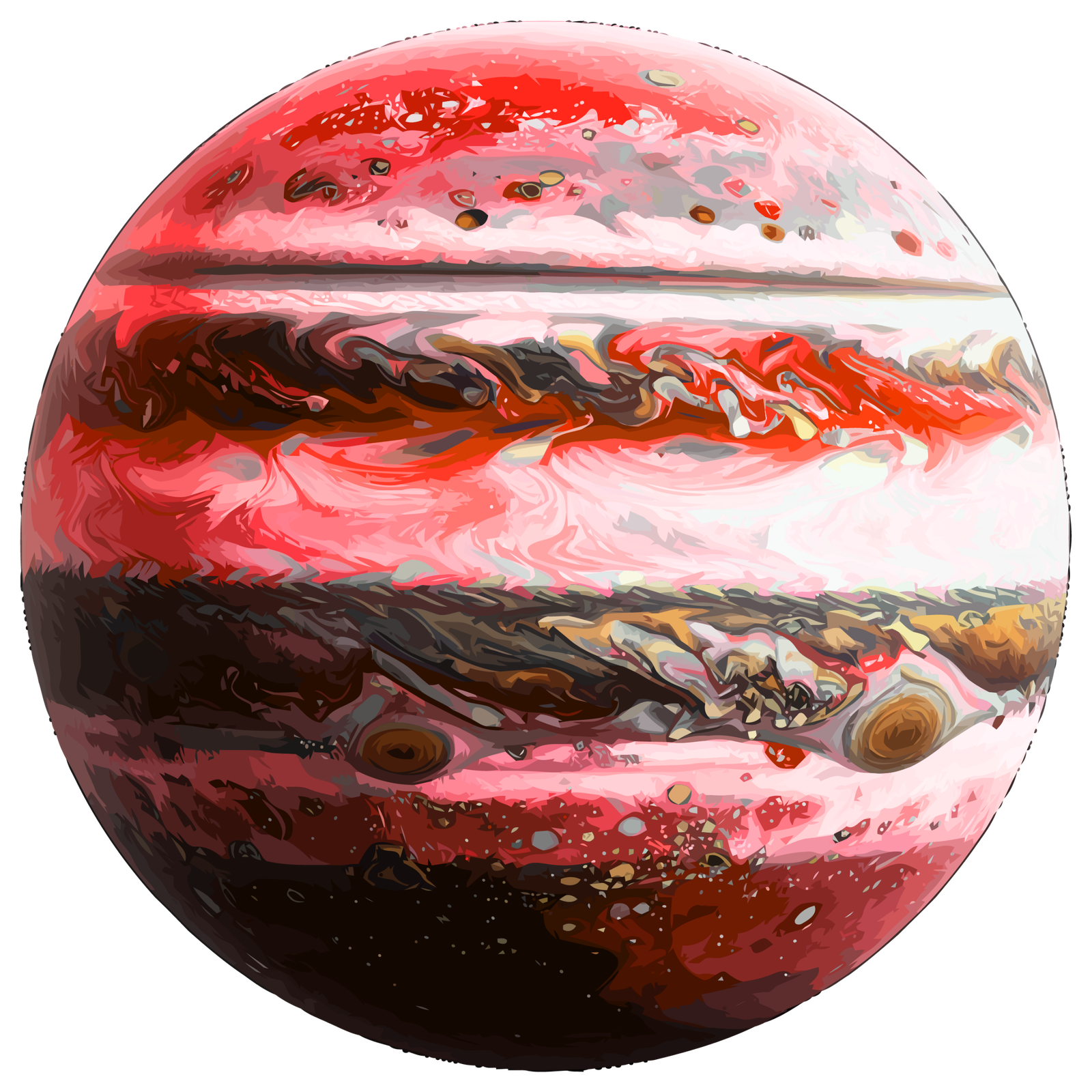

Somewhere between a planet and a star sits a category of object that never quite earned the title of either. Brown dwarfs form the same way stars do, but they never gather enough mass to fully ignite, leaving them stuck in a strange cosmic middle ground astronomers sometimes call “failed stars.”
Almost a Star, But Not Quite
A brown dwarf begins its life exactly like any other star, a massive cloud of gas and dust collapsing under its own gravity. What determines the outcome is mass. Stars need enough of it for their core to reach the extreme temperature and pressure required to sustain hydrogen fusion, the steady nuclear reaction that powers stars for millions or billions of years. Brown dwarfs simply never gather quite enough material to cross that threshold.
Astronomers generally place brown dwarfs somewhere between 13 and 80 times the mass of Jupiter. Below that range, an object is considered a planet; above it, gravity finally generates enough core pressure to sustain proper, long-term hydrogen fusion and the object becomes a genuine star.
 Faint red brown dwarfs, sometimes called “failed stars,” spotted for the first time in visible light within the Orion Nebula by the Hubble Space Telescope. (Image: NASA, ESA, K. Luhman/Penn State University, G. Schneider/University of Arizona)
A Brief Flicker, Then a Long, Slow Fade
Brown dwarfs aren’t entirely dead weight, though. As the collapsing cloud contracts, its core does heat up, just not enough to sustain hydrogen fusion long term. Some brown dwarfs briefly fuse deuterium, a heavier isotope of hydrogen, and the most massive ones can even fuse a small amount of lithium for a while. These reactions burn out quickly, though, and once that limited fuel runs dry, a brown dwarf simply cools and dims for the rest of its extremely long existence, radiating away leftover heat from its original formation rather than generating any new energy.
That slow cooling makes older brown dwarfs genuinely difficult to find, the coldest ones, called Y dwarfs, can drop below 350 degrees Fahrenheit, similar to a warm oven, compared to our Sun’s roughly 10,000 degree surface. Astronomers estimate as many as 100 billion brown dwarfs could be scattered throughout the Milky Way, yet only around 2,000 have actually been confirmed so far, since most are simply too faint and cold to spot.
Redefining Just How Small a “Star” Can Be
In 2023, astronomers using the James Webb Space Telescope pushed the lower boundary of brown dwarfs even further, identifying one weighing just three to four times the mass of Jupiter, deep into territory that overlaps with giant planets. Discoveries like that one keep blurring an already fuzzy line, and they’re a genuine reminder that nature doesn’t always sort neatly into the categories astronomers invent. If you’re curious about the actual smallest true star category that manages to sustain fusion, our piece on what a red giant becomes over its stellar lifetime covers the fully successful side of stellar evolution for comparison.
Not a Failure So Much As a Different Path
Despite the unflattering nickname, brown dwarfs aren’t really failures, they’re simply a different, genuinely common outcome of the same star-forming process that builds everything from red dwarfs to blue supergiants. Studying them helps astronomers understand exactly where the dividing line between star and planet actually sits, a boundary that keeps getting more interesting the closer scientists look.
For more on brown dwarf research and recent discoveries, check out the overview from Space.com and the record-breaking find reported by ESA/Webb.
If you enjoyed this article, don’t forget to drop us a comment, it really helps support the site, and be sure to check out our other articles because we think you’re going to love them too.