
Saturn is the planet everyone recognizes instantly thanks to its rings, but the numbers behind it are just as striking as the view through a telescope. Here’s how big Saturn actually is, how far it sits from the Sun, and why a single Saturnian season lasts longer than most people’s entire childhood.
The Second Largest Planet, by a Wide Margin
Saturn is the sixth planet from the Sun and the second largest in the solar system, with a diameter of about 74,900 miles, roughly 9.4 times wider than Earth. Despite that massive size, Saturn is startlingly lightweight for its bulk, it’s the least dense planet in the solar system, made almost entirely of hydrogen and helium. Its density is actually lower than water, meaning if you somehow found an ocean large enough, Saturn would technically float.
That low density comes paired with real heft, Saturn’s total mass is about 95 times greater than Earth’s, even though it’s built almost entirely from the lightest elements in the universe.
Nearly a Billion Miles From the Sun
Saturn orbits the Sun at an average distance of about 886 million miles, or roughly 9.5 astronomical units, meaning it sits nearly ten times farther from the Sun than Earth does. Sunlight that takes 8 minutes to reach Earth needs about 80 minutes to make the trip out to Saturn. Because Saturn’s orbit is elliptical, that distance actually shifts throughout its year, ranging from about 839 million miles at its closest to 934 million miles at its farthest.
Despite that enormous distance, Saturn remains the farthest planet a person can spot with the naked eye alone, no telescope required, though its rings only become visible with at least a small telescope or a strong pair of binoculars.
A Year Longer Than Most Careers
Covering that much orbital ground takes time, a single trip around the Sun lasts about 29.5 Earth years, meaning someone born the year Saturn was at a certain point in its orbit wouldn’t see it return to that same spot until nearly middle age. Saturn’s rotation runs remarkably fast for its size, completing one full day in just under 10.7 hours, the second fastest rotation of any planet in the solar system after Jupiter.
Saturn’s axis is tilted 26.7 degrees, similar to Earth’s own 23.4 degree tilt, which gives it seasons much like our own. The difference is scale, thanks to that nearly 30 year orbit, each individual Saturnian season lasts more than seven Earth years. If you’re curious how another distant, tilted world compares, our profile of Uranus’s distance from the Sun covers the ice giant with an even stranger tilt.
Explored by Just Four Spacecraft
Only four robotic missions have ever visited Saturn up close. NASA’s Pioneer 11 provided the first flyby in 1979, followed by Voyager 1 and Voyager 2 nine months apart in 1980 and 1981. It wasn’t until Cassini entered orbit in 2004 that scientists really began to understand Saturn in detail, studying the planet and its moons for 13 years before deliberately diving into Saturn’s atmosphere in 2017 to avoid contaminating any of its potentially habitable moons.
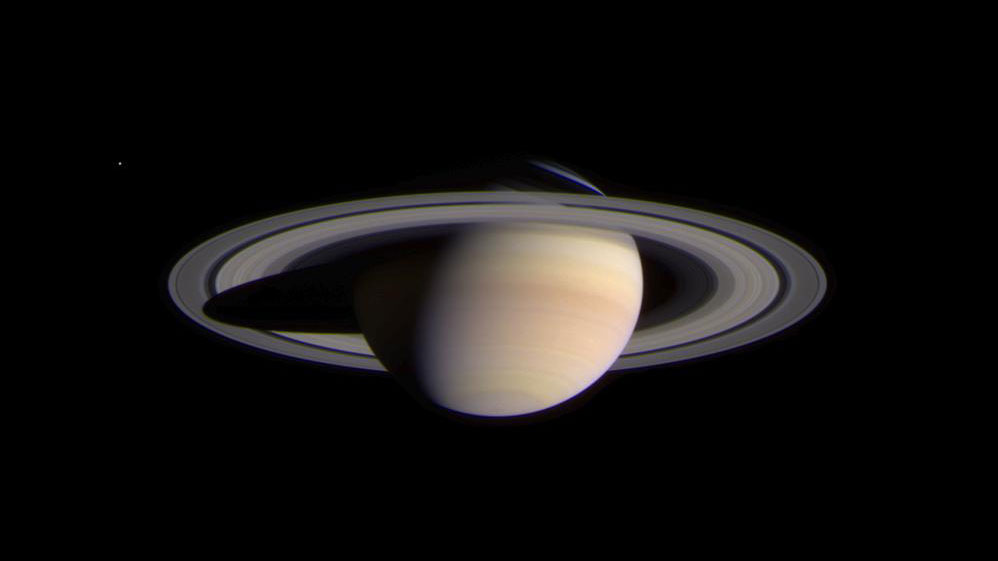 Saturn and its rings, captured by NASA’s Cassini spacecraft on February 9, 2004, from about 43 million miles away. (Image: NASA/JPL/Space Science Institute)
For more detailed data straight from the source, check out NASA’s Saturn Facts page and the additional overview from Britannica.
If you enjoyed this article, don’t forget to drop us a comment, it really helps support the site, and be sure to check out our other articles because we think you’re going to love them too.