
In just two weeks, NASA is launching a telescope specifically built to chase down one of the biggest mysteries in physics, why the universe’s expansion is speeding up instead of slowing down. The culprit is something scientists call dark energy, and despite making up roughly 68 to 70 percent of everything in existence, we genuinely don’t know what it is.
A Discovery Nobody Expected
Throughout the early 1990s, cosmologists assumed gravity should be gradually slowing the universe’s expansion down, the same way gravity eventually pulls a thrown ball back to Earth. In 1998, two independent teams studying distant exploding stars called Type Ia supernovae found something baffling instead, the expansion wasn’t slowing at all, it was speeding up. That discovery earned its researchers the 2011 Nobel Prize in Physics, and it forced scientists to accept that some unknown force was actively pushing galaxies apart faster and faster over time.
Repulsive Gravity, Sort Of
Dark energy behaves almost like the opposite of gravity, a form of negative pressure that pushes space outward rather than pulling matter together. One leading explanation treats it as vacuum energy, a background energy built into empty space itself. Ironically, Einstein had proposed something almost identical decades earlier, a “cosmological constant” meant to keep the universe static, then abandoned it once Hubble proved the universe was expanding, famously calling it his biggest blunder.
That abandoned constant may have been onto something after all, just for the opposite reason Einstein originally intended it.
A Telescope Built to Solve It
NASA’s Nancy Grace Roman Space Telescope is scheduled to launch August 30, 2026, nine months ahead of its original schedule. Named for NASA’s first chief astronomer, Roman will observe light from potentially a billion galaxies over its lifetime, using that enormous dataset to track how dark energy has influenced the universe’s expansion and the growth of cosmic structure across billions of years of history. It joins the European Space Agency’s Euclid mission, launched in 2023, which is independently building its own 3D map of how dark energy has pulled matter apart over cosmic time.
If you want to see how dark energy fits alongside the universe’s other invisible ingredients, our companion piece on what dark matter actually is covers the roughly 25 percent of the universe that dark energy doesn’t account for.
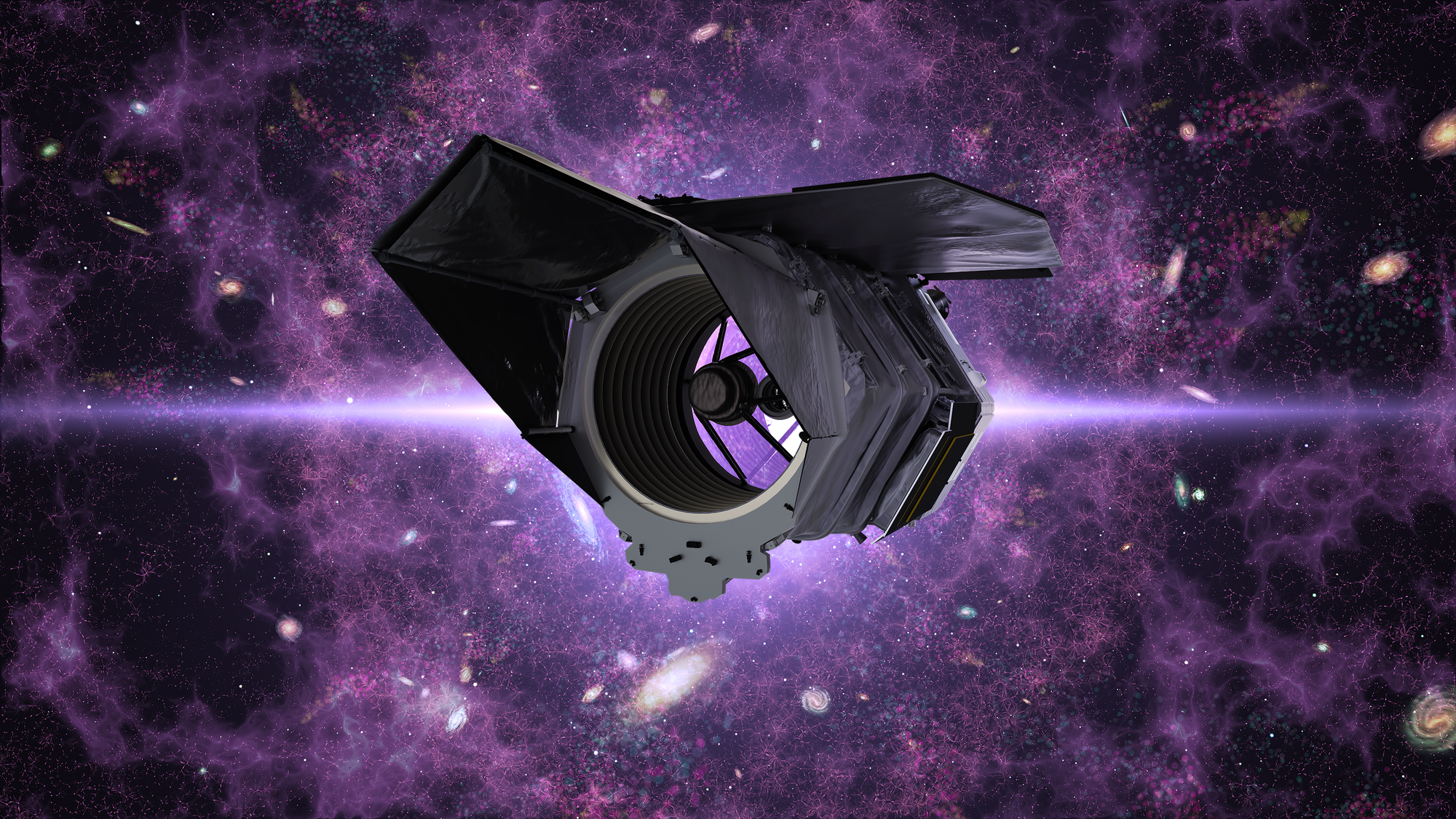 NASA’s Nancy Grace Roman Space Telescope, set to launch August 30, 2026, carries a field of view over 100 times larger than Hubble’s, built specifically to map how dark energy has shaped the universe’s structure over billions of years. (Image: NASA)
Still a Genuine Mystery
Quantum physics predicts dark energy should exist, but its predicted strength is off from what astronomers actually observe by a staggering factor, one of the largest disagreements between theory and observation in all of science. Some researchers think dark energy is a fixed cosmological constant, others propose it might change over space and time, and a smaller group wonders if it signals a genuine gap in Einstein’s theory of general relativity itself.
Whatever the answer turns out to be, it matters enormously, dark energy currently controls the ultimate fate of the universe, whether it expands forever, slows down, or something stranger happens entirely.
For more on the discovery and ongoing search for answers, check out the overview from NASA Science and the mission details for NASA’s Roman Space Telescope.
If you enjoyed this article, don’t forget to drop us a comment, it really helps support the site, and be sure to check out our other articles because we think you’re going to love them too.