
Look up at a truly dark sky and you’re seeing light from thousands of stars, but almost none of them are actually close. In fact, every star you can spot with your naked eye belongs to our own Milky Way, and the genuinely nearby ones, the stars close enough that spacecraft could theoretically reach them within a human lifetime, are a surprisingly short and strange list. Here are the 10 nearest stars to Earth, ranked by distance, starting with our closest neighbor and working outward.
1. Proxima Centauri — 4.24 Light-Years
The closest star to our Sun is a small, dim red dwarf that you’d never spot without a telescope, despite it being our nearest stellar neighbor. Proxima Centauri is part of the larger Alpha Centauri system and hosts at least one confirmed rocky planet, Proxima b, sitting in its habitable zone, though the star’s frequent, violent flares raise serious doubts about whether that planet could actually support life.
2. Alpha Centauri A & B — 4.37 Light-Years
Just slightly farther out sit Alpha Centauri A and B, a pair of Sun-like stars locked in a close orbital dance with each other. Together with Proxima Centauri, they make up the full Alpha Centauri system, and A and B are bright enough to see with the naked eye from the southern hemisphere, appearing as a single brilliant point of light without a telescope to split them apart.
3. Barnard’s Star — 5.96 Light-Years
Barnard’s Star holds the title of closest single star to our Sun, and it’s also the fastest moving star in the entire night sky, drifting across its background stars faster than any other known star, a phenomenon astronomers call proper motion. Long nicknamed the “great white whale” of planet hunting for how many false starts scientists had trying to find worlds around it, Barnard’s Star has finally paid off, with four small exoplanets confirmed between 2024 and 2025, all uncomfortably close to their star and almost certainly too hot and irradiated to host life.
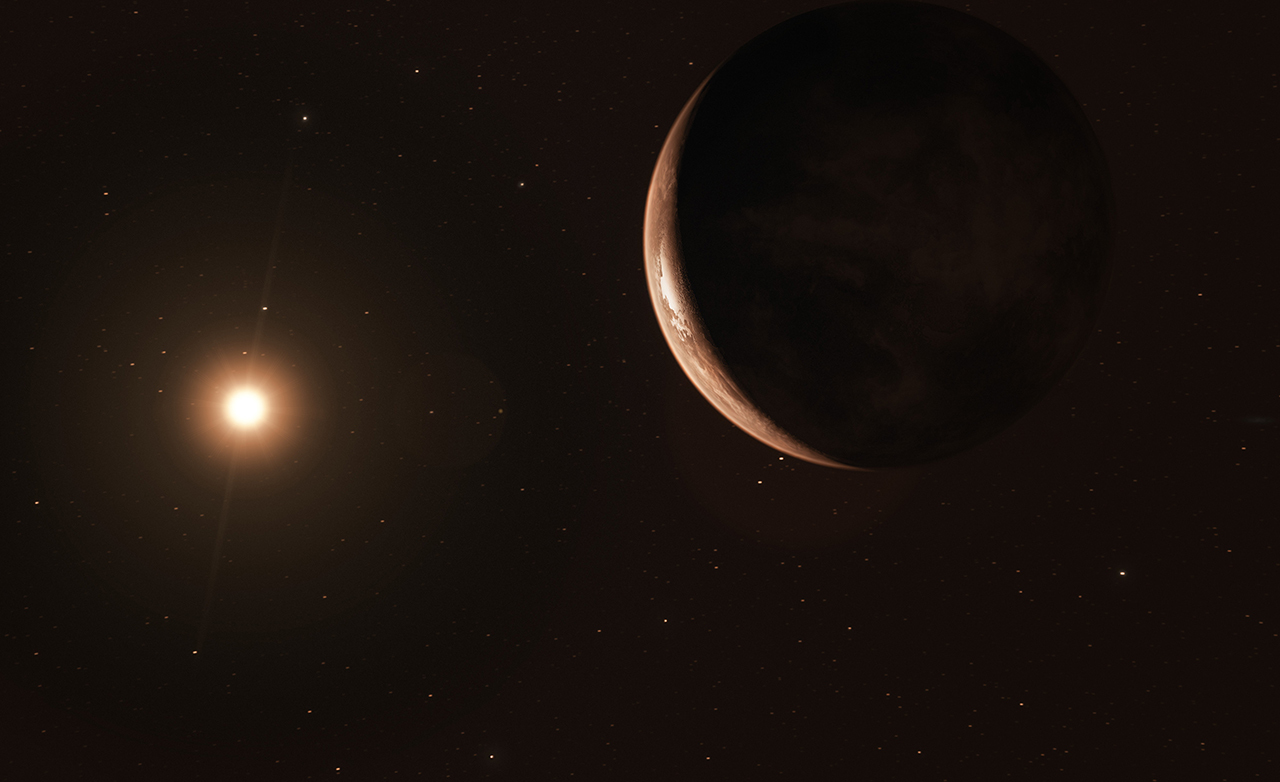 An artist’s impression of one of the small, rocky exoplanets discovered orbiting Barnard’s Star, the fastest-moving star in Earth’s night sky. (Image: ESO/M. Kornmesser)
4. Wolf 359 — 7.86 Light-Years
Wolf 359 is one of the faintest, lowest mass stars known in our stellar neighborhood, so dim it requires a genuinely powerful telescope just to spot. It’s also a flare star, capable of sudden, dramatic bursts of brightness, and it’s picked up a fair bit of pop culture fame as the site of a major space battle in Star Trek: The Next Generation, despite being almost invisible in reality.
5. Lalande 21185 — 8.31 Light-Years
Lalande 21185 is another red dwarf, but it holds a small distinction of its own, its the brightest red dwarf visible from the Northern Hemisphere. Despite that, it still requires a telescope to see, and astronomers have found evidence suggesting it may host a small planetary system of its own, though details remain far less settled than for some of its neighbors on this list.
6. Sirius A & B — 8.66 Light-Years
Sirius needs no telescope at all, it’s the single brightest star in Earth’s entire night sky, and ancient civilizations built entire calendars around tracking its appearance. What most naked eye observers don’t realize is that Sirius is actually a binary system, Sirius A, a hot, brilliant white star roughly twice the Sun’s size, and Sirius B, a faint white dwarf companion so small and dim it took Hubble’s most sensitive instruments to properly study it.
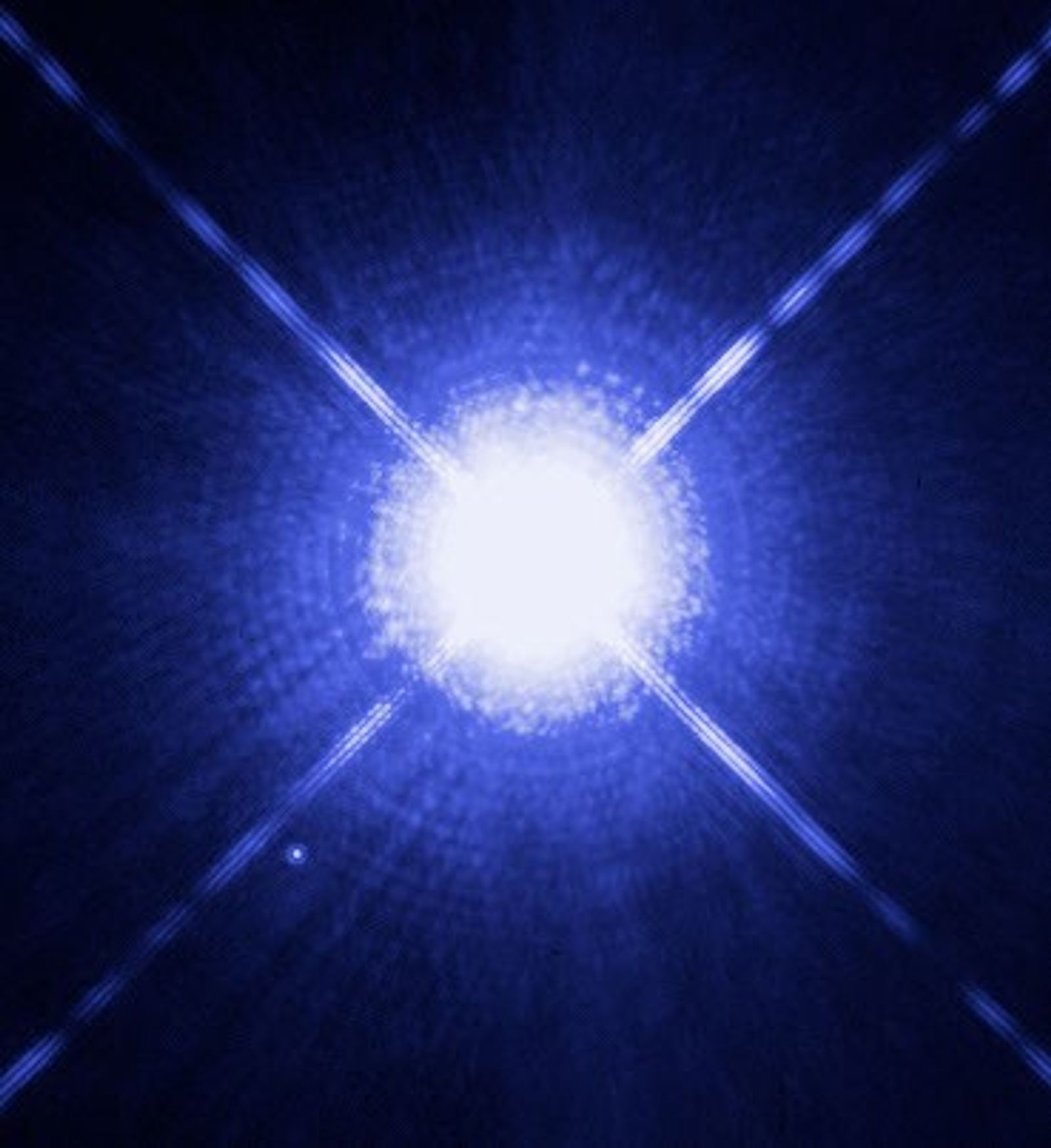 Sirius A, the brightest star in Earth’s night sky, alongside its faint companion Sirius B, a white dwarf roughly the size of Earth but containing nearly as much mass as our Sun. (Image: NASA, H.E. Bond and E. Nelan/STScI; M. Barstow and M. Burleigh/University of Leicester; J.B. Holberg/University of Arizona)
7. Luyten 726-8 A & B — 8.73 Light-Years
This faint binary pair, sometimes better known by the individual names BL Ceti and UV Ceti, sits just barely farther out than Sirius. UV Ceti in particular is famous among astronomers as one of the most extreme flare stars ever studied, capable of flaring bright enough to increase its brightness fivefold in under a minute before gradually settling back down.
8. Ross 154 — 9.68 Light-Years
Ross 154 is yet another red dwarf, and like several others on this list, its classified as a flare star prone to sudden, unpredictable bursts of brightness. It’s far too faint to see without a telescope, and relatively little else about it stands out compared to its more famous neighbors, its simply a quiet, dim member of our stellar neighborhood.
9. Ross 248 — 10.32 Light-Years
Ross 248 earns a spot on this list for a genuinely wild reason, its moving. In roughly 36,000 years, Ross 248 will actually overtake Proxima Centauri and become the new closest star to our Sun, before eventually drifting away again. Its also directly in the path of Voyager 2, which is expected to pass within about 1.7 light-years of Ross 248 in around 42,000 years, assuming the long silent spacecraft is still drifting along that same trajectory by then.
10. Epsilon Eridani — 10.52 Light-Years
Rounding out the list is Epsilon Eridani, a young, orange tinted star bright enough to spot with the naked eye under dark skies. It hosts a confirmed gas giant exoplanet along with a dusty debris disk that hints at the possible presence of even more unseen planets. Science fiction fans might also recognize it, Epsilon Eridani is the real star system Star Trek fans long associated with the fictional planet Vulcan.
Why This Neighborhood Matters
Every star on this list sits within about 10.5 light-years of our own Sun, and yet that distance is still almost impossible to picture in practical terms, light itself takes over a decade just to make the trip from the farthest entries here. Studying these close neighbors gives astronomers their best shot at directly imaging exoplanets, testing atmospheres for biosignatures, and generally getting a detailed look at worlds beyond our own solar system, simply because they’re the ones close enough to actually study in real detail with today’s technology.
If you want a deeper, more narrative dive into several of these same stars, along with a few others just a little farther out, our full guide to the closest star systems to Earth covers the mythology, discovery history, and ongoing exoplanet search across this same stretch of sky. And if you’re curious just how much time light itself takes to cross these distances, our light travel time calculator is a fun way to put numbers like these into perspective.
For more detailed data and additional entries just beyond this top 10, check out the full breakdown from BBC Sky at Night Magazine and the reference list from Science Notes.
If you enjoyed this article, don’t forget to drop us a comment, it really helps support the site, and be sure to check out our other articles because we think you’re going to love them too.