
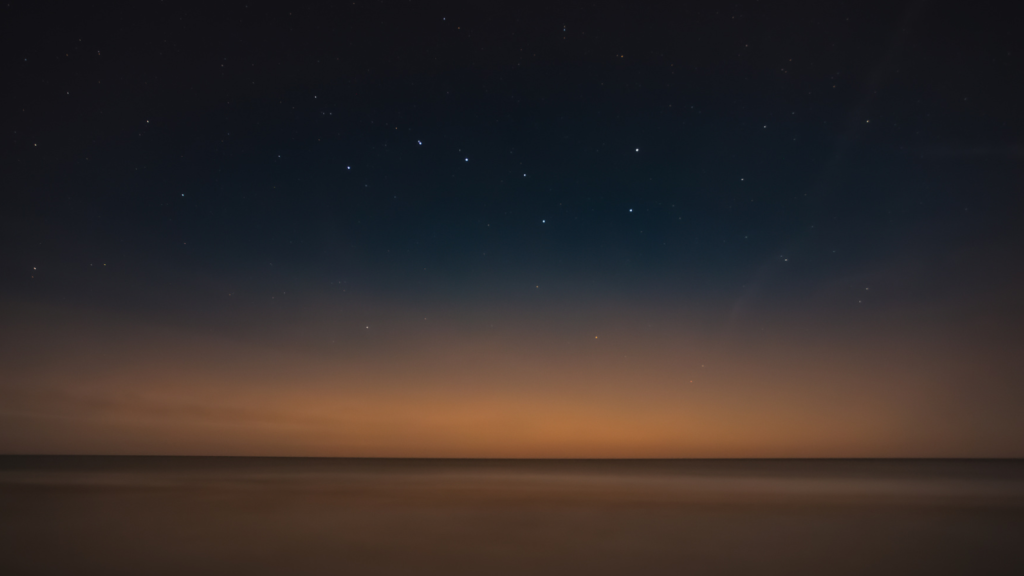
Most people’s mental image of the night sky is pretty simple, a scattering of plain white dots against a black background. Spend a little more time actually looking, though, especially away from city lights, and you’ll start noticing something most casual sky watchers miss entirely, stars actually come in colors. Reds, oranges, yellows, even faint hints of blue, all scattered across the sky like a subtle, cosmic color chart. Once you know what to look for, spotting colorful stars becomes one of the most rewarding parts of learning your way around the night sky.
Why Stars Have Different Colors in the First Place
Before hunting down specific stars, it helps to understand why they’re colored differently at all. A star’s color comes down almost entirely to its surface temperature. Cooler stars glow red, warmer stars shift toward orange and yellow, and the hottest stars burn a brilliant blue white. Its the exact same principle as watching a piece of metal heat up, it starts out a dull red, then orange, then yellow, and eventually a blinding white if it gets hot enough. Stars just operate on a scale that’s almost impossible to picture, with surface temperatures ranging from around 3,000 Kelvin for the coolest red stars up past 30,000 Kelvin for the hottest blue ones.
Its worth knowing that true green or purple stars don’t actually exist, even though temperature alone would suggest they should at certain ranges. Stars emit light across a broad range of wavelengths all at once rather than a single narrow color, and once your eyes blend all of that light together, any color that would have appeared green or purple gets washed out into white instead. If the physics behind that surprises you, our deeper dive into why there are no green stars breaks down exactly why that happens.
The Easiest Colorful Stars to Spot
A handful of bright, well known stars make fantastic starting points for anyone just getting into color spotting, since they’re easy to find and their colors are noticeable even to the naked eye.
Betelgeuse, marking the shoulder of the constellation Orion, is probably the single best beginner target. Its a red supergiant, and its reddish orange tint is genuinely obvious even without any equipment, especially when compared against Orion’s other bright, blue white stars sitting nearby. Orion is visible during winter evenings across most of the United States, making it one of the most reliable constellations for practicing color spotting.
Rigel, sitting at Orion’s opposite foot, offers a perfect contrast to Betelgeuse, a blazing blue white supergiant running at a scorching surface temperature. Having both stars visible in the same constellation, one glowing red, the other blazing blue, makes Orion an almost perfect natural classroom for understanding stellar color firsthand.
Arcturus, one of the brightest stars in the entire spring and summer sky, shows off a warm, noticeable orange glow, easy to spot once you know to look for it arcing off the handle of the Big Dipper. Vega, a brilliant blue white star prominent during summer evenings, and Antares, a deep red supergiant marking the heart of Scorpius, round out a solid list of naked eye color targets worth tracking down.
Tools That Make Colors Pop Even More
While plenty of colorful stars are visible to the naked eye, a basic pair of binoculars or a beginner telescope genuinely transforms the experience. Optical equipment gathers more light than your eyes alone can manage, which tends to make subtle color differences noticeably more vivid, especially for stars that appear only faintly tinted without any assistance.
Double stars offer some of the most rewarding views for colorful star hunting. Albireo, located in the constellation Cygnus, is a favorite among amateur astronomers specifically because it splits into two clearly distinct colored stars through even a modest telescope, one glowing gold, the other a striking blue, sitting right next to each other in the eyepiece. Its often recommended as one of the best beginner targets for exactly this reason, the color contrast is dramatic and immediately obvious, even to someone who’s never used a telescope before.
If you’re still building confidence finding constellations before diving into color spotting specifically, our guide on what you can see in the night sky without a telescope tonight is a solid place to start.
Tips for Actually Seeing the Colors
A few practical habits make a real difference when you’re trying to pick out star colors. Give your eyes at least 20 to 30 minutes to fully adjust to the darkness before you start, and avoid checking your phone during that window, since even a brief glance at a bright screen resets your night vision and makes subtle colors harder to catch.
Getting away from city lights matters enormously too. Light pollution doesn’t just hide fainter stars altogether, it also washes out the subtle color differences in the brighter ones that do remain visible. A rural location, or at minimum a spot with minimal streetlight interference, makes a genuinely noticeable difference.
Its also worth using whats called averted vision, a technique where you look slightly to the side of a star rather than directly at it. The part of your eye responsible for detecting faint light and subtle color sits slightly off center from your direct line of sight, so this small trick can actually make dimmer, more subtly colored stars easier to pick out than staring straight at them.
Why Color Spotting Makes You a Better Stargazer
Beyond just being a fun visual hobby, learning to notice star colors actually teaches you something real about the universe every single time you look up. Every reddish star you spot is cooler and often older or nearing the end of its life. Every blue white star burns hotter, younger, and typically far more massive than our own Sun. Color spotting turns a simple glance at the night sky into a quick, informal read on the physics playing out light-years away, all without needing a single piece of equipment beyond your own eyes.
If diving deeper into stellar classification interests you, our piece on what sort of star the Sun actually is covers exactly where our own Sun’s yellow white glow fits into this same color and temperature scale.
Start Tonight
The great thing about hunting for colorful stars is that it costs nothing and requires no special equipment to get started, just clear skies, a little patience, and a general sense of where to look. Next clear night, step outside, find Orion if its winter or Scorpius if its summer, and take a slow, deliberate look at the stars scattered across it. Once you start noticing the subtle reds, oranges, and blues hiding in plain sight, its genuinely hard to go back to seeing the night sky as just a field of plain white dots ever again.
For more detailed star charts and color spotting guides, check out the resources from EarthSky and the observing tips from Sky & Telescope.
If you enjoyed this article, don’t forget to drop us a comment, it really helps support the site, and be sure to check out our other articles because we think you’re going to love them too.