

Every so often, the night sky offers up something that genuinely doesn’t happen very often, an event so rare that most people alive today have never seen anything like it and never will again. T Coronae Borealis is exactly that kind of event. Astronomers have been watching this star system closely for years now, waiting for it to erupt in a nova bright enough to see with nothing but your own eyes, and once it finally happens, its expected to be one of the most talked about sky events in a generation.
What Exactly Is T Coronae Borealis?
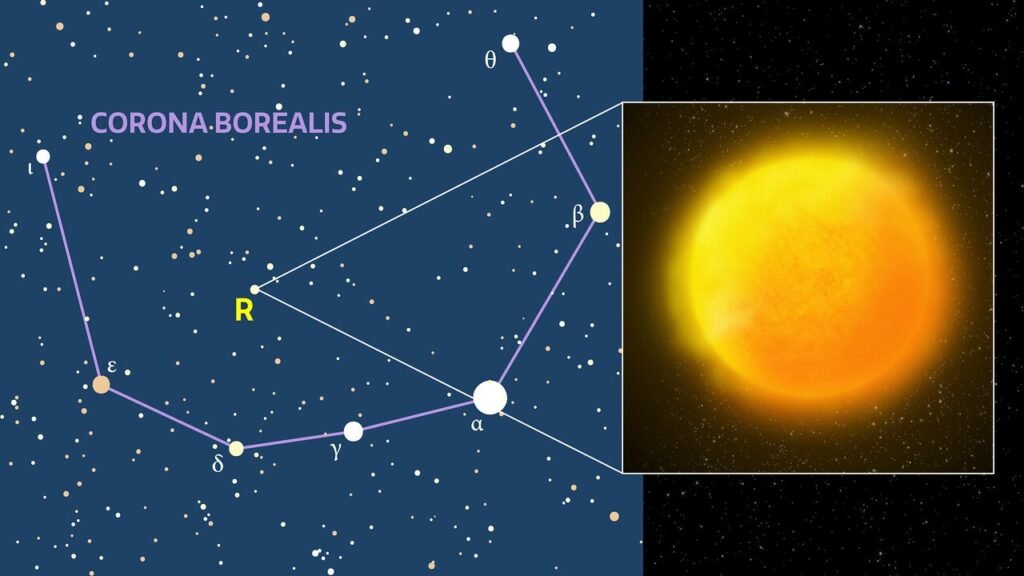
T Coronae Borealis, often nicknamed the “Blaze Star” and shortened to T CrB by astronomers, is a binary star system located about 3,000 light-years away in the small, crown shaped constellation Corona Borealis. Normally, its an unremarkable little star, sitting at around 10th magnitude, meaning its far too dim to see without a telescope. But every roughly 80 years, something dramatic happens, and T CrB briefly transforms into one of the brightest stars in the entire night sky.
The system is made up of two very different stars locked in a tight orbit, a white dwarf and a red giant. The red giant is a bloated, aging star that’s constantly shedding material from its outer layers. Thanks to the tight orbit, a lot of that material gets pulled onto the white dwarf, slowly building up a layer of hydrogen on its surface. Eventually, that layer gets so dense and hot that it triggers a runaway thermonuclear reaction, and the whole thing erupts in a sudden, dramatic flash of light. That’s the nova.
Nova vs Supernova, and Why the Star Survives
Its worth clearing up a common mix up right away, T CrB going nova is not the same thing as a supernova, even though both words share the same Latin root. A supernova is a catastrophic, one time event that completely destroys a star. A nova, on the other hand, is a surface explosion, violent and dramatic, but the white dwarf underneath survives completely intact. In fact, T CrB is what astronomers call a recurrent nova, meaning it’s done this before, and it will almost certainly do it again decades from now, once the white dwarf has had time to build up another layer of stolen material from its companion.
When Will It Actually Happen?
Here’s the honest answer, nobody knows for certain, and thats part of what makes this whole event so exciting to follow. T CrB has erupted twice in recorded history that astronomers are confident about, once in 1866 and again in 1946, exactly 80 years apart. Based on that pattern, astronomers have been expecting another eruption sometime in the mid 2020s.
A widely cited study published in 2024 pinpointed June 25, 2026 as the statistically most likely date based on the star’s orbital behavior and comparisons to its 1946 outburst. That date has come and gone without an eruption, following a string of other predicted windows in 2024 and 2025 that also passed quietly. Predicting the exact moment a star like this will erupt is notoriously difficult, and astronomers openly admit their models can only narrow down a likely window, not guarantee an exact day. The honest takeaway right now is that T CrB remains overdue and could erupt at essentially any time, possibly tonight, possibly months from now.
How to Find Corona Borealis in the Sky
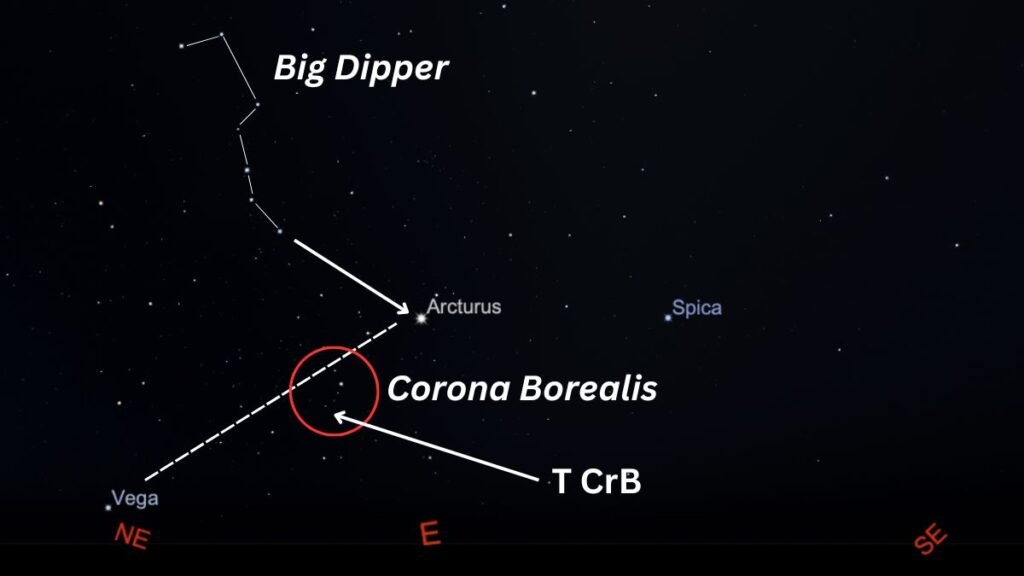
Whenever the eruption does happen, you’ll want to already know exactly where to look, since the whole event only stays bright enough to see with the naked eye for about a week or two before fading back into obscurity. The good news is, Corona Borealis is a pretty easy constellation to track down once you know the trick.
Start by locating two of the brightest stars in the summer sky, Arcturus and Vega. Corona Borealis sits in the gap between them, appearing as a small, distinctive semicircle of stars, often described as looking like a tiny crown or a backwards letter C. Its not a large or particularly bright constellation on its own, but that gap between Arcturus and Vega makes it easy to zero in on once you know what you’re looking for.
The constellation is best positioned for viewing from around March through September for observers in the Northern Hemisphere, with the summer months offering the most convenient evening viewing windows. If you want a broader introduction to reading star patterns like this before hunting down T CrB specifically, our guide on what you can see in the night sky without a telescope tonight is a solid place to build up some confidence first.
What to Expect When It Erupts
Once the eruption actually begins, T CrB will brighten dramatically and quickly, jumping from its usual invisible 10th magnitude to somewhere around magnitude +2 within a matter of hours. Thats roughly the same brightness as Polaris, the North Star, meaning it’ll suddenly appear as a “new” star sitting right in the middle of Corona Borealis where nothing was visible before. You won’t need a telescope or even binoculars to see it, just clear skies and a general idea of where to look.
Astronomers expect the star to stay visible to the naked eye for anywhere from several days up to about a week, gradually fading afterward, though it will remain observable through binoculars and telescopes for considerably longer as it settles back down.
If you want to stay ahead of the announcement the moment it happens, the American Association of Variable Star Observers, known as AAVSO, tracks the star’s brightness continuously and issues real time alerts the moment any significant change is detected. Its worth bookmarking their site if you don’t want to miss the exact night it happens.
Why This Event Is Such a Big Deal
Part of what makes T Coronae Borealis so exciting isn’t just the rarity, its how much scientific attention its already receiving in preparation. Astronomers around the world have spent years positioning telescopes, satellites, and monitoring campaigns specifically to catch this eruption from the very first moment it begins, hoping to gather data on exactly how these thermonuclear explosions unfold in real time. Its a genuinely rare chance to study a well known recurrent nova with modern instruments that simply didn’t exist back in 1946.
For casual skywatchers, its also just a rare shot at witnessing something most people will only get to see once in their entire lifetime. The next expected eruption after this one won’t happen again for another 80 years, so whenever T CrB does finally light up, its worth stepping outside to actually see it for yourself.
For the latest updates and real time brightness tracking, check out the observation resources from AAVSO and the detailed background from EarthSky.
If you enjoyed this article, don’t forget to drop us a comment, it really helps support the site, and be sure to check out our other articles because we think you’re going to love them too.