
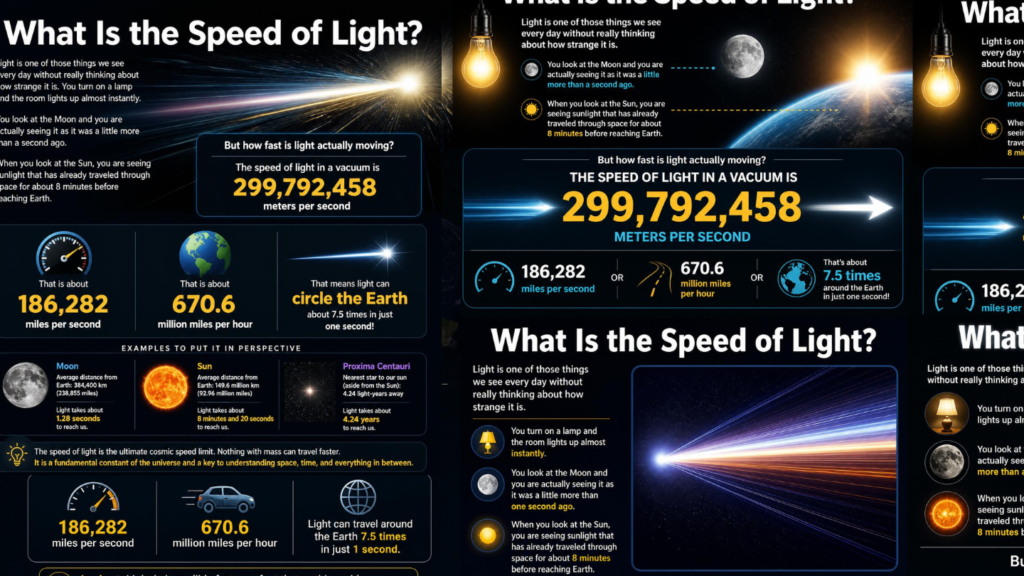
Light is one of those things we see every day without really thinking about how strange it is. You turn on a lamp and the room lights up almost instantly. You look at the Moon and you are actually seeing it as it was a little more than a second ago. When you look at the Sun, you are seeing sunlight that has already traveled through space for about 8 minutes before reaching Earth.
But how fast is light actually moving?
The speed of light in a vacuum is 299,792,458 meters per second. That is about 186,282 miles per second, or roughly 670.6 million miles per hour.
That number is so large that it is hard to imagine. If you could travel at the speed of light, you could circle Earth more than 7 times in a single second.
And the interesting part is that the speed of light is not just a random number describing how fast a beam from a flashlight moves. It is one of the most important constants in all of physics and it plays a huge role in how we understand space, time, energy and the universe itself.
How Fast Is Light?
When people ask how fast light travels, the answer usually given is around 300,000 kilometers per second or 186,000 miles per second.
The exact value is 299,792,458 meters per second in a vacuum.
For everyday comparisons, that means light can travel around the Earth in roughly 0.13 seconds. In one second, it can travel almost 300,000 kilometers through empty space.
That is incredibly fast compared with anything humans have built.
A commercial airplane might travel around 500 to 600 miles per hour. Even some of the fastest spacecraft humans have ever launched are nowhere close to the speed of light.
The difference is so huge that comparing a spacecraft to light is almost like comparing a person walking down the street to a jet aircraft.
Why Does Light Travel So Fast?
Light is a form of electromagnetic radiation. What we normally call visible light is only a small part of a much larger electromagnetic spectrum.
Radio waves, microwaves, infrared radiation, visible light, ultraviolet radiation, X-rays and gamma rays are all forms of electromagnetic radiation.
They may look completely different to us and they have very different wavelengths and energies, but in a vacuum they all travel at the same speed.
That speed is represented by the letter c.
The reason light can travel through empty space is another interesting part of the story. Unlike sound, light does not need air, water or another material to carry it. Sound needs a medium to travel through, which is why there is no normal sound traveling through the vacuum of space.
Light is different.
Sunlight can leave the surface of the Sun, cross millions of miles of nearly empty space and eventually reach Earth.
Is the Speed of Light Always the Same?
There is an important detail here.
The speed of light is exactly 299,792,458 meters per second in a vacuum.
When light passes through a material such as glass, water or even air, it travels more slowly than it does through a vacuum.
This is why the phrase “speed of light” usually means the speed of light in a vacuum.
You might have seen the number written simply as 300,000 kilometers per second. That’s a rounded number and it is perfectly fine for most astronomy and everyday explanations.
The exact value is used when scientists need a very high level of precision.
How Long Does Light Take to Reach Earth?
One of the easiest ways to understand the speed of light is to look at the distances involved in space.
The Sun is about 93 million miles from Earth. Even though that sounds like an enormous distance, light crosses it in only about 8 minutes and 20 seconds.
So when you look at the Sun, you are not seeing the Sun exactly as it is at that moment.
You are seeing the Sun as it was about 8 minutes earlier.
The same idea applies to everything we see in the night sky.
The Moon is much closer, so moonlight takes only about 1.3 seconds to reach Earth.
Light from Jupiter can take roughly 35 to 52 minutes to reach us depending on where Earth and Jupiter are in their orbits.
And when astronomers look at distant stars and galaxies, they are looking much farther back in time.
This is one of the coolest things about astronomy. Looking farther into space also means looking farther into the past.
What Is a Light-Year?
The word light-year can be confusing because it sounds like a measurement of time.
It isn’t.
A light-year is a unit of distance.
It is the distance light travels through a vacuum in one year. That distance is about 5.88 trillion miles, or approximately 9.46 trillion kilometers.
Astronomers use light-years because the distances between stars and galaxies are so enormous that using miles or kilometers can quickly become difficult.
For example, Proxima Centauri, the closest known star to the Sun, is a little more than 4 light-years away.
That means the light we see from it today began its journey more than four years ago.
When you look at a star that is 100 light-years away, you are seeing light that started traveling toward Earth about 100 years ago.
In a very real sense, the night sky is a view of the past.
Why Can’t Anything With Mass Travel Faster Than Light?
This is where the speed of light becomes much more than just a fact about astronomy.
Albert Einstein’s theory of special relativity tells us that the speed of light in a vacuum is a fundamental limit for how information and matter can travel through space.
As an object with mass gets closer and closer to the speed of light, the amount of energy needed to continue accelerating it becomes enormously large.
According to our current understanding of physics, an object with mass cannot be accelerated all the way up to the speed of light.
Light itself is different.
Particles of light are called photons, and photons have no rest mass. They naturally travel at the speed of light in a vacuum.
This is one reason the speed of light is so important in modern physics.
It isn’t simply a very fast speed. It is deeply connected to the structure of space and time.
What Does Einstein Have to Do With the Speed of Light?
Einstein didn’t discover the speed of light, but his work changed the way scientists understood it.
Before Einstein’s theory of special relativity, scientists were still trying to understand why the speed of light appeared to be the same regardless of how an observer was moving.
Einstein’s theory showed that space and time are connected and that measurements of distance and time can change depending on the observer’s motion.
One of the most famous consequences of special relativity is the relationship between mass and energy represented by the equation:
E = mc²
The “c” in this equation is the speed of light.
Because c is such an enormous number, even a small amount of mass corresponds to a huge amount of energy.
This relationship became one of the most famous equations in science and helped transform our understanding of energy, matter and the universe.
Does Light Have a Maximum Speed?
As far as modern physics tells us, yes.
The speed of light in a vacuum is considered the ultimate speed limit for information and causal influence.
There are some fascinating situations in physics that can make it look like something is moving faster than light, but these don’t mean that ordinary matter or usable information has actually broken the speed limit.
For example, the expansion of the universe can cause extremely distant galaxies to move away from us at an effective rate greater than the speed of light because space itself is expanding.
That is very different from a spaceship traveling through space faster than light.
Scientists continue to study these questions because the universe is full of situations that challenge our intuition.
Could Humans Ever Travel at the Speed of Light?
With the technology we have today, absolutely not.
Even reaching a small fraction of the speed of light would require an enormous amount of energy and would create major engineering problems.
There are also serious issues involving acceleration, radiation, collisions with tiny particles in space and the energy required to slow down once a spacecraft reaches its destination.
Science fiction often shows spaceships traveling faster than light or jumping instantly between distant locations.
Those ideas are fun to think about, and physicists have studied theoretical concepts involving things like wormholes and spacetime shortcuts. But there is currently no proven technology that allows humans to travel faster than light.
For now, the speed of light remains far beyond anything we can achieve with a conventional spacecraft.
What Happens to Light Near a Black Hole?
Black holes are another place where the speed of light becomes especially interesting.
A black hole has such an intense gravitational field that once something passes beyond its event horizon, it cannot escape back out.
That includes light.
This doesn’t mean light suddenly slows down and gets trapped like a car hitting a wall. Instead, the extreme curvature of spacetime around a black hole changes what paths are possible.
From far away, an observer can see the effects of gravity on light as it passes near a black hole. Light can bend, stretch and change in frequency because of gravity.
This effect is called gravitational lensing, and astronomers actually use it to study objects and structures that would otherwise be very difficult to see.
Why Is the Speed of Light Important to Astronomy?
Without the speed of light, modern astronomy would be almost impossible to understand.
Astronomers use light to learn about stars, planets, galaxies, black holes and enormous structures spread across the universe.
But light doesn’t just tell us where something is.
By studying different wavelengths of electromagnetic radiation, scientists can learn about temperature, chemical composition, motion and other physical properties of distant objects.
Visible light is only one small window into the universe.
Radio telescopes can detect radio waves. Infrared telescopes can see heat and objects hidden behind dust. X-ray and gamma-ray observatories can reveal some of the most energetic events in the cosmos.
All of these observations are connected by the same fundamental speed.
The Speed of Light in Everyday Life
You don’t have to be an astronomer to see the effects of light’s speed.
When you turn on a flashlight, the light reaches nearby objects so quickly that it appears instantaneous.
When you make a video call, the information being transmitted is carried by electromagnetic signals that travel incredibly fast.
GPS satellites also rely on extremely precise measurements involving time and electromagnetic signals. Because light and radio signals don’t arrive everywhere at exactly the same moment, even tiny timing differences matter when calculating positions.
Modern communication, astronomy, satellite navigation and countless technologies depend on our understanding of electromagnetic radiation and the speed at which it travels.
The Speed of Light Is More Than Just a Number
It is easy to look at 299,792,458 meters per second and treat it as just another scientific number.
But the speed of light is much more than that.
It tells us something fundamental about the universe.
Light from the Sun needs about eight minutes to reach Earth. Light from nearby stars takes years. Light from distant galaxies can travel for millions or even billions of years before reaching our telescopes.
Every time we look deeper into space, we are also looking deeper into cosmic history.
The speed of light is what makes that possible.
It gives us a way to connect distance and time on a scale that is almost impossible to imagine. It helps explain why the universe looks the way it does, why space and time are connected and why there are limits to how quickly information can travel.
So the next time you look up at the night sky, remember that the light reaching your eyes has been traveling across space for a very long time.
Some of it may have started its journey before humans ever existed.
And somehow, after traveling across all that distance at nearly 186,282 miles every second, it ends its journey right here on Earth.