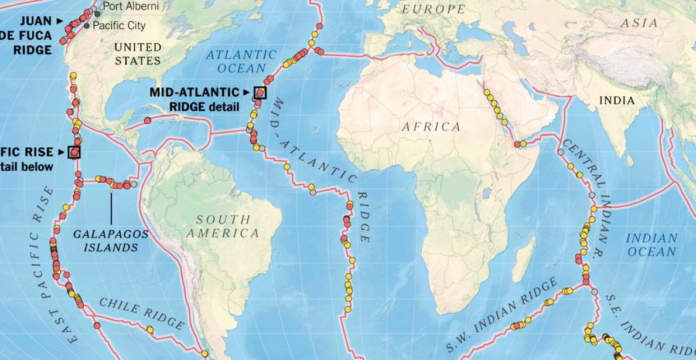

There is a massive mountain range running through the Atlantic Ocean that most people will never see.
It is not on a map of mountain peaks like the Rockies or the Appalachians. It is hidden under thousands of feet of seawater and stretches for thousands of miles across the ocean floor. This enormous underwater feature is called the Mid-Atlantic Ridge, and it is one of the most important geological structures on Earth.
The Mid-Atlantic Ridge is part of the global mid ocean ridge system, a huge network of underwater mountains that wraps around the planet. In fact, the entire mid-ocean ridge system stretches about 40,000 miles around Earth, making it the longest mountain range on the planet. About 90 percent of it is hidden beneath the oceans.
What makes the Mid-Atlantic Ridge even more interesting is that it is not just a mountain range sitting quietly on the seafloor. It is a place where Earth’s tectonic plates are slowly pulling apart and new oceanic crust is being created right now.
And yes, that means the Atlantic Ocean is still growing.

5
Where Is the Mid-Atlantic Ridge?
The Mid-Atlantic Ridge runs roughly from north to south through the middle of the Atlantic Ocean.
It begins in the region of the Arctic and continues southward through the Atlantic, passing between North America and Europe and between South America and Africa before extending toward the Southern Ocean.
It is not perfectly straight. The ridge bends, shifts and is broken into different sections by large underwater faults called transform faults.
If you could somehow drain the Atlantic Ocean and stand on the seafloor, you wouldn’t see one smooth mountain chain. You’d see an enormous underwater landscape made up of ridges, valleys, volcanic areas and deep fractures.
The United States sits on the North American Plate, while Europe is mostly on the Eurasian Plate and much of Africa is on the African Plate. Along the Mid-Atlantic Ridge, these plates are moving away from each other.
That movement is extremely slow by human standards.
The average spreading rate along the Mid-Atlantic Ridge is around 2.5 centimeters per year, although the rate varies in different sections. That’s roughly the width of a fingernail every year. Over a million years though, that adds up to around 25 kilometers of movement.
It sounds tiny, but Earth’s geology has a very long timeline.
What Is a Mid Ocean Ridge?
A mid ocean ridge is an underwater mountain system formed where tectonic plates move apart.
When two plates separate, material from Earth’s mantle rises toward the surface. As it reaches the seafloor, molten rock can cool and harden into new oceanic crust.
This process is known as seafloor spreading.
The new crust doesn’t stay in one place. As more magma rises and solidifies at the ridge, older crust is pushed farther away from the center.
It’s kind of like a conveyor belt that is slowly creating new ocean floor.
The Mid-Atlantic Ridge is one of the best examples of this process on Earth. NOAA describes it as a divergent boundary where plates separate, magma rises and new seafloor is created.
This process is happening today, not just millions of years ago.
Every year, tiny amounts of new oceanic crust are being added along the ridge.

6
Why Is the Atlantic Ocean Getting Wider?
This is probably the coolest part of the whole story.
The Atlantic Ocean is getting wider because new oceanic crust is being produced along the Mid-Atlantic Ridge.
The Americas are slowly moving away from Europe and Africa as the tectonic plates on either side of the ridge move apart.
We’re not talking about something you could notice in your lifetime. The movement is measured in centimeters per year, so you aren’t going to wake up one morning and find the Atlantic suddenly a mile wider.
But over millions of years, those centimeters become thousands of kilometers.
USGS explains that seafloor spreading during the last 100 to 200 million years helped transform the Atlantic from a much smaller body of water into the enormous ocean we know today.
This is one of the reasons plate tectonics is such a powerful idea in Earth science.
Continents don’t just sit permanently in one location.
They are attached to huge tectonic plates that move incredibly slowly across the planet.
How Does New Ocean Floor Form?
Deep below the Atlantic, Earth’s mantle is hot enough for rock to behave very differently than it does at the surface.
When tectonic plates pull apart at the ridge, pressure decreases beneath the spreading center. This allows some mantle material to partially melt and produce magma.
That magma rises through cracks and reaches areas near the seafloor.
When it cools, it becomes new basaltic oceanic crust.
Then the plates continue moving apart.
More magma rises.
More rock cools.
More crust is created.
The process repeats again and again.
Over time, the oldest oceanic crust moves farther away from the ridge while the youngest crust remains near the ridge axis.
This is also one reason scientists can study the age of the ocean floor and find a pattern that matches the idea of seafloor spreading.
The Mid-Atlantic Ridge Is Volcanically Active
When people think about volcanoes, they usually imagine mountains like Mount St. Helens or Hawaii.
But some of Earth’s largest volcanic activity is happening far below the ocean surface.
The Mid-Atlantic Ridge contains thousands of individual volcanic features and segments. NOAA describes the global mid-ocean ridge system as the largest single volcanic feature on Earth.
Most of these eruptions happen where nobody can see them.
Instead of lava flowing down the side of a mountain under a clear sky, molten rock emerges from cracks in the ocean floor and rapidly cools in seawater.
That might sound less dramatic than a volcano erupting on land, but geologically it is incredibly important.
A huge amount of Earth’s oceanic crust has been produced through this kind of volcanic activity.
And the process is still going on.


5
Iceland Is Sitting on the Mid-Atlantic Ridge
There is one place where you can actually see the Mid-Atlantic Ridge without going thousands of feet underwater.
That place is Iceland.
Iceland sits directly across the boundary between the North American and Eurasian plates. The Mid-Atlantic Ridge comes up through the country, making Iceland one of the best places on Earth to observe a divergent plate boundary on land.
This unusual location is also a major reason Iceland has so much volcanic and geothermal activity.
Visitors can actually see cracks and geological formations connected to the movement of the plates.
The landscape is basically giving people a rare opportunity to see processes that are happening beneath the Atlantic Ocean.
Of course, the plates aren’t ripping apart in some dramatic movie-style event.
The movement is extremely slow.
But over geological time, the effect is huge.
What Happens at a Divergent Plate Boundary?
The Mid-Atlantic Ridge is known as a divergent plate boundary.
That’s a scientific way of saying the tectonic plates are moving away from one another.
There are three basic types of plate boundaries.
At divergent boundaries, plates move apart.
At convergent boundaries, plates move toward each other.
At transform boundaries, plates slide horizontally past one another.
The Mid-Atlantic Ridge is mainly associated with the first type.
As the plates separate, hot material from below rises and new crust forms.
This is very different from places where one tectonic plate is forced beneath another in a process called subduction.
At the Mid-Atlantic Ridge, the ocean floor is being built rather than destroyed.
That makes it one of the clearest examples of plate tectonics in action.
Why Does the Ridge Have a Deep Valley?
If the Mid-Atlantic Ridge is a mountain range, you might expect it to have one giant sharp peak running down the middle.
It doesn’t.
Many sections of the ridge contain a long rift valley near the center.
NOAA says the rift valley along the Mid-Atlantic Ridge can be about the depth and width of the Grand Canyon, although its exact shape varies along the ridge.
The reason has to do with the plates pulling apart and the faults that develop around the spreading center.
The Earth’s crust near the ridge is relatively young and hot. As it cools and moves away from the ridge, it changes physically and becomes part of the broader ocean floor.
The result is a huge underwater landscape that looks nothing like the flat blue surface we see from above.
The Ridge Is Connected to Earthquakes Too
Volcanic activity isn’t the only thing happening around the Mid-Atlantic Ridge.
Earthquakes occur along the ridge and its associated faults as the Earth’s crust moves.
Most of these earthquakes happen far from populated areas, deep beneath the Atlantic Ocean, so they don’t usually get the same attention as earthquakes in California, Japan or other densely populated regions.
The ridge system also includes transform faults where sections of the ridge are offset.
Those faults allow different parts of the spreading system to move relative to each other.
Some earthquakes along these structures can be significant. The USGS has documented large earthquakes along the Mid-Atlantic Ridge and associated transform faults.
So beneath what looks like a quiet Atlantic Ocean, there is actually a huge amount of geological activity taking place.
How Fast Is the Mid-Atlantic Ridge Moving?
The movement is slow, but it is not zero.
The average spreading rate along the Mid-Atlantic Ridge is around 2.5 centimeters per year, although different sections can spread at somewhat different rates. NOAA gives a broader range of about 2 to 5 centimeters per year for the ridge.
Think about that for a second.
Two centimeters doesn’t seem like much.
But after 100 years, you’re talking about roughly two meters.
After 10,000 years, roughly 200 meters.
After a million years, roughly 20 kilometers.
And the process has been operating over millions of years.
That’s how something that moves only a few centimeters a year can eventually reshape an entire ocean.
Geology is basically the ultimate example of small changes adding up.
What Does the Mid-Atlantic Ridge Tell Us About Plate Tectonics?
The Mid-Atlantic Ridge is one of the strongest pieces of evidence for plate tectonics.
Before scientists understood how Earth’s plates move, there was a major mystery.
Why do the continents seem to fit together?
Why are the rocks and fossils on opposite sides of the Atlantic sometimes remarkably similar?
Why does the ocean floor show patterns that seem to record its history?
The discovery of seafloor spreading helped answer those questions.
Scientists found that new oceanic crust forms at mid-ocean ridges and then moves away from them.
Even more interesting, the rocks on either side of the ridge show symmetrical patterns in their magnetic properties.
That’s because Earth’s magnetic field has reversed many times throughout geological history. When molten rock cools into new crust, magnetic minerals can preserve the direction of Earth’s magnetic field at that moment.
The result is a kind of magnetic timeline written into the seafloor.
The patterns on opposite sides of the ridge match remarkably well.
It was powerful evidence that the ocean floor was actually spreading outward.
The Mid-Atlantic Ridge Is Part of Something Much Bigger
The Mid-Atlantic Ridge doesn’t exist by itself.
It is one section of the global mid ocean ridge system.
This massive underwater network stretches around Earth like the stitching on a baseball.
It runs through the Atlantic, Pacific, Indian and other ocean basins and forms a connected system of underwater mountains.
NOAA estimates the entire mid-ocean ridge system stretches approximately 65,000 kilometers, or about 40,389 miles.
That’s an almost hard-to-imagine distance.
If you could somehow place the entire ridge system end to end across the United States, it would cross the country more than 20 times.
And most of it is hidden under the ocean.
We live on a planet where one of the largest mountain systems is almost completely invisible from the surface.

4
What Lives Around the Mid-Atlantic Ridge?
The environment around the ridge is also home to some of the strangest ecosystems on Earth.
One of the most famous features associated with mid-ocean ridges is the hydrothermal vent.
These vents form when seawater moves down through cracks in the ocean crust, becomes heated by hot rock or magma and then rises back toward the seafloor.
The water can emerge extremely hot and loaded with dissolved minerals.
Yet entire communities of organisms can live around these vents.
Instead of depending directly on sunlight for energy, many organisms rely on chemical energy through a process called chemosynthesis.
That discovery changed how scientists think about life.
It showed that complex ecosystems can exist in places where sunlight cannot reach.
The deep ocean around the Mid-Atlantic Ridge is still being explored, and scientists continue to find unusual organisms and geological features down there.
Why Is the Mid-Atlantic Ridge Important?
The Mid-Atlantic Ridge may seem like something that belongs in a geology textbook, but it plays a huge role in shaping our planet.
It creates new oceanic crust.
It helps drive the long-term movement of tectonic plates.
It produces volcanic activity.
It is associated with earthquakes.
It influences the shape and depth of the Atlantic seafloor.
And it provides unusual environments where scientists can study life in extreme conditions.
It also helps explain something much bigger.
The Atlantic Ocean wasn’t always the enormous ocean we see today.
Millions of years ago, the continents surrounding the Atlantic were positioned differently. As tectonic plates moved and seafloor spreading continued, the ocean gradually expanded.
The process is still happening now.
Will the Atlantic Ocean Keep Getting Bigger?
For now, the Mid-Atlantic Ridge continues to create new oceanic crust, so the Atlantic continues to expand in the broad geological sense.
But Earth’s tectonic system is much more complicated than simply saying “the Atlantic gets bigger.”
Other parts of the planet are undergoing subduction, where old oceanic crust is pushed back into Earth’s interior.
The size of individual ocean basins changes over geological time depending on the balance between crust being created at spreading centers and crust being consumed at subduction zones.
So the Atlantic isn’t simply expanding forever without anything else happening.
Earth’s surface is constantly being recycled and rearranged.
That is one of the reasons the planet looks so different when we compare geological maps from tens or hundreds of millions of years ago.
The Hidden Mountain Range Beneath the Atlantic
The next time you’re looking at a map of the Atlantic Ocean, remember that the huge blue space between North America, South America, Europe and Africa isn’t just empty water.
Deep underneath it is one of the greatest geological structures on Earth.
The Mid-Atlantic Ridge stretches for thousands of miles and marks a place where Earth’s tectonic plates are slowly moving apart.
Magma rises.
New rock forms.
The ocean floor moves outward.
Earthquakes happen.
Volcanoes erupt far below the surface.
And the whole thing keeps moving at a pace that is almost impossible to notice during a human lifetime.
That’s what makes the Mid-Atlantic Ridge so fascinating.
It looks like a quiet line on a map, but underneath the Atlantic Ocean, our planet is literally building new land.
And it’s been doing it for millions of years.