

In 1950, physicist Enrico Fermi was having lunch with colleagues at Los Alamos, chatting about recent UFO reports, when he reportedly blurted out a question that’s haunted scientists ever since: “But where is everybody?” With billions of stars and likely billions of habitable planets in our galaxy alone, why hasn’t humanity found a single trace of anyone else out there?
The Math Says We Shouldn’t Be Alone
The Fermi Paradox describes the tension between two things that don’t fit together. On one hand, the universe is almost incomprehensibly vast, home to hundreds of billions of stars in the Milky Way alone, and current estimates suggest billions of Earth-sized planets in our galaxy could sit in their star’s habitable zone. On the other hand, despite decades of searching, humanity has found zero confirmed evidence of intelligent life anywhere beyond Earth.
Given how old the universe is, roughly 13.8 billion years, and how quickly life appeared on Earth once conditions allowed it, scientists have long argued that even a modest civilization with slow interstellar travel should have had time to spread across the entire galaxy by now. So where is everybody?
The Great Filter
One of the most discussed explanations is something economist Robin Hanson dubbed the Great Filter, the idea that some barrier exists that prevents life from evolving into a galaxy-spanning civilization, and that barrier is so severe almost nothing gets past it. The unsettling part is that nobody knows whether that filter sits behind us or ahead of us. If it’s behind us, perhaps the jump from simple to complex life, or from single-celled to multicellular organisms, is the rare, nearly impossible step, and we got lucky. If it’s still ahead of us, it could mean every civilization eventually destroys itself, through nuclear war, climate collapse, or some other technological trap we haven’t hit yet.
Neither possibility is especially comforting, though only one of them is a warning about our own future.
Other Ways to Explain the Silence
The Great Filter isn’t the only proposed answer. Some scientists argue civilizations are simply too far apart, given the sheer scale of the galaxy, two intelligent species might never cross paths even if both exist right now. Others suggest advanced civilizations might avoid interstellar radio broadcasts entirely, or that we simply haven’t been listening long enough, humanity’s own radio signals have only been leaking into space for about a century, a blink of an eye against a 13.8 billion year old universe. It’s also possible complex, technological intelligence really is exceptionally rare, and Earth just happened to draw a winning ticket.
If you’re curious about the specific nearby worlds scientists consider genuinely promising candidates in this search, our detailed profile of Proxima Centauri b covers exactly the kind of world this paradox keeps circling back to.
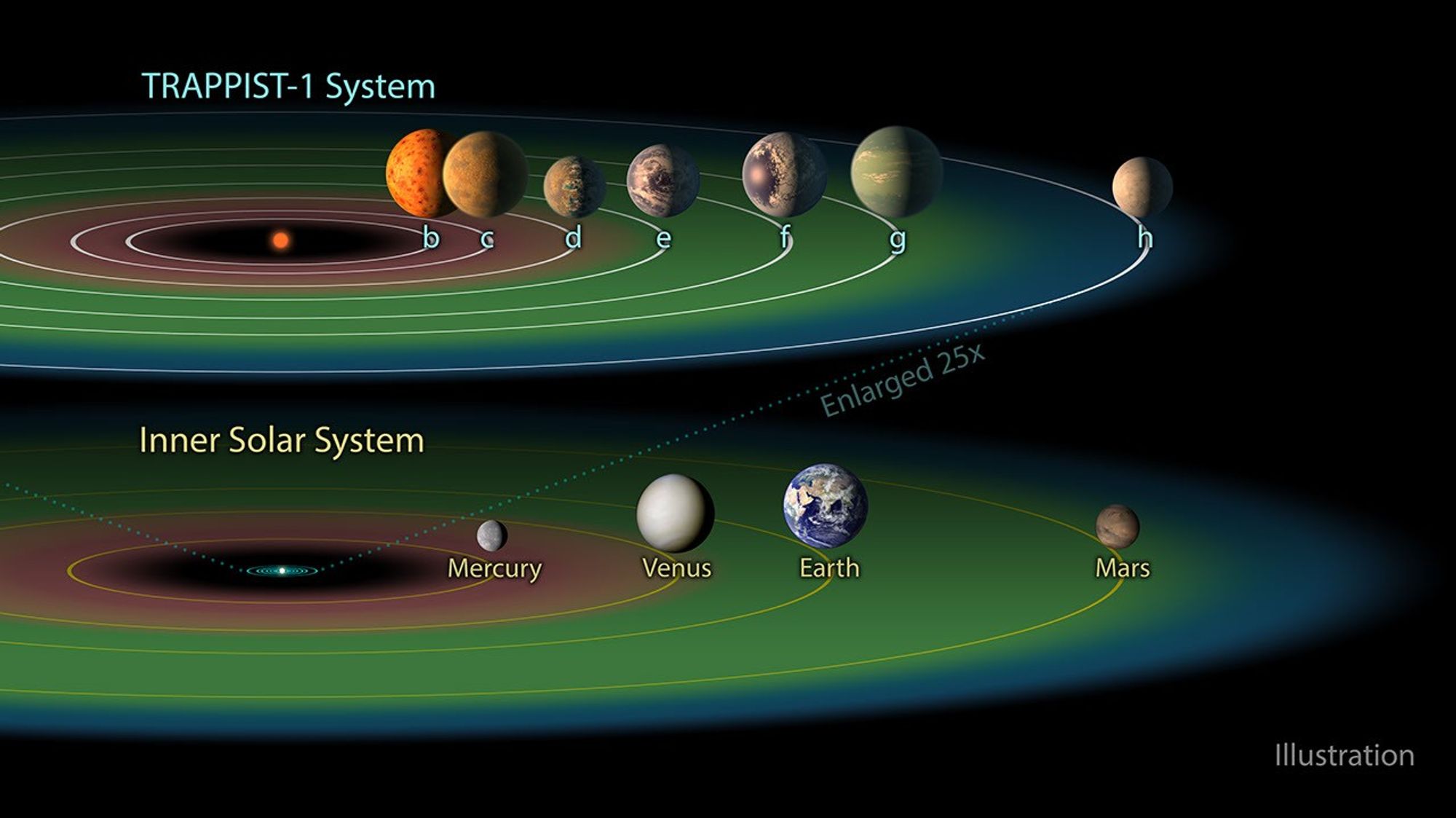 The TRAPPIST-1 system, with three of its seven Earth-sized planets sitting in the star’s habitable zone (shown in green). Discoveries like this one only deepen the paradox, habitable worlds appear to be common, yet we’ve detected no signs of anyone living on them. (Image: NASA/JPL-Caltech)
A Question That Cuts Both Ways
What makes the Fermi Paradox genuinely unsettling isn’t just the silence itself, its what that silence might imply about our own future. Every proposed solution either suggests we’re rarer than we’d like to believe, or that intelligent civilizations tend not to last, and figuring out which one is true might matter more than any other question science has ever asked.
For more on the various proposed solutions, check out the overview from Britannica and the detailed breakdown from Universe Today.
If you enjoyed this article, don’t forget to drop us a comment, it really helps support the site, and be sure to check out our other articles because we think you’re going to love them too.