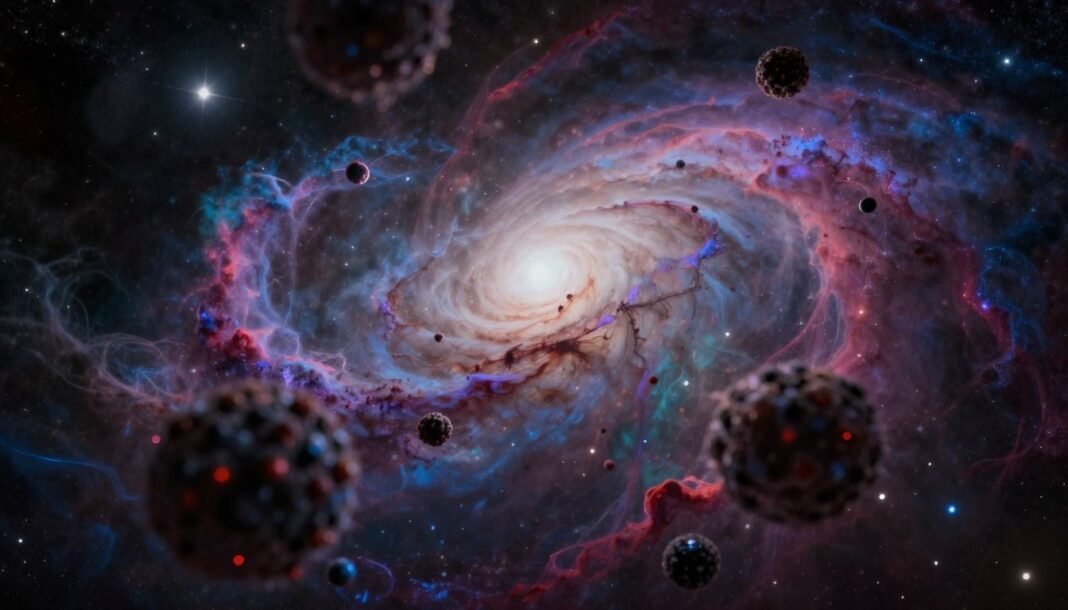

Did you know that everything we can see in the entire cosmos makes up less than five percent of its total contents? The rest remains hidden, acting as a silent driver for the expansion of our vast surroundings.
Many people ask, What Is Dark Energy? This invisible phenomenon pushes galaxies apart at an accelerating rate. It acts like a mysterious pressure that defies our traditional understanding of gravity.
We invite you to join us on a journey through the stars to uncover this fascinating puzzle. By exploring what is dark energy?, we can begin to grasp the forces that shape our future. Let us simplify these complex ideas together without the headache of heavy jargon.
Key Takeaways
- Visible matter accounts for only a tiny fraction of the universe.
- This mysterious force drives the rapid expansion of space.
- Scientists view this phenomenon as a constant pressure throughout the cosmos.
- Gravity pulls objects together, while this force pushes them apart.
- Understanding this topic helps us predict the ultimate fate of our universe.
The Cosmic Puzzle: What Is Dark Energy?
Imagine a force so powerful it pushes the entire universe apart, yet remains completely invisible to our eyes. This mysterious influence is what scientists call dark energy. It acts as a repulsive force that works against gravity, causing the expansion of the cosmos to speed up over time. If you have ever asked, what is dark energy?, you are touching on the most significant enigma in modern astrophysics.

Defining the Invisible Force
At its core, this phenomenon serves as a cosmic accelerator. While gravity pulls matter together to form stars and galaxies, this energy pushes space itself outward. A clear dark energy explanation suggests that it is a property of space itself. As the universe expands, more space is created, which in turn adds more of this energy to the mix.
This creates a self-reinforcing cycle of acceleration. Because it is spread uniformly throughout the vacuum of space, it does not clump together like matter. Instead, it exerts a constant, outward pressure on the fabric of the universe.
Why We Call It “Dark”
Scientists use the term “dark” because this energy does not interact with light or any other form of electromagnetic radiation. We cannot see it with telescopes, nor can we detect it with traditional sensors. It remains completely transparent to our current technology, leaving us to infer its existence only through its gravitational effects on the largest scales.
The following table highlights how this mysterious component compares to other parts of our universe:
| Component | Interaction with Light | Primary Effect |
|---|---|---|
| Normal Matter | Visible/Reflective | Attraction (Gravity) |
| Dark Matter | Invisible | Attraction (Gravity) |
| Dark Energy | Invisible | Repulsion (Expansion) |
By studying these differences, researchers continue to refine their dark energy explanation. While we still do not know exactly what is dark energy?, we know it makes up roughly 68% of the total energy density of the universe. This makes it the dominant player in the ultimate fate of our cosmos.
A Brief History of the Dark Energy Discovery
Imagine looking at the night sky and realizing that everything you knew about gravity was wrong. For most of the 20th century, astronomers operated under the assumption that the expansion of the universe was slowing down. They believed that the mutual gravitational pull of all matter would eventually act as a cosmic brake.
However, a major breakthrough in the late 1990s shattered this long-held belief. This discovery provided a new dark energy explanation that changed physics forever. It forced researchers to accept that the universe is not just expanding, but that it is actually speeding up.

The Surprising Observations of Distant Supernovae
The evidence for this cosmic acceleration came from studying Type Ia supernovae. These specific stellar explosions act as standard candles, allowing scientists to measure vast distances across space with incredible precision. By comparing the brightness of these distant events to their expected distance, researchers noticed something strange.
The supernovae appeared much dimmer than they should have been if the universe were expanding at a constant or slowing rate. This indicated that they were actually much farther away than predicted. This observation was the first concrete evidence that the expansion of space is accelerating.
Shifting Paradigms in 20th-Century Cosmology
This revelation sent shockwaves through the scientific community. It required a complete rethink of our understanding dark energy and its role in the evolution of the cosmos. Before this, gravity was thought to be the dominant force shaping the large-scale structure of the universe.
The discovery proved that an unknown, repulsive force was pushing galaxies apart at an ever-increasing speed. This paradigm shift moved us away from a simple, gravity-driven model toward a more complex understanding dark energy. Today, this mysterious force remains one of the most significant puzzles in modern science.
How Scientists Measure the Expansion of the Universe
Mapping the expansion of the universe is a feat of modern scientific ingenuity. To gain a better understanding dark energy, researchers must first determine how fast the cosmos is growing. This requires precise tools that act as cosmic yardsticks across billions of light-years.

Using Standard Candles to Map the Cosmos
Astronomers rely on objects with a known brightness, often called “standard candles,” to measure vast distances. The most famous of these are Type Ia supernovae, which explode with a consistent, predictable intensity. By comparing how bright these stars appear from Earth to their known intrinsic brightness, scientists can calculate exactly how far away they are.
“The universe is not only queerer than we suppose, but queerer than we can suppose.”
— Arthur Eddington
This method provides a reliable way to map the structure of the deep cosmos. Without these standard candles, our ability to track the acceleration of the universe would be significantly limited.
The Role of Redshift in Measuring Cosmic Speed
Once distance is established, researchers look at the light coming from these distant objects. As galaxies move away from us, the light they emit stretches out, shifting toward the red end of the spectrum. This phenomenon is a key component in the definition dark energy, as it reveals the velocity of receding galaxies.
Understanding the Doppler Effect in Space
The Doppler effect explains why this shift occurs, much like how the pitch of a siren changes as an ambulance drives past you. In space, light waves behave similarly; they stretch as the source moves away, creating a “redshift.” By measuring this shift, scientists can determine the speed at which the universe is expanding.
| Measurement Tool | Primary Use | Distance Range |
|---|---|---|
| Type Ia Supernovae | Standard Candles | Up to 10 billion light-years |
| Cepheid Variables | Distance Calibration | Up to 100 million light-years |
| Redshift Analysis | Velocity Calculation | Universal scale |
These combined techniques allow us to build a clearer picture of the cosmos. By tracking both distance and speed, we move closer to a complete definition dark energy and its role in our expanding reality.
The Leading Dark Energy Theory: Einstein’s Cosmological Constant
Modern cosmology relies heavily on a concept that was once dismissed as a mistake by its own creator. While we search for a clear definition dark energy, we often find ourselves returning to the foundational work of Albert Einstein. His original equations provided the canvas upon which our current understanding of the universe is painted.
Revisiting the Vacuum Energy Concept
For a long time, scientists believed that empty space was truly void of any substance. However, quantum physics suggests that the vacuum is actually buzzing with hidden activity. This energy, inherent to space itself, exerts a subtle pressure that pushes outward.
Physicists now use this idea to explain why the expansion of the universe is accelerating. By treating the vacuum as a source of energy, we can model the behavior of the cosmos on a grand scale. This perspective has become a vital component in our modern facts about dark energy.
The Mathematical Framework of General Relativity
Einstein’s theory of General Relativity describes gravity as the curvature of spacetime caused by mass and energy. To keep his model of the universe static, he added a specific term to his field equations. This term, known as the cosmological constant, acted as a counter-force to gravity.
Although the universe is not static, the mathematical structure remains incredibly useful today. Researchers have repurposed this constant to represent the energy density of the vacuum. It serves as a mathematical anchor for our current models of cosmic expansion.
Why Einstein Initially Rejected His Own Constant
Einstein famously referred to the cosmological constant as his “biggest blunder” after learning that the universe was expanding. He felt that adding a term just to force a static result was an unnecessary complication. He preferred a model that emerged naturally from his equations without extra adjustments.
History has shown that his intuition was more complex than he realized. While he rejected the constant for the wrong reasons, the term itself is now considered a cornerstone of modern astrophysics. It highlights how even the perceived mistakes of genius can lead to profound scientific breakthroughs.
Alternative Explanations and Dark Energy Research
Researchers are actively debating whether dark energy is a static force or something far more dynamic. While many models rely on the cosmological constant, these facts about dark energy suggest that we must keep an open mind. Exploring alternative theories helps us grasp the complex nature of the dark sector and the ongoing evolution of the cosmos.
Quintessence: A Dynamic Energy Field
One compelling dark energy theory involves a concept known as quintessence. Unlike a static constant, quintessence describes a dynamic energy field that changes over time. This field could potentially speed up or slow down the expansion of the universe depending on its density.
If this theory holds true, the acceleration we observe today might not be permanent. It suggests that the energy driving the universe is fluid rather than fixed. Scientists continue to look for subtle signals in the cosmic microwave background that might confirm this behavior.
Modifying Gravity: Is Our Understanding of Physics Incomplete?
Some physicists argue that we do not need a mysterious energy source at all. Instead, they propose that our current understanding of gravity is fundamentally flawed on a cosmic scale. This perspective suggests that Einstein’s equations might require adjustments when applied to the vast reaches of space.
Testing Gravity on Galactic Scales
To test these ideas, researchers observe how galaxies rotate and interact with one another. If gravity behaves differently than expected, it could explain the accelerated expansion without needing extra energy. This dark energy theory remains a major focus of modern astrophysics as we refine our measurements.
| Theory | Mechanism | Key Characteristic |
|---|---|---|
| Cosmological Constant | Static vacuum energy | Constant density |
| Quintessence | Dynamic scalar field | Time-varying density |
| Modified Gravity | Geometric adjustment | Scale-dependent force |
Why Dark Energy Matters for the Future of the Universe
The ultimate fate of our universe depends heavily on the mysterious force driving its expansion. As dark energy theory continues to evolve, astronomers are piecing together a picture of how the cosmos might eventually reach its conclusion. This invisible influence acts as a cosmic accelerator, pushing galaxies apart at ever-increasing speeds.
Current dark energy research suggests that the density of this energy will determine the final state of space-time. Depending on how this force behaves over billions of years, we face several distinct possibilities for the end of everything we know.
The Big Freeze Scenario
The most widely accepted prediction is known as the Big Freeze, or the “Heat Death” of the universe. In this model, the universe continues to expand forever, causing galaxies to drift so far apart that they become invisible to one another.
As stars exhaust their nuclear fuel, they will fade into darkness, leaving behind only cold remnants like white dwarfs and black holes. Eventually, even these objects will decay, leaving the universe as a vast, empty, and incredibly cold void where no new energy can be harnessed.
The Big Rip: Could the Universe Tear Itself Apart?
A more dramatic alternative is the Big Rip, which occurs if the density of dark energy increases over time. If this happens, the expansion rate will become so violent that it overcomes the gravitational forces holding galaxies together.
In this scenario, the expansion would eventually become strong enough to shred stars, planets, and even the atoms themselves. It is a frightening prospect that highlights just how much power this mysterious force holds over the fabric of reality.
| Scenario | Primary Mechanism | Final Outcome |
|---|---|---|
| Big Freeze | Constant expansion | Cold, empty, dark void |
| Big Rip | Increasing energy density | Matter is shredded apart |
| Current Theory | Dark energy dominance | Accelerated expansion |
Distinguishing Dark Energy from Dark Matter
If you have ever wondered why the universe behaves the way it does, you must distinguish between these two invisible giants. While they share similar names, they are fundamentally different in how they influence the cosmos. Modern dark energy research has helped scientists clarify that these two phenomena are not just different, but actually act in opposition to one another.
The Role of Gravity in Holding Galaxies Together
Dark matter acts as the invisible glue of the universe. It provides the extra gravitational pull needed to keep galaxies from flying apart as they rotate. Without this mysterious substance, stars would simply drift away into the void.
Scientists have observed that galaxies rotate much faster than their visible mass would allow. This discrepancy led to the realization that a massive, unseen component must be present. It creates a stable environment where stars, planets, and life can thrive.
“Dark matter is the scaffolding of the universe, providing the gravitational structure upon which everything else is built.”
Comparing Repulsive and Attractive Cosmic Forces
While dark matter pulls things together, dark energy pushes the universe apart. Since the dark energy discovery, we have learned that this force is responsible for the accelerating expansion of space itself. It acts as a repulsive force that works against the inward pull of gravity.
To better understand this cosmic tug-of-war, consider the following comparison:
| Feature | Dark Matter | Dark Energy |
|---|---|---|
| Primary Effect | Attractive (Gravity) | Repulsive (Expansion) |
| Role | Holds structures together | Pushes space apart |
| Influence | Dominates small scales | Dominates large scales |
The balance between these two forces determines the ultimate fate of our universe. Ongoing dark energy research continues to refine our understanding of how these forces interact. Every new dark energy discovery brings us closer to solving the greatest puzzle in modern physics.
Current Challenges in Modern Astrophysics
Modern astrophysics is currently facing a fascinating puzzle that challenges our understanding of the cosmos. While the dark energy discovery changed how we view the universe, researchers are now working to refine these findings through rigorous testing and observation.
The field remains a vibrant area of study, as new data often brings fresh questions to the table. Understanding the dark energy importance is vital for mapping the ultimate fate of our expanding universe.
The Hubble Tension: A Discrepancy in Expansion Rates
One of the most significant hurdles today is known as the Hubble Tension. This term refers to a persistent disagreement between two different ways of measuring how fast the universe is expanding.
When scientists look at the early universe using cosmic microwave background radiation, they get one result. However, when they measure the expansion using local “standard candles” like supernovae, the numbers do not match up.
This gap suggests that our current model of the universe might be missing a key piece of the puzzle. Researchers are working hard to determine if this is a measurement error or a sign of new physics waiting to be found.
Next-Generation Telescopes and Future Missions
To solve these mysteries, the scientific community is turning to more advanced technology. Upcoming space missions are designed to provide the precision needed to settle the debate over expansion rates.
These tools will allow us to look deeper into space and time than ever before. By gathering more accurate data, we can better grasp the dark energy importance in the grand scheme of cosmic evolution.
As we continue this exciting journey, every new observation brings us closer to the truth. The ongoing dark energy discovery process ensures that our knowledge of the stars will continue to grow for generations to come.
Conclusion
The vast expanse of space holds mysteries that challenge our basic grasp of physics. We now recognize that the dark energy importance remains a central pillar in modern astrophysics. This invisible force dictates the ultimate fate of every galaxy and star in the sky.
Scientists at NASA and the European Space Agency work tirelessly to map these cosmic shifts. Their dedication highlights the dark energy importance as we strive to understand why the universe accelerates. Every new observation brings us closer to solving this grand puzzle.
You play a vital role in this journey by staying informed about these breakthroughs. Keep your sense of wonder alive as researchers utilize the James Webb Space Telescope to peer deeper into the void. The quest to define our origins is far from over.
Engage with the latest findings from global observatories to see how our perspective changes. Your curiosity fuels the drive for discovery in this exciting era of science. The story of our universe continues to unfold with every passing day.
FAQ
What is dark energy?
Dark energy is a mysterious, invisible force that permeates all of space and is responsible for the accelerated expansion of the universe. While we cannot see it directly, scientists observe its effects by watching how galaxies move away from us at ever-increasing speeds. This dark energy explanation suggests that space itself has an inherent energy that pushes outward, counteracting the pull of gravity on a cosmic scale.
Why is there such a major focus on dark energy research today?
The goal of modern dark energy research is to solve one of the biggest puzzles in physics: what makes up the majority of our universe? Since dark energy accounts for roughly 68% of everything in the cosmos, understanding dark energy is essential for explaining how the universe began, how it evolved, and where it is headed in the distant future.
How does the definition dark energy differ from dark matter?
It is easy to get them confused, but they are actually opposites! The definition dark energy refers to a repulsive force that pushes the universe apart. On the other hand, dark matter acts like “cosmic glue,” providing the gravitational pull necessary to hold galaxies and clusters together. While dark matter attracts, dark energy repels.
What was the pivotal moment in the dark energy discovery?
The landmark dark energy discovery occurred in 1998 when two independent teams of astronomers, including researchers like Saul Perlmutter, Brian Schmidt, and Adam Riess, were studying distant Type Ia supernovae. They expected to see the expansion of the universe slowing down due to gravity, but they were shocked to find that the expansion was actually speeding up!
What are some of the most surprising facts about dark energy?
One of the most mind-blowing facts about dark energy is that it doesn’t get diluted as the universe expands. Unlike matter, which becomes less dense as space grows, the density of dark energy remains constant. This means as more space is created, there is more dark energy, which further fuels the expansion—a self-reinforcing cycle that dominates the fate of the cosmos.
What is the most widely accepted dark energy theory?
The leading dark energy theory involves Albert Einstein’s Cosmological Constant, often denoted by the Greek letter Lambda (Λ). Einstein originally proposed this constant to keep the universe static in his equations. Today, physicists use it to represent vacuum energy, or the idea that “empty” space actually has its own energy that pushes outward.
Why is dark energy importance so high when discussing the “Big Rip” or “Big Freeze”?
The dark energy importance cannot be overstated because it determines the ultimate end of our universe. If dark energy remains constant, we may experience a “Big Freeze,” where galaxies move so far apart that the universe becomes cold and dark. However, if dark energy becomes even stronger, it could lead to a “Big Rip,” where the expansion becomes so violent that it eventually shreds stars, planets, and even atoms.
How do scientists use the Hubble Space Telescope to measure cosmic expansion?
Astronomers use tools like the Hubble Space Telescope and the James Webb Space Telescope to observe “standard candles”—objects with a known brightness, like certain supernovae. By measuring the redshift of these objects, which is how much their light has been stretched by the expansion of space, they can calculate exactly how fast the universe is growing and how dark energy is influencing that speed.
Are there any alternative theories to the Cosmological Constant?
Yes! Some scientists explore a concept called quintessence, which suggests that dark energy is a dynamic field that changes over time, rather than a constant force. Others investigate Modified Gravity, questioning if Einstein’s General Relativity needs an update to explain why gravity behaves differently on a massive, universal scale compared to what we see locally.