

Somewhere out there sits a stellar remnant so magnetically powerful it could, in theory, wipe every credit card on Earth from over halfway to the Moon. That’s a magnetar, an extreme type of neutron star wielding the strongest magnetic fields ever measured anywhere in the universe.
A Neutron Star Turned Up to Extreme
Magnetars start out the same way ordinary neutron stars do, as the crushed, city-sized core left behind after a massive star explodes as a supernova. What sets a magnetar apart is its magnetic field, up to a thousand times stronger than a typical neutron star’s, and roughly 10 trillion times the strength of an ordinary refrigerator magnet. Scientists have catalogued 29 confirmed magnetars in the Milky Way so far, most quietly flaring in X-rays without much fanfare.
Every so often, though, a magnetar does something dramatic enough to notice from across the galaxy, or even from other galaxies entirely.
When the Magnetic Field Snaps
Magnetar fields get so twisted and stressed that they occasionally undergo a sudden, catastrophic reconfiguration, releasing a burst of X-rays and gamma rays called a giant flare. Only three of these have ever been confirmed from magnetars in or near our own galaxy, and the most powerful, detected on December 27, 2004, came from a magnetar roughly 28,000 light-years away yet still managed to measurably disturb Earth’s upper atmosphere.
Astronomers think these giant flares result from either a sudden untwisting of the magnetic field high above the star’s surface, or a “starquake,” a literal fracture in the magnetar’s rigid crust, sparked by the same underlying magnetic stress either way.
A Link to Mysterious Radio Bursts
Magnetars have recently become prime suspects in another cosmic mystery, fast radio bursts, brief eruptions of radio waves that can release as much energy as the Sun produces in an entire year, all within a fraction of a second. In 2020, astronomers caught a magnetar inside our own galaxy producing exactly this kind of burst, the first time one had ever been traced back to a specific source. In 2022, NASA’s NICER and NuSTAR telescopes went further, watching a magnetar called SGR 1935+2154 abruptly lose material and slow its spin at the precise moment it unleashed a fast radio burst.
Rare, Extreme, and Still Full of Surprises
Despite decades of study, magnetars remain genuinely difficult to fully explain, their giant flares are unpredictable, their fast radio bursts are still poorly understood, and researchers continue catching new behavior nobody had documented before, like NASA’s NICER telescope watching hot spots on a magnetar’s surface drift and merge together in 2022, a phenomenon never previously observed.
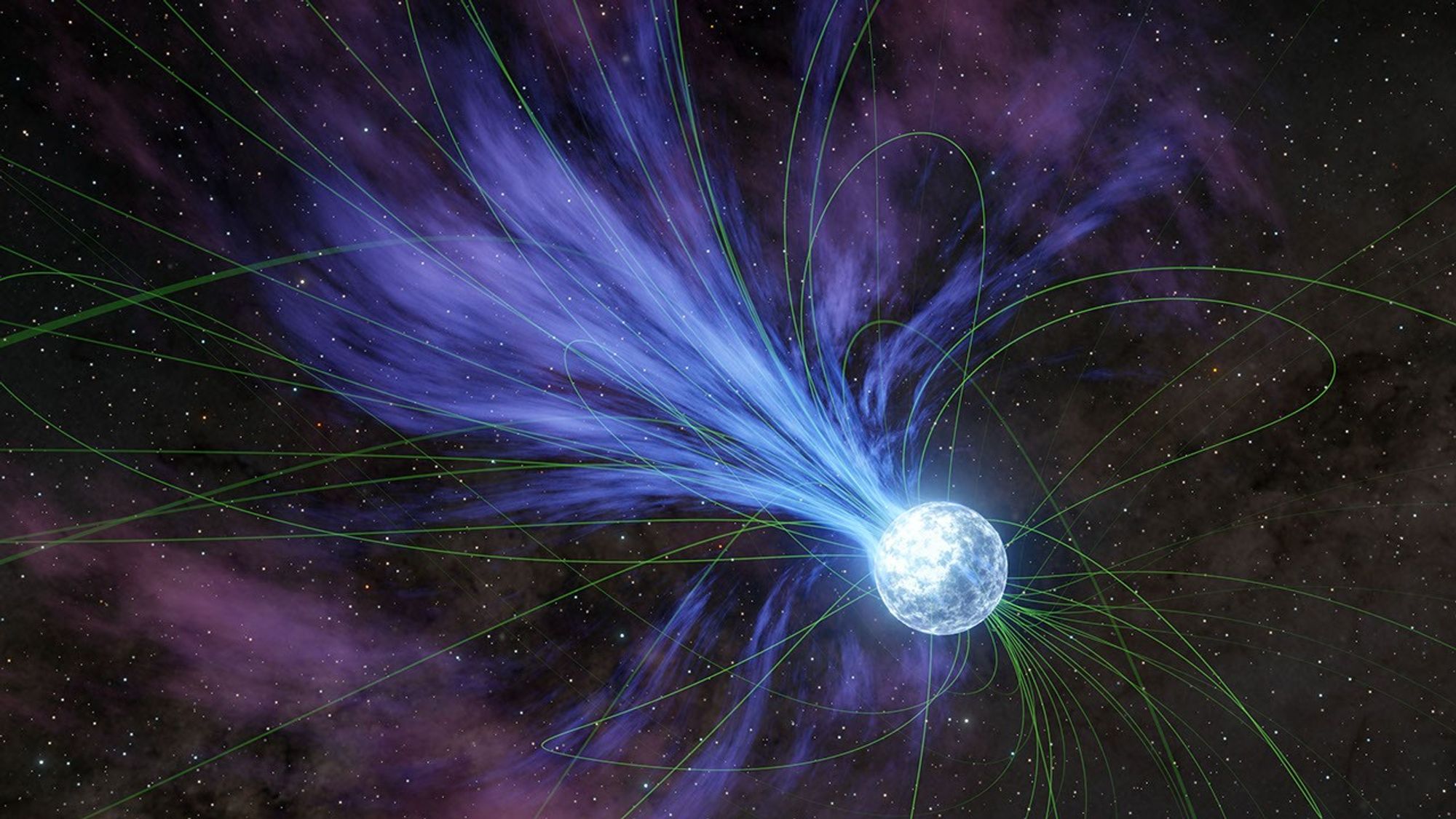 An artist’s concept of a magnetar losing material into space along its twisted magnetic field lines, shown here in green. NASA’s NICER and NuSTAR telescopes observed a magnetar do exactly this in 2022, coinciding with a burst of radio energy powerful enough to rival the Sun’s yearly output in a fraction of a second. (Image: NASA/JPL-Caltech)
For more on magnetar research and their connection to fast radio bursts, check out the coverage from NASA and the detailed overview from NASA’s Goddard Space Flight Center.
If you enjoyed this article, don’t forget to drop us a comment, it really helps support the site, and be sure to check out our other articles because we think you’re going to love them too.