
Five thousand light-years away, a dying star is carving a lion’s face out of glowing gas, and on August 10, NASA released the sharpest look at it yet. The James Webb Space Telescope just captured stunning new infrared images of NGC 2392, nicknamed the Lion Nebula, and the detail is genuinely striking.
A Familiar Face, Seen in a New Light
The Lion Nebula first got its nickname from Hubble’s visible-light images back in 2000, which revealed a face-like structure with a hazy “mane” of comet-shaped objects surrounding it. Webb’s new observations, combining its NIRCam and MIRI infrared instruments, cover the same target but pull out details Hubble’s visible-light view simply couldn’t reach. At first glance, the overall shape looks familiar, but Webb’s infrared vision reveals compact clumps of dust and wisps of ionized gas that were invisible before.
The nebula sits in the constellation Gemini, and this new image covers a patch of sky just 1.8 arcminutes across, roughly 2.6 light-years in real terms.
A Dying Star Still Has Work to Do
At the center of all that structure sits a white dwarf, the exposed, blisteringly hot core of a star that has already shed its outer layers. That core is so hot its radiation is effectively cooking the surrounding material from the inside out, carving a bubble of ionized hydrogen gas that forms the lion’s “face.” Tendrils of that bubble are actively expanding outward, destroying dust wherever they reach it.
Not everything gets obliterated, though. The nebula’s “mane,” a thick ring of dust illuminated by the central star, still holds compact clumps that have managed to survive the onslaught so far, some trailing comet-like tails as they slowly erode. If you’re curious what happens to a star once it reaches this white dwarf stage, our recent explainer on what a white dwarf actually is covers that dense stellar remnant in more detail.
A Snapshot That Won’t Last
What makes planetary nebulae like this one genuinely poignant is how temporary they are on cosmic timescales. Astronomers estimate the Lion Nebula formed over the past several thousand years and will fully disperse in roughly 10,000 more, a brief flash by astronomical standards. Webb’s new portrait captures it mid-transformation, still being actively reshaped by the dying star at its heart.
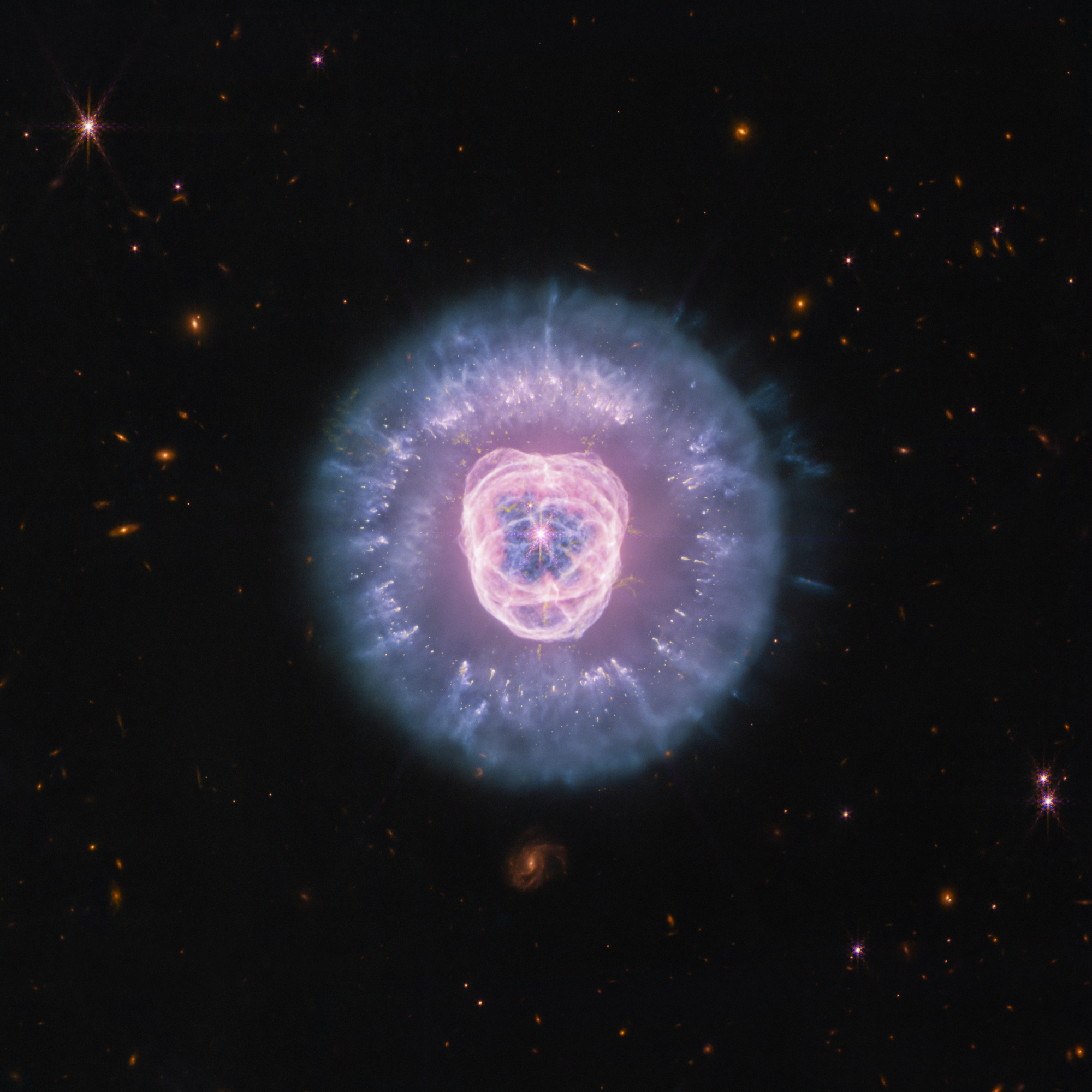 NASA’s James Webb Space Telescope captured this near- and mid-infrared composite image of the Lion Nebula (NGC 2392), released August 10, 2026. The white dwarf at center, resembling the lion’s “nose,” is sculpting the surrounding gas and dust with intense radiation. (Image: NASA, ESA, CSA, STScI; Image processing: Alyssa Pagan/STScI)
For the full image gallery and more technical detail, check out the original release from NASA and the additional coverage from ESA/Webb.
If you enjoyed this article, don’t forget to drop us a comment, it really helps support the site, and be sure to check out our other articles because we think you’re going to love them too.