
Every once in a while, the night sky throws in something extra, a bright, glowing visitor with a long streaming tail that shows up unannounced and sticks around for weeks or even months before disappearing again for decades, or sometimes centuries. These are the great comets, and if you’ve ever gone searching for comets images pictures online after hearing about one in the news, you already know just how stunning these objects can look through a camera lens. Lets talk about what makes a comet “great,” some of the most famous ones in recent history, and why photographers and astronomers alike get so obsessed with capturing them.
What Exactly Is a Comet?
Before diving into the greatest hits, its worth covering the basics. A comet is basically a chunk of ice, dust, and rock left over from the early days of our solar system, often nicknamed a “dirty snowball.” Most of the time, comets sit way out in the cold, distant edges of the solar system where nothing much happens to them. But every so often, ones orbit brings it swinging in close to the Sun.
That’s when the show starts. As a comet gets closer to the Sun’s heat, the ice on its surface begins to vaporize, releasing gas and dust that forms a glowing cloud around the nucleus called a coma. Solar wind then pushes that gas and dust outward, stretching it into the long, glowing tail that makes comets so recognizable, and so photogenic.
What Makes a Comet “Great”
Not every comet earns the title of a Great Comet. Its a somewhat informal label astronomers use for comets that become bright enough to see easily with the naked eye, often without needing dark skies or any special equipment at all. Only a handful of comets each century ever reach that level of brightness, which is exactly why they generate so much buzz, and why so many people go hunting for comets images pictures the moment one becomes visible.
Hale-Bopp: The Comet Everyone Remembers
If you ask anyone who was around in the 1990s about a comet they remember seeing, theres a good chance they’ll mention Hale-Bopp. Discovered independently in 1995 by two amateur astronomers, Alan Hale and Thomas Bopp, this comet became the Great Comet of 1997 and one of the most viewed comets in modern history. What made it so special was its sheer size, its nucleus measured somewhere around 37 miles across, making it roughly five times bigger than the space rock believed to have wiped out the dinosaurs.
Hale-Bopp was visible to the naked eye for an incredible 18 months, doubling the previous record set by the Great Comet of 1811. It was so bright that people could spot its twin blue and white tails even from light polluted cities. Photographers had a field day, and to this day, some of the most iconic comets images pictures ever taken come from Hale-Bopp’s long stay in our skies.
Halley’s Comet: The Original Celebrity
No conversation about famous comets is complete without mentioning Halley’s Comet, probably the most well known comet in human history. Unlike Hale-Bopp, Halley returns on a predictable schedule, swinging back into view roughly every 76 years. Its been observed and recorded by different civilizations for over two thousand years, and its 1986 appearance drew huge public attention even though it was actually fainter than expected from Earth that particular pass.
Halley holds another distinction too, it’s the only comet whose nucleus has actually been directly photographed up close, thanks to a European spacecraft called Giotto that flew right past it in 1986 and beamed back detailed images. If you’re patient, mark your calendar, Halley’s Comet isn’t due to swing back through our skies again until 2061.
Hyakutake and the Long Bright Tail
Just a year before Hale-Bopp stole the spotlight, another comet briefly amazed skywatchers. Comet Hyakutake, discovered in 1996 by a Japanese amateur astronomer using nothing more than long range binoculars, became known for having one of the longest tails ever recorded stretching across the sky. It didn’t stick around nearly as long as Hale-Bopp did, but for the brief window it was visible, it put on an unforgettable show.
Why Comet Photos Look So Different From One Another
If you spend any time browsing comets images pictures online, you’ll notice they can look wildly different from each other, some show a tight, bright coma with barely any tail, while others show tails stretching what looks like halfway across the frame. A lot of that comes down to how close the comet passes to both the Sun and Earth, how much ice and dust its actually releasing, and the kind of camera equipment used to photograph it. Long exposure astrophotography tends to produce those dramatic, richly colored comet tails you often see circulating online, while a quick naked eye glance usually shows something more modest, still beautiful, just less saturated than what a camera can pull out of the sky.
If you’re inspired to try capturing the next bright comet yourself, understanding your equipment matters a lot, and our telescope magnification calculator is a good starting point for figuring out what kind of setup will actually work for photographing something moving as unpredictably as a comet.
Keeping an Eye Out for the Next Great Comet
Great comets don’t follow a neat, predictable schedule the way meteor showers do, which is part of what makes them so exciting when they do show up. Astronomers usually get some advance warning once a new comet is discovered and its orbit gets calculated, giving skywatchers and photographers time to prepare. Keeping tabs on space news is honestly the best way to make sure you don’t miss the next one when it finally brightens up enough to be visible from your own backyard.
Comets remind us that the night sky isn’t always static. Most nights, the stars sit exactly where you expect them, but every once in a while, something new drifts through, glowing and temporary, giving us a reason to look up a little more often than usual.
For more history and photos of history’s most famous comets, check out the deep dive from History.com and the detailed Hale-Bopp breakdown from Space.com.
If you enjoyed this article, don’t forget to drop us a comment, it really helps support the site, and be sure to check out our other articles because we think you’re going to love them too.
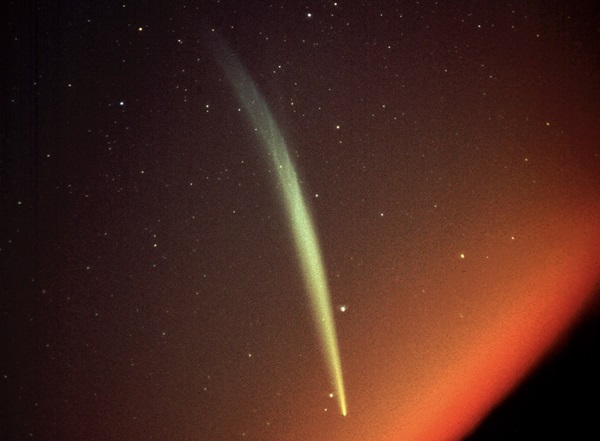
1. Ikeya-Seki (C/1965 S1)
Roger Lynds/NOIRLab/NSF/AURA
Discovered in September 1965, this sungrazer lived up to all expectations. Over the next month, it blossomed into one of the brightest comets of the millennium — an indisputably great comet. This four-minute exposure was taken at dawn from Kitt Peak National Observatory Oct. 29, 1965, eight days after perihelion.
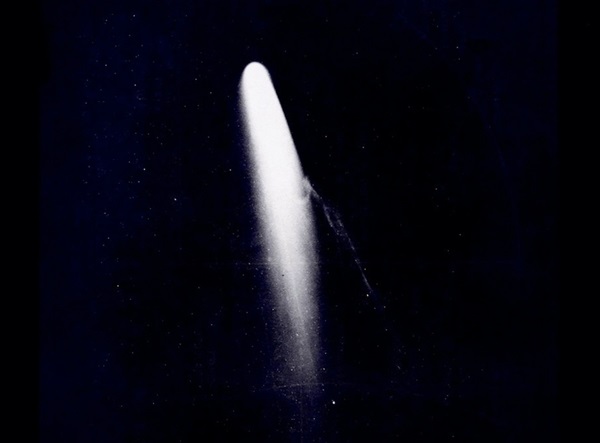
2. Bennett (C/1969 Y1)
Burlaga et al. 1972; K. Lubeck, Hamburg Observatory
Bennett’s ion tail featured a prominent kink, seen in this two-minute exposure taken April 4, 1970, with the 0.8-meter Schmidt telescope at Hamburg Observatory. Nine days later, the crew of Apollo 13 attempted to photograph Comet Bennett from deep space, but they were unsuccessful.
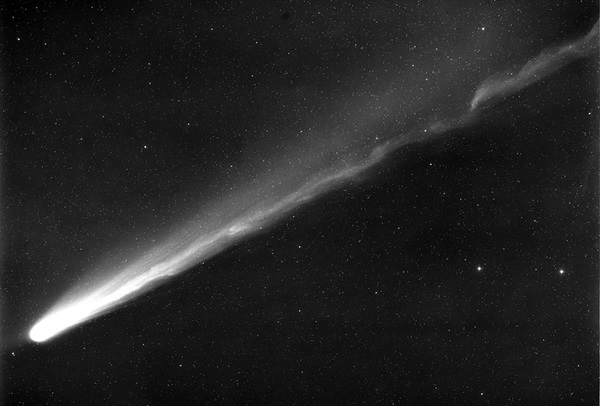
3. Kohoutek (C/1973 E1)
Palomar Observatory
Comet Kohoutek may not have lived up to its billing as the “comet of the century,” but this three-minute exposure on Palomar Observatory’s 1.2-meter Schmidt telescope taken Jan. 12, 1974, captured its streaming tail in stunning detail.
4. West (C/1975 V1)
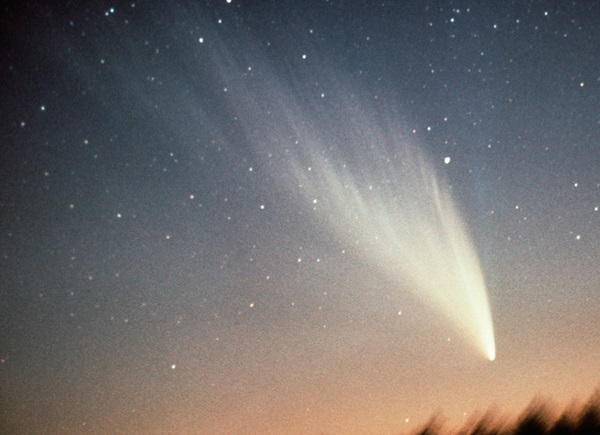
Linder/ESO
Burned by the letdown of Kohoutek, the media did not trumpet Comet West with much fanfare. But West put on a fine display and reached a peak apparent magnitude of –3, making it the brightest comet since Ikeya-Seki.
5. Hale-Bopp (C/1995 O1)
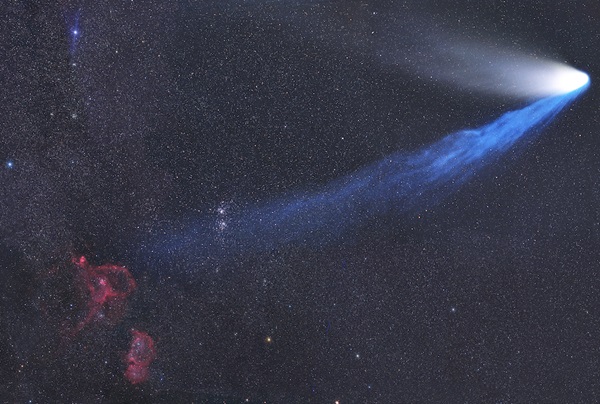
Gerald Rhemann
The magnificent Comet Hale-Bopp was already visible to the naked eye in May 1996, nearly a year before it reached perihelion. When it reappeared after swinging around the Sun, it remained visible unaided through nearly all of 1997. In this shot taken April 2, 1997, its blue ion tail is passing over the Heart and Soul nebulae (IC 1805 and IC 1848) at lower left and, just to the right, the Double Cluster in Perseus (NGC 869 and NGC 884).
6. Halley (1P)
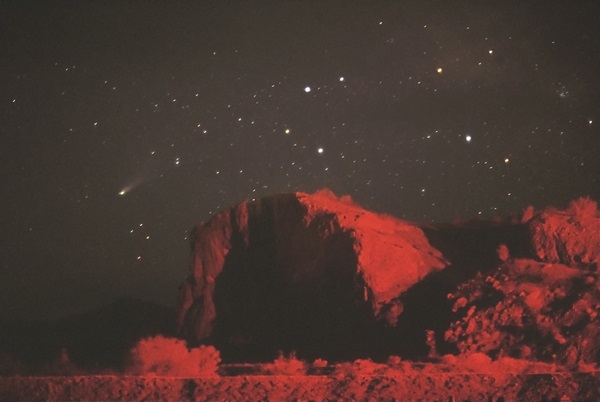
Alan Dyer
Comet Halley’s most recent apparition, in 1986, was its least-favorable on record, especially for Northern Hemisphere viewers. Still, it was a nearly-once-in-a-lifetime chance to see the most famous comet in history. This photo captures one such moment from Lake Havasu, Arizona, in March of that year.
7. Levy (C/1990 K1)
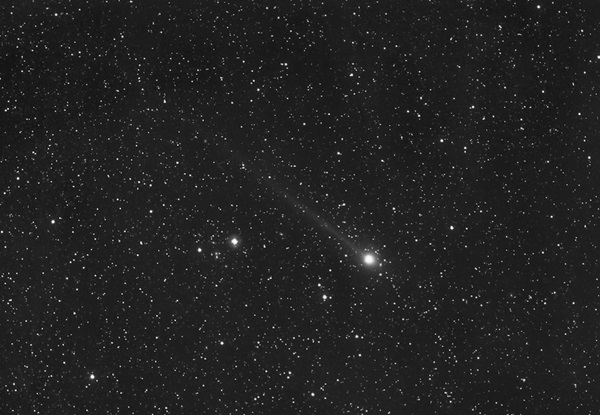
Chris Schur
Comet hunter David Levy is perhaps best known for his co-discovery of Shoemaker-Levy 9, which smashed into Jupiter in July 1994. But Comet Levy (C/1990 K1) put on a show closer to home, reaching magnitude 3.1 in August 1990. It was also the first comet observed by the Hubble Space Telescope.
8. Hyakutake (C/1996 B2)
Gerald Rhemann
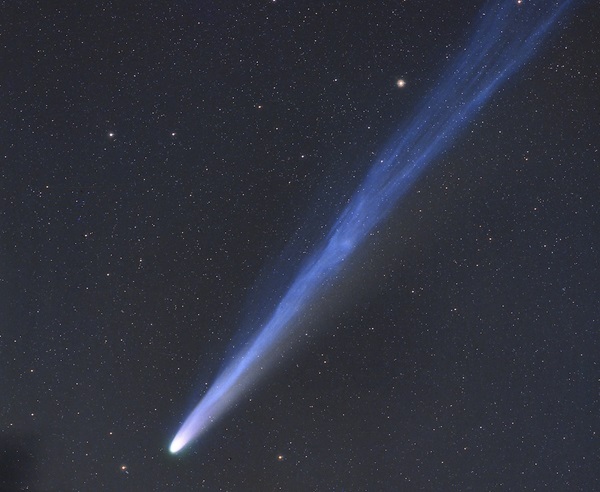
As the world awaited the arrival of Hale-Bopp in early 1996, Comet Hyakutake, discovered Jan. 31, suddenly rose to prominence, temporarily stealing the spotlight with a colorful display. This five-minute exposure was taken as Hyakutake reached perihelion in April 1996.
9. NEAT (C/2002 V1)
Chris Schur
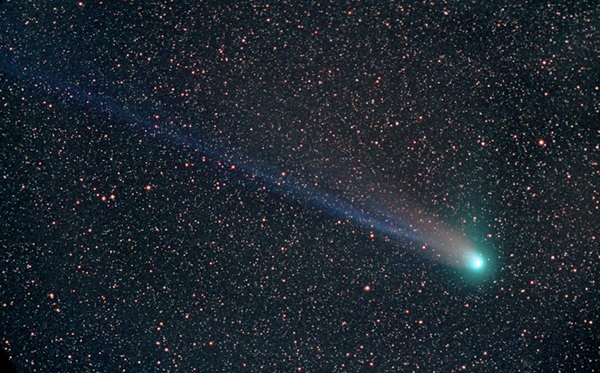
Comet NEAT revealed a couple of intriguing scientific implications. To many astronomers’ surprise — and despite its apparent diminutive size — it survived its close encounter with the Sun. It even endured a solar storm in the form of a coronal mass ejection, a powerful cloud of charged particles ejected from the surface of the Sun. This plasma interacted with the tail, putting a kink in it.
10. PANSTARRS (C/2011 L4)
Gerald Rhemann
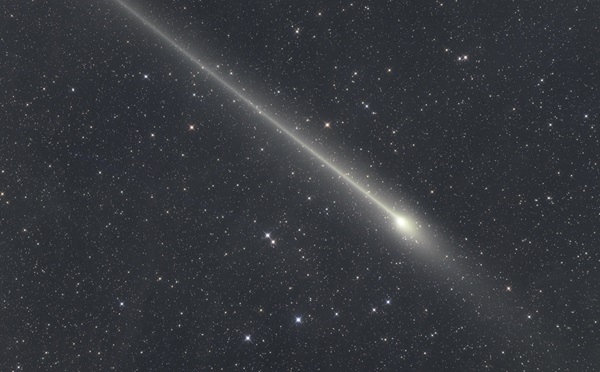
When this comet was discovered in June 2011 by the Pan-STARRS telescope on Haleakalā in Hawaii, it still lay between the orbits of Jupiter and Saturn. It finally became visible to the naked eye near perihelion in March 2013. Although it did not quite match initial brightness predictions, it featured a remarkably long anti-tail that spanned as much as 7°, visible in this May 22 image.
11. LINEAR (C/1999 S4)
. NASA, H. Weaver and P. Feldman (Johns Hopkins University), M. A’Hearn (University of Maryland), C. Arpigny (Liege University), M. Combi (University of Michigan), M. Festou (Observatoire Midi-Pyrenees), and G.-P. Tozzi (Arcetri Observatory)
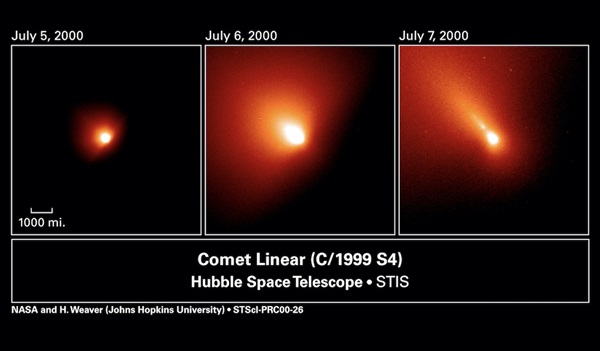
Comet LINEAR was, overall, a bit of a disappointment, disintegrating before it reached perihelion in late July 2000. But before it fell apart, the Hubble Space Telescope managed to capture a dramatic outburst in early July, when the comet suddenly brightened by half in the span of four hours and, a day later, expelled a chunk of its crust behind it. These images offered scientists one of their most detailed glimpses to date of how a comet erupts and fragments.
12. McNaught (C/2006 P1)
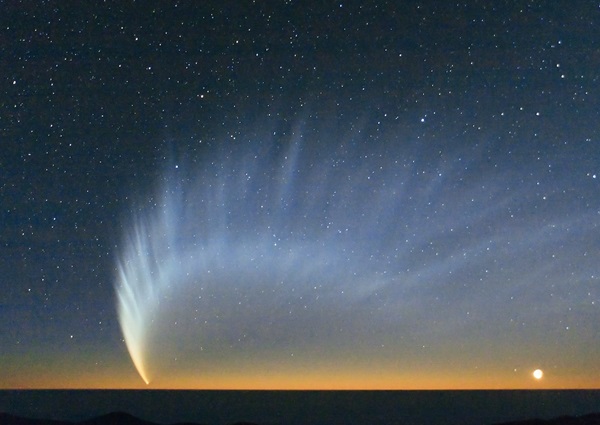
S. Deiries/ESO
Comet McNaught proved a treat for Southern Hemisphere observers, featuring prominent striations in its spectacular dust tail. The beautiful structure was captured fanning out above the Pacific Ocean in this image taken from Paranal Observatory in Chile in January 2007.
13. ISON (C/2012 S1)
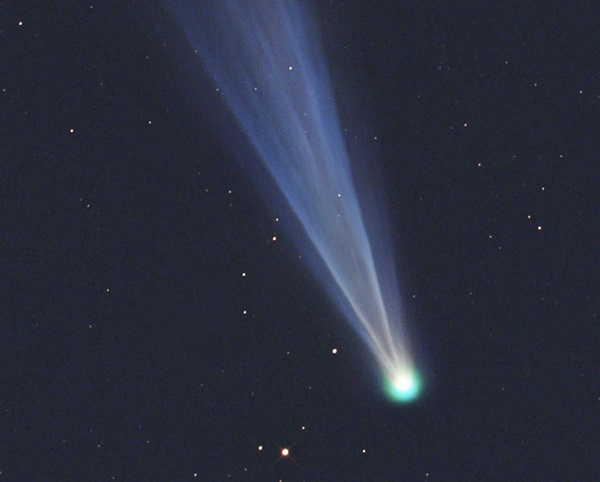
Gerald Rhemann
Like so many comets before it, ISON was heralded and hyped but ultimately turned out to be a dud — relatively speaking. It still proved an alluring photographic target, as this shot from Nov. 21, 2013, demonstrates.
14. Holmes (17P)
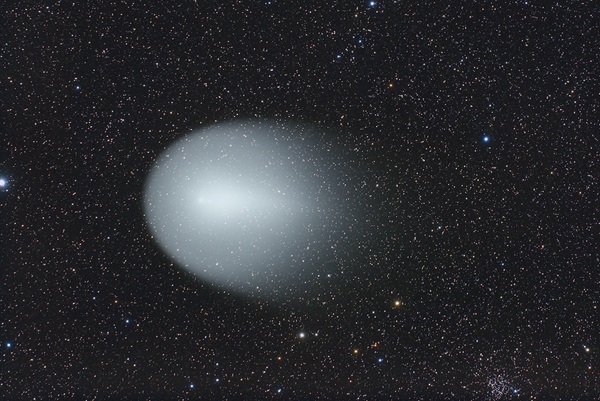
Chris Schur
Comet Holmes was discovered by Edwin Holmes in 1892 and has a period of just under seven years. But it was lost for several decades between 1906 and 1964 as it was too faint. It gave its most dazzling performance in October 2007, when it suddenly underwent an outburst. This image was taken Dec. 3, after the coma had expanded to a volume greater than that of the Sun.
15. Lovejoy (C/2011 W3)
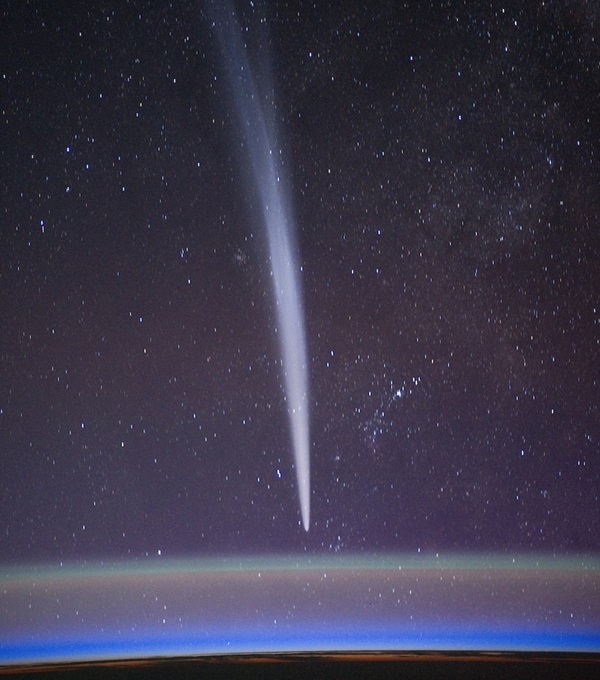
NASA
Comet Lovejoy was discovered in November 2011 and emerged from perihelion in mid-December, putting a glimmering celestial bow on a festive time of year. Here, it appears above the limb of Earth Dec. 22, 2011, as photographed from the International Space Station by the orbiting laboratory’s then-commander Dan Burbank.
NEOWISE (C/2020 F3)
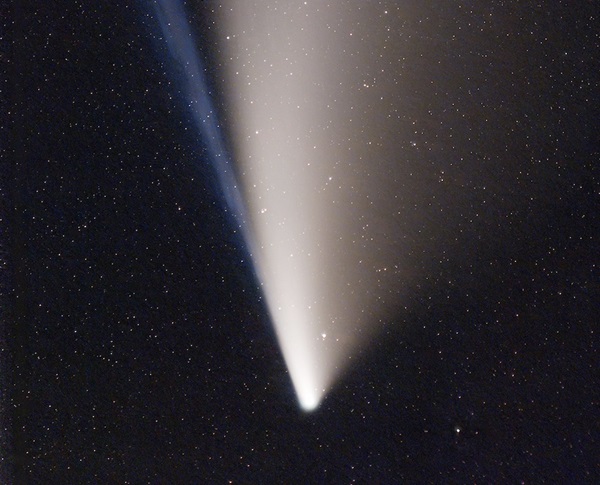
Adam Block
Comet NEOWISE was discovered in late March 2020, just as the world was locking down due to the COVID-19 pandemic. When it peaked July 23, it was the brightest comet since McNaught. Millions around the world went outside to observe it — socially distanced but reveling together in the sight of a sublime cosmic phantom. While astronomers debate whether NEOWISE qualifies as a great comet, we can all agree on one thing: Hopefully, the next great comet will arrive amid more auspicious circumstances.