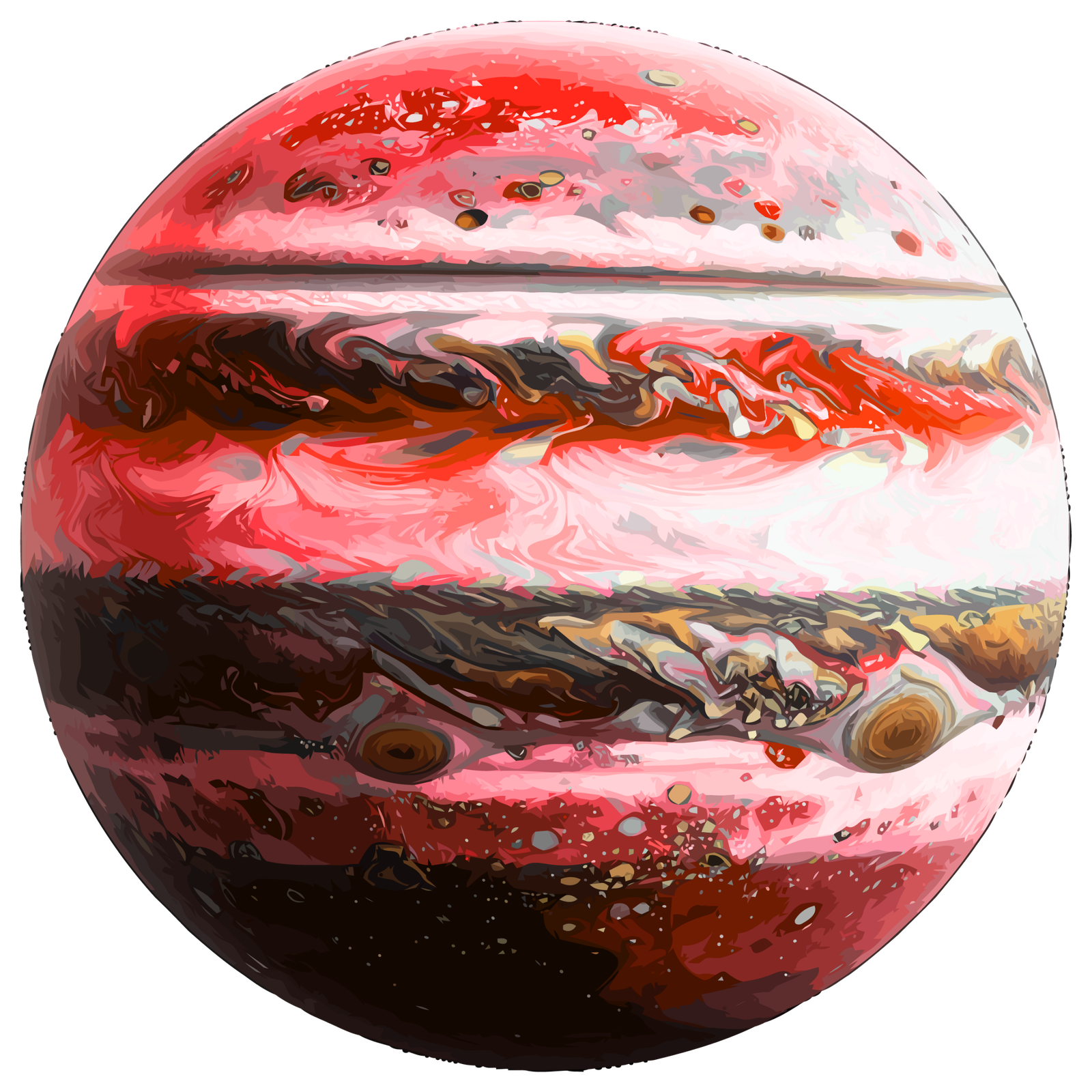

Look up at the Moon a few nights in a row and something quietly strange happens. One night it’s a thin curved sliver. A week later it’s a tidy half. Give it another week and it’s a full glowing disk lighting up the whole backyard. Then it starts shrinking again, as if the sky is slowly rubbing it out. Phases of the Moon
For most of human history people found this baffling, and honestly, it’s a fair thing to be puzzled by. The Moon looks like it’s changing shape. But it isn’t. It’s the same rocky ball it always was. What’s actually changing is how much of its sunlit side we can see from here, and that simple idea is the key to understanding every single one of the phases of the Moon.
What Actually Creates the Phases of the Moon
Here’s the part worth getting straight before anything else, because a lot of people carry the wrong version of it around for years.
The Moon does not make its own light. It shines because sunlight bounces off it, the same way a mirror catches a lamp. And just like Earth, the Moon always has one half lit by the Sun and one half in darkness. That never changes. The Sun is always lighting up exactly half of it.
What changes is our viewing angle. As the Moon travels around Earth over the course of a month, we catch that sunlit half from different directions. Sometimes we’re looking straight at the lit side, sometimes at the dark side, and most of the time we’re somewhere in between, seeing only a slice of the daylight half. That shifting slice is what we call a phase.
And no, the phases are not caused by Earth’s shadow falling on the Moon. That’s a common mix-up. Earth’s shadow only touches the Moon during a lunar eclipse, which is a rare event, not a monthly one. The phases happen because of geometry and sunlight, not shadow. If you want to see exactly which slice is showing on any given night, our Moon phase and supermoon calculator will tell you at a glance.
The 8 Phases of the Moon, In Order
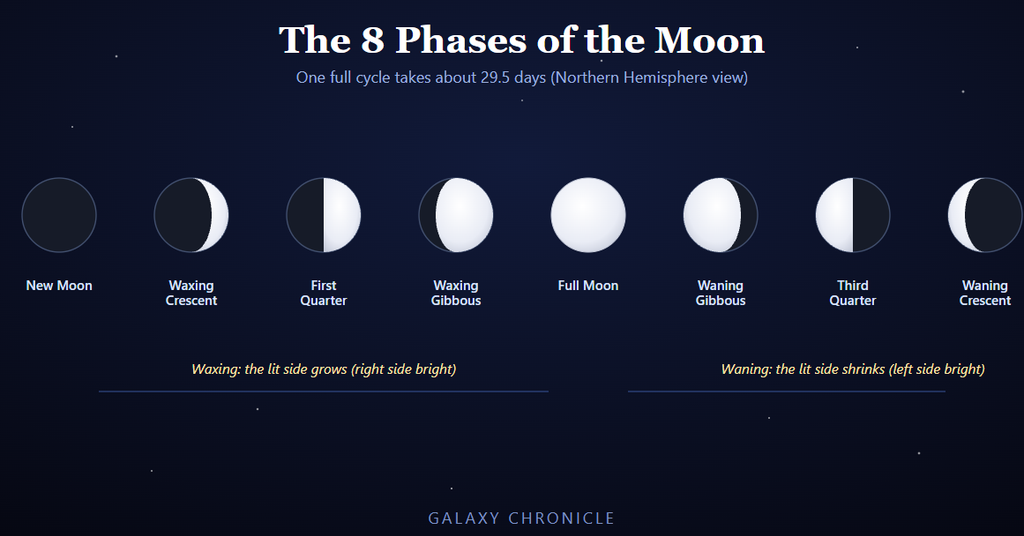
The full cycle runs through eight recognized phases, and it takes about 29.5 days to get from one new moon all the way back to the next. Astronomers call that stretch a synodic month. Here’s the whole sequence, start to finish.
1. New Moon
This is the invisible one. The Moon sits roughly between Earth and the Sun, so the lit half is facing entirely away from us and the side pointed our way is in darkness. You basically can’t see it. It rises and sets with the Sun, lost in the glare. A new moon is the quiet reset button at the start of every cycle.
2. Waxing Crescent
A day or two later, a slim curve of light appears on the right side of the Moon, at least for those of us watching from the Northern Hemisphere. This is the waxing crescent. “Waxing” simply means the lit part is growing. You’ll catch it low in the west shortly after sunset, a delicate sliver that’s easy to miss if you’re not looking.
3. First Quarter
Now half of the Moon’s face is lit, the right half from our northern view. It’s called the first quarter not because a quarter is showing, but because the Moon is one quarter of the way through its monthly journey. This one is easy to spot, since it rises around midday and sits high in the sky through the evening.
4. Waxing Gibbous
Between the half and the full stage, the Moon swells into a rounded shape that’s more than half lit but not quite complete. That bulging shape has a name most people never learn: gibbous. A waxing gibbous moon keeps brightening night after night as it heads toward full.
5. Full Moon
The showstopper. Earth now sits between the Sun and the Moon, so we’re looking straight at the fully sunlit face. The whole disk glows. A full moon rises right as the Sun sets and stays up all night, which is why it feels like it owns the sky. This is also the phase behind supermoons, blood moons, and most of the Moon’s starring roles in folklore.
6. Waning Gibbous
After full, the light begins to retreat. “Waning” means shrinking. The Moon is still mostly lit, but now the dark edge is creeping in from the right side instead of the left. A waning gibbous rises later each night, well after sunset.
7. Third Quarter
Also called the last quarter, this is the mirror image of the first quarter. Half the face is lit again, but now it’s the left half glowing while the right sits in shadow. It rises around the middle of the night and is often still hanging in the western sky well after sunrise, pale against the blue.
8. Waning Crescent
The final act. The lit portion has thinned back down to a slender curve, this time on the left. You’ll find the waning crescent low in the east in the hours before dawn. Once it fades completely, the Moon slips back into a new moon and the whole cycle begins again.
Waxing vs Waning: A Trick to Never Get Them Confused
The two words that trip everyone up are waxing and waning, so here’s the shortcut.
Waxing means the lit area is growing, heading toward full. Waning means it’s shrinking, heading toward new. For anyone watching from the Northern Hemisphere, there’s an even simpler visual cue. If the right side is lit, the Moon is waxing and getting brighter. If the left side is lit, it’s waning and fading. Light on the right, growing bright. Light on the left, on its way out.
One important note for readers south of the equator. In the Southern Hemisphere the whole thing appears flipped, so a waxing moon is lit on the left instead of the right. The phases and their names are exactly the same, you’re just viewing them upside down relative to your northern neighbors.
Why Knowing the Moon’s Phases Is Actually Useful
This isn’t only trivia for impressing people at a campfire, though it does work well for that. The phase of the Moon shapes real, practical things.
Stargazers plan around it, because a bright full moon washes out faint stars, galaxies, and meteors, while a new moon gives the darkest, clearest skies for deep viewing. Ocean tides swing to the Moon’s rhythm, with the strongest tides arriving near the new and full phases. And once you can read the sky yourself, you’ll start noticing that the Moon has a schedule. A thin crescent after sunset, a full moon rising in the east as the Sun goes down, a pale half moon lingering into the morning. It stops being random and starts making sense. If the Moon has you curious about our nearest neighbor in general, our piece on what makes our Moon so special is a good place to wander next.
The Moon has been running this same eight-step routine for billions of years, long before anyone was around to name the shapes. Learning to follow it is one of the oldest and most rewarding habits in all of stargazing, and you don’t need a telescope or an app to start. Just your eyes and a clear night.
For more detail straight from the experts, NASA has an excellent breakdown of the Moon’s phases along with a kid-friendly explainer over at NASA Space Place.
If you enjoyed this article, don’t forget to drop us a comment, it really helps support the site, and be sure to check out our other articles because we think you’re going to love them too.