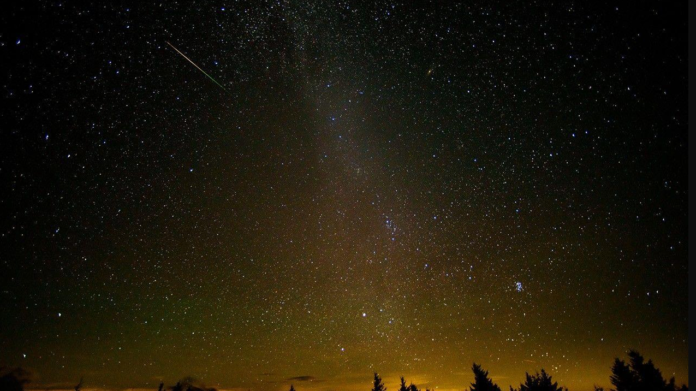

If you enjoy stepping outside on a warm summer night and watching the sky, August 2026 is giving you a pretty good reason to stay up late.
The Perseid meteor shower 2026 is expected to reach its peak overnight on August 12 into August 13, and this year comes with one big advantage for stargazers: there will be very little moonlight to wash out the sky. The Moon reaches its new phase on August 12, which means the darker sky should make faint Perseid meteors much easier to see.
The Perseids are already active by late July, but the real show builds toward the middle of August. If the weather is clear and you can get away from city lights, this could be one of the better nights of the year to simply lay back, look up and wait for a bright streak to cross the sky.
And you don’t need a telescope for this one.
When Is the Perseid Meteor Shower Peak in 2026?
The Perseid meteor shower peaks on August 12-13, 2026 according to the American Meteor Society. The shower is active from around July 17 through late August, but the nights around the peak are when you’re most likely to see the highest number of meteors.
For people in the United States, the best time to watch will generally be after midnight and into the early morning hours of August 13.
That’s because the Perseid radiant, the area of the sky where the meteors seem to come from, gets higher in the sky as the night goes on. The American Meteor Society notes that the radiant is best placed during the last dark hour before dawn, when it is highest in the northeastern sky.
So if you go outside at 9 p.m. and don’t see much, don’t assume you’ve missed the shower.
The better part of the show is still coming.

6
Why the Perseids Could Be Especially Good in 2026
One of the biggest problems with meteor showers is the Moon.
A bright full or nearly full Moon can light up the night sky and make many of the fainter meteors almost impossible to see. Even when a meteor shower is active, a bright Moon can make the experience feel pretty underwhelming.
That won’t be much of a problem during the Perseid meteor shower 2026.
The American Meteor Society lists the Moon at 0% illumination for the August 12-13 peak, because the Moon will be at its new phase. That creates very dark conditions, assuming your local weather cooperates.
This is a big deal for anyone trying to watch from a darker location.
Under good rural conditions, the Perseids can normally produce around 30 to 50 visible shower meteors per hour around the peak. The theoretical Zenithal Hourly Rate is about 100 meteors per hour, but that number is based on ideal conditions and doesn’t mean a person standing in a backyard will actually see 100 meteors every hour.
Real life is different.
Trees can block part of the sky. Light pollution can hide faint meteors. Clouds can ruin the whole thing. And sometimes you just happen to look in the wrong direction when the brightest meteor of the night goes flying past.
Still, the lack of moonlight gives the Perseids a nice advantage this year.
What Are the Perseid Meteors?
The Perseids aren’t stars falling out of the sky, even though they can look that way for a second.
The meteors come from tiny pieces of dust and debris left behind by Comet 109P/Swift-Tuttle.
As Earth travels around the Sun, it passes through the stream of debris left along the comet’s orbit. Some of those tiny particles hit Earth’s atmosphere at extremely high speeds. The particles heat and glow as they interact with the atmosphere, creating the quick flashes of light we call meteors.
The Perseids are known for producing fast and often bright meteors. Their entry speed is around 59 kilometers per second, or about 37 miles per second.
Most of the particles are tiny. They don’t need to be huge rocks to create a bright streak in the sky.
That’s part of what makes meteor showers so interesting. Something that may have been sitting in the debris trail of a comet for a very long time can end up burning away above Earth in just a moment.
Where Should You Look for the Perseids?
The Perseids get their name from the constellation Perseus.
That’s because the meteors appear to come from a point in the sky near Perseus called the radiant.
But you don’t actually need to stare directly at Perseus.
In fact, you may see more meteors by looking at a wider area of the sky rather than focusing on one small spot. The meteors can travel across large sections of the sky, and some of the longer and brighter ones may appear far away from the radiant.
For observers in the Northern Hemisphere, look generally toward the northeastern sky as the night progresses. The radiant becomes higher after midnight and is especially well placed during the hours before sunrise.
Don’t worry if you can’t identify Perseus right away.
You can still enjoy the shower without knowing a single constellation.

5
The Best Place to Watch the Perseid Meteor Shower
If you live in a major city, you can still try watching the Perseids, but you’ll be fighting against light pollution.
Street lights, buildings and the glow from nearby cities can make the sky much brighter than it naturally would be. That means you’ll see fewer of the faint meteors.
A darker location is much better.
You don’t necessarily need to drive halfway across the country. Even getting outside the brightest part of town can make a noticeable difference. A rural area, dark-sky park, open field or quiet spot away from direct lights can all work.
Try to find somewhere with a wide open view.
A location with tall trees or buildings surrounding you may block a large part of the sky, which means you’re giving yourself fewer chances to see a meteor.
And if you’re planning a late night outside, bring something comfortable to sit or lay on. A reclining lawn chair works great. So does a blanket if the ground isn’t too damp.
Meteor watching is much more enjoyable when your neck isn’t killing you after 15 minutes.
You Don’t Need a Telescope
This is probably one of the best things about the Perseids.
You don’t need an expensive telescope or a complicated astronomy setup.
In fact, a telescope isn’t really the best tool for watching a meteor shower because its narrow field of view makes it harder to catch meteors moving across the sky.
Your eyes are enough.
Binoculars aren’t necessary either, although they can be fun for looking at stars and other objects between meteors.
The most important equipment is patience.
Give your eyes time to adjust to the darkness. Try to avoid looking at your phone every few minutes because the bright screen can make it harder for your eyes to stay adjusted.
Once your eyes get used to the dark, you’ll start noticing more stars and eventually those quick flashes of light will start showing up.
Sometimes you’ll get a tiny streak.
Sometimes you’ll get a long bright line that seems to travel halfway across the sky.
And once in a while, you may get a really bright fireball that makes you say “whoa” before you even realize what happened.

6
What Time Should You Watch the Perseids?
The simple answer is late at night and especially after midnight.
The shower can produce meteors earlier in the evening, but the activity generally gets better as the radiant climbs higher in the sky.
For the 2026 peak, the strongest viewing is expected during the overnight hours of August 12-13 and toward dawn on August 13. NASA’s Night Sky Network is also listing Perseid observing events during those overnight hours, with some locations expecting the best activity after midnight.
If you’re in the U.S., your exact best viewing time will depend on your location.
But you don’t have to obsess over the exact minute.
This isn’t an eclipse.
There’s no single 30-second window where you have to be looking up or you’ll miss everything. The Perseids remain active for hours, and the peak itself is spread across time.
A good plan is to head outside sometime after midnight, get comfortable and stay out for at least an hour if you can.
The longer you watch, the better your chances.
What If the Weather Is Cloudy?
Unfortunately, even perfect astronomical conditions can’t do anything about clouds.
A new Moon won’t help if your entire sky is covered in clouds.
That’s why checking your local weather forecast before heading out is important. Clear skies are the biggest factor you can control besides getting away from bright lights.
If the forecast is bad on the exact peak night, don’t automatically give up.
The Perseids remain active for weeks around the peak, so you may still have opportunities to see Perseid meteors before or after August 12-13, although the number of meteors will normally be lower away from the maximum.
Can You Photograph the Perseid Meteor Shower?
Yes, and you don’t need to be a professional photographer to try.
A camera that allows long exposures can capture meteors that you may not even notice with your eyes. A tripod is very useful because the camera needs to remain completely still during the exposure.
A wide-angle lens is usually a better choice than a zoomed-in lens because you want to capture as much of the sky as possible.
The most important thing is to point the camera somewhere with a good view of the sky and leave it running for a while. Meteor photography is partly about luck. You can take dozens of frames and get only a few good meteors, then suddenly one image can come out amazing.
NASA also recommends using a tripod and long-exposure photography when photographing meteor showers, since the meteors are brief flashes and the camera needs to capture a large portion of the night sky.

5
Why the Perseids Are One of the Best Meteor Showers of the Year
There are several meteor showers throughout the year, but the Perseids have become one of the most popular for a pretty simple reason.
They happen in August.
For people in the Northern Hemisphere, August usually means warmer nights, so sitting outside for a couple hours isn’t nearly as unpleasant as trying to watch a winter meteor shower in freezing temperatures.
The Perseids can also produce fast meteors, bright streaks and occasional fireballs. And because the shower can produce a strong number of meteors around its peak, even someone who isn’t an astronomy expert can walk outside and see something interesting.
In 2026, the timing gets even better because the peak happens around a new Moon.
That’s a combination skywatchers don’t want to waste.
Perseid Meteor Shower 2026 Viewing Checklist
Before you head outside on August 12, there are a few simple things worth remembering.
Find the darkest location you can.
Check the weather before you leave.
Try to get a wide open view of the sky.
Go outside after midnight for the best chance of seeing more Perseids.
Give your eyes time to adjust to the darkness.
Leave the telescope at home unless you want it for other objects.
Keep your phone brightness low.
Bring a chair, blanket or something comfortable.
And most of all, be patient.
You may not see a meteor right away. That’s normal.
The sky isn’t a vending machine where you put in five minutes and get a meteor.
Sometimes you’ll wait several minutes between meteors. Other times you might see several in a short period. The Perseids are unpredictable on a moment-to-moment basis, and that’s part of the fun.
A Dark August Sky Could Make 2026 Special
The Perseid meteor shower 2026 has a lot going for it.
The shower will reach its peak around August 12-13, the Moon will be at new phase, and the best viewing will come during the late-night and early-morning hours when Perseus is higher in the sky. The American Meteor Society expects normal rural rates around 30 to 50 Perseids per hour at maximum, with a theoretical rate of around 100 under ideal conditions.