
Andromeda has been humanity’s most-watched galaxy for over a century, close enough to spot with the naked eye on a dark night, close enough for Hubble to resolve 200 million of its individual stars. New data now shows something changing there, star birth across the entire galaxy has been quietly declining for the past 500 million years, and the drop-off has sharply accelerated just recently.
From a Solar Mass a Year to a Fifth of That
A team led by Tobin Wainer at the University of Washington combined two major Hubble surveys covering roughly two-thirds of Andromeda’s disk, mapping the ages and locations of 200 million stars in the process. Half a billion years ago, the galaxy was forming stars at a rate of about one solar mass per year. By 40 million years ago, that rate had already dropped by half. Today, Andromeda is producing new stars at only about one-fifth that original pace.
“We need to measure the individual stars because they are the fossil record of the galaxy’s formation,” said co-author Ben Williams. Younger, more massive stars burn distinctly bluer than older, smaller ones, so by mapping color across thousands of 300-light-year sections of the galaxy, the team could essentially read Andromeda’s recent star-forming history directly off its stellar population.
“You’ve Got to Take a Bit of a Breather”
The good news, for anyone worried Andromeda is running dry, is that this doesn’t look like the galaxy running out of raw material to build new stars from. Around 2 billion years ago, Andromeda went through a dramatic burst of star formation, likely triggered by a past merger or close interaction with another galaxy, and researchers think what we’re seeing now is simply the long, natural exhale that follows a burst like that. Wainer put it about as plainly as a professional astronomer can. “It’s just like after running a marathon, sometimes you’ve got to take a bit of a breather.”
Most of that recent decline is concentrated in one specific region, a ring of star formation sitting about 32,000 light-years from Andromeda’s center, which appears to be responsible for the bulk of the galaxy-wide slowdown.
A Small Neighbor Might Be the Culprit
The team also went looking for a more specific trigger, and one candidate kept showing up. M32, a small satellite galaxy sitting just 16,000 light-years from Andromeda in the sky, appears to correlate with a localized dip in star formation nearby, one that researchers traced back to roughly 60 million years ago. Nobody can say for certain that M32 caused the slowdown, its exact three-dimensional path relative to Andromeda’s disk is still uncertain, but the timing lines up suspiciously well. “We can’t explicitly say that we are seeing a decrease in star formation because of M32,” Wainer said, “but it’s right there, and it’s definitely the most likely suspect.”
If you’re curious about the constellation Andromeda actually sits within and how to spot the galaxy yourself, our stargazing guide to the constellation Andromeda covers exactly where to look.
Bigger Eyes Are About to Open
Hubble’s own view, sharp as it is, only covers two-thirds of Andromeda’s disk. That’s about to change, NASA’s Nancy Grace Roman Space Telescope, launching as early as August 30, 2026, carries a field of view over 100 times wider than Hubble’s, and an approved observing program will image Andromeda’s entire disk along with parts of its surrounding halo. “Andromeda is important because it’s a neighbor that is close enough that we can see it in great detail while also getting a global perspective,” said co-author Raja GuhaThakurta. Given that Andromeda and our own Milky Way are on a slow collision course set to unfold billions of years from now, understanding exactly how our nearest large neighbor ages, slows down, and eventually settles matters more than just academic curiosity, it’s a preview of a process our own galaxy is running in parallel.
For more on the research, check out the full release from NASA and the published study in The Astrophysical Journal.
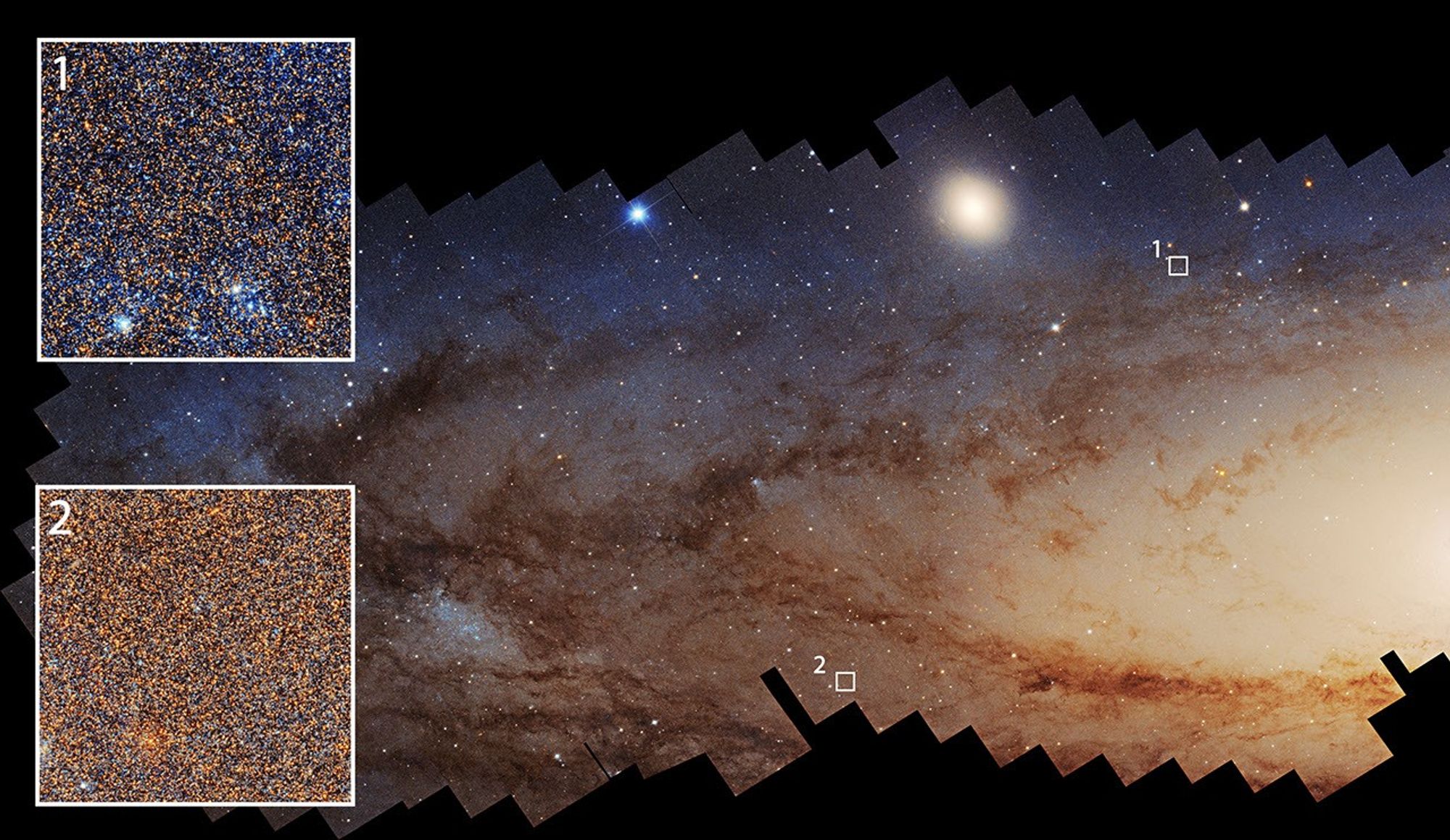 NASA’s Hubble Space Telescope resolved 200 million individual stars across two-thirds of Andromeda’s disk, revealing a 500-million-year decline in star formation. The small satellite galaxy M32 appears near the top as a fuzzy yellow oval. (Image: NASA, ESA, Benjamin Williams/UWashington, Zhuo Chen/UWashington, L. Clifton Johnson/Northwestern; Image processing: Joseph DePasquale/STScI)