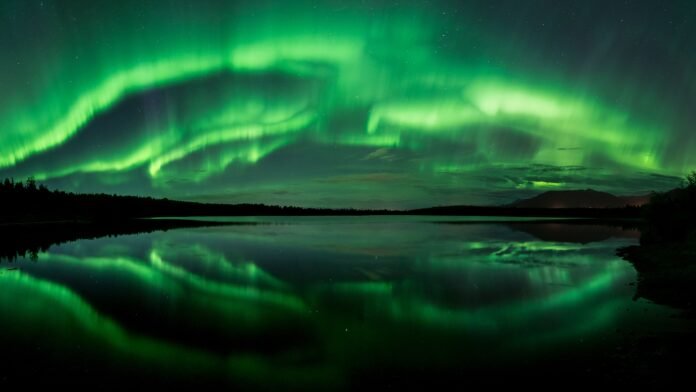

Seeing the northern lights in person is one of those experiences that reorganizes your sense of what the sky can do. Photos are beautiful, but they don’t prepare you for the moment curtains of green and pink actually start rippling and dancing overhead, silent and alive. The good news is that catching them isn’t just luck. With the right timing, the right place, and a little planning, your chances go way up, and 2026 happens to be a genuinely great year to try.
So here’s exactly when, where, and how to see the aurora borealis for yourself.
Why 2026 Is Such a Good Year
The aurora is powered by the Sun, and the Sun runs on an 11-year cycle of activity. Around the peak of that cycle, called solar maximum, the Sun throws out far more charged particles, which means more frequent and more dramatic auroras, sometimes visible much farther south than usual.
We just passed the peak of the current cycle, and here’s the encouraging part, the years right after the peak still deliver well above-average activity. Forecasters expect 2026 and 2027 to keep producing strong, frequent displays, better than almost any stretch in the decade before. In short, if seeing the northern lights is on your list, this is one of the best windows in years to make it happen. The whole show starts with our own star, and if you’re curious about what kind of star drives all this, our piece on what sort of star the Sun actually is is a good starting point.
What the Aurora Actually Is
Before we get to the how, a quick word on the what, because it makes the hunt more meaningful. The aurora appears when charged particles streaming off the Sun, the solar wind, reach Earth and get funneled toward the poles by our planet’s magnetic field. When those particles slam into oxygen and nitrogen high in the atmosphere, they make the gases glow, green and red from oxygen, blues and purples from nitrogen. It’s genuinely space weather that you can see with your own eyes, a ribbon of light lit from the inside by the Sun.
Get to Know the Kp Index
If you take away one piece of jargon, make it this. Every aurora forecast revolves around the Kp index, a scale from 0 to 9 that measures geomagnetic activity. The higher the number, the stronger the aurora and the farther south it can be seen.
Here’s a rough guide to reading it. A Kp of 3 or below means the lights are mostly confined to the far north, places above about 67 degrees latitude like northern Lapland or Alaska. A Kp of 5 or higher signals a geomagnetic storm, when the aurora expands southward and becomes visible across much of Scandinavia, Scotland, and the northern United States. If you ever see a forecast of Kp 7 or above, the advice is simple, go outside immediately regardless of the hour. Free apps and alert services will text you when the Kp climbs into range for your location, which takes most of the guesswork out of it.
When to Look: Season and Time of Night
Two timing factors matter, and getting both right transforms your odds.
For the season, aim for the darker months, roughly September through March. You need genuine darkness, so the summer months near the Arctic Circle are actually useless because the sky never gets dark enough. Many aurora hunters swear by the weeks around the equinoxes, late September and late March, when geomagnetic activity tends to run a little higher.
For the time of night, the sweet spot is generally between 10 p.m. and 2 a.m. local time. Auroras tend to peak around magnetic midnight, when your spot on Earth is best positioned to catch the solar wind. So a dark, clear night in autumn or early spring, watched in those late hours, gives you the best possible shot.
Where to Go: It’s All About Darkness and Facing North
You don’t need a fancy dedicated viewing platform. What you actually need is two simple things, a dark sky and a clear view toward the north.
Get away from city lights, since light pollution washes out all but the strongest displays. A dark field on the edge of a small town beats a famous “viewing spot” in a bright city center every time. Often just driving 10 to 15 minutes out of town to an open area, a frozen lake, a field, a hilltop, makes all the difference. Then face north and give yourself an unobstructed horizon in that direction, because at lower latitudes the aurora often appears as a glow low on the northern skyline rather than directly overhead.
The classic destinations sit under the “auroral oval,” the ring where activity concentrates, think northern Norway, Sweden, Finland, Iceland, Alaska, and northern Canada. But during strong storms, the oval stretches south and brings the lights to places that rarely see them.
A Few Practical Tips for the Night Itself
Check the weather first, because clouds will hide the aurora completely no matter how strong it is. Let your eyes adjust to the dark for a good 20 to 30 minutes, and keep your phone screen off, since bright light resets your night vision instantly. Dress far warmer than you think you need to, aurora season means long, cold, still nights standing around outside, so thermal layers, a hat, and gloves are essential.
And if you want to photograph what you see, a phone in night mode on a small tripod can capture surprising results, often pulling out colors your eyes can barely detect. Just brace it steady for a long exposure. If you want the deeper science of exactly why the sky lights up in those colors, our explainer on what causes the aurora borealis breaks down the physics behind the glow.
Seeing the northern lights takes a bit of effort and a bit of patience, but standing under a sky that’s rippling with silent color is worth every cold minute. Plan around the Sun, the season, and a dark northern horizon, and 2026 might just be your year.
For live forecasts and more detail, check out NOAA’s Space Weather Prediction Center and the Farmers’ Almanac guide to aurora sightings.
If you enjoyed this article, don’t forget to drop us a comment, it really helps support the site, and be sure to check out our other articles because we think you’re going to love them too.