
Try to imagine every grain of sand on every beach on Earth. Now imagine that each one of those grains is actually a galaxy, packed with hundreds of billions of stars of its own. It sounds like something out of science fiction, but that’s roughly the scale astronomers are dealing with when they try to answer a simple sounding question: how many galaxies are actually out there?
The honest answer is that nobody knows for sure. But that doesn’t mean scientists are just shrugging their shoulders. Over the last few decades, telescopes like Hubble and now the James Webb Space Telescope have given us some genuinely mind bending estimates, and the number keeps climbing every time our equipment gets better.
The classic estimate: 100 to 200 billion
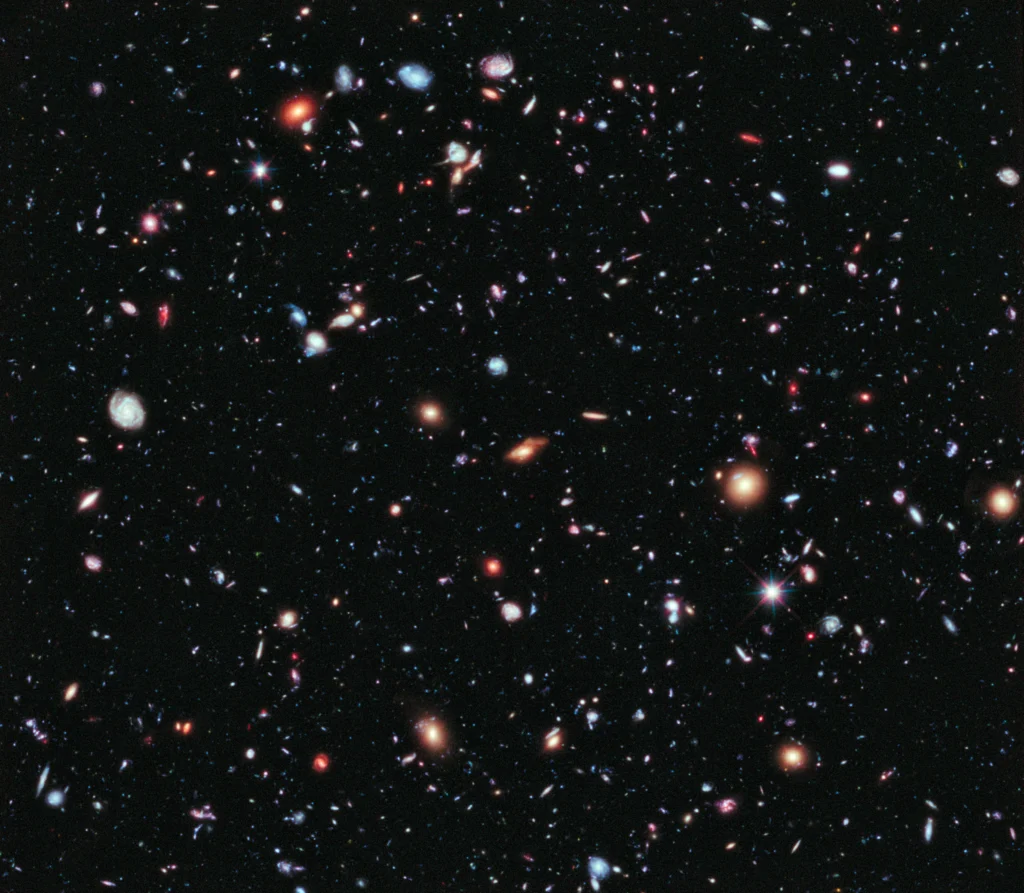
For a long time, the go to number in textbooks and documentaries was somewhere between 100 and 200 billion galaxies in the observable universe. That estimate mostly comes from a landmark study using the Hubble Space Telescope, where astronomers pointed the telescope at a tiny, seemingly empty patch of sky for a very long exposure. That patch turned out to be anything but empty. It was packed with thousands of faint, distant galaxies, each one a whole separate island of stars.
Here’s the trick scientists used. If you take a small patch of sky, count every galaxy visible in it no matter how faint, and then figure out what fraction of the total sky that patch represents, you can scale that number up to estimate a total. When researchers did this using the Hubble eXtreme Deep Field, a spectacularly deep image covering a sliver of the sky the size of a grain of sand held at arm’s length, they counted about 5,500 individual galaxies. Scale that up to cover the entire sky and you land on a figure of roughly 170 billion galaxies. For years, that was considered a solid, defensible lower limit.
Then the number jumped to two trillion
In 2016, a team led by astronomer Christopher Conselice took a closer look at that same kind of deep field data, but this time they factored in something crucial: galaxies that are simply too faint, too small, or too far away for even Hubble to resolve individually. Using computer modeling to account for all those hidden galaxies, their revised estimate came out to a staggering two trillion galaxies in the observable universe. That’s roughly ten times higher than the older estimate, and it made headlines everywhere because it meant our galaxy count had been off by an entire order of magnitude.
It’s worth pausing on why that gap exists. Most of those extra galaxies aren’t full sized spirals like our own Milky Way. Many are small, faint dwarf galaxies from the early universe, the kind that put out relatively little light and are easy to miss unless you’re looking incredibly deep into space and incredibly far back in time.
Enter the James Webb Space Telescope
If Hubble cracked the door open, the James Webb Space Telescope has practically kicked it down. Webb sees in infrared light, which lets it peer through cosmic dust and detect the faint, redshifted glow of galaxies that existed when the universe was less than a billion years old. That capability has already reshaped the conversation around galaxy counts.
One of the most ambitious projects using Webb’s data is called COSMOS-Web, a survey covering a patch of sky larger than three full moons, built from over 200 hours of observing time. The result is a catalog of nearly 800,000 individual galaxies, spanning almost the entire history of the universe. Researchers working on COSMOS-Web found something surprising too: roughly ten times more early galaxies than their models had predicted, suggesting galaxies formed faster and in greater numbers in the young universe than anyone expected.
Scientists have used this same kind of survey data to map something even bigger than individual galaxies, a structure called the cosmic web. Picture a three dimensional net of filaments made of galaxies and dark matter, stretching across unimaginable distances, with vast near empty voids in between. One recent effort placed more than 164,000 galaxies within this filamentary structure, tracing it all the way back to when the universe was barely a billion years old.
Why we may never get an exact number
Even with all this progress, there’s a hard physical limit standing in the way of a truly final answer. We can only observe the part of the universe whose light has had enough time to reach us since the Big Bang. That region is called the observable universe, and it’s estimated to be a sphere roughly 93 billion light years across. Beyond that boundary, there could be more galaxies, endlessly more, but their light simply hasn’t had time to arrive yet, and depending on how the universe is shaped, it may never arrive at all.
There’s also a deeper question lurking underneath all of this. Some cosmological models suggest that the universe as a whole, not just the observable part, might actually be infinite. If that’s true, then in a very real sense, there could be an infinite number of galaxies out there. We would only ever be capable of counting the ones inside our own cosmic horizon.
So what’s the real number?
If you want a single figure to walk away with, somewhere in the range of one to two trillion galaxies in the observable universe is currently the best supported estimate, built on Hubble’s deep field work and refined by newer statistical modeling. But treat that number as a snapshot rather than a final verdict. Every time a more powerful telescope gets pointed at a dark patch of sky, the count tends to go up, not down.
What’s genuinely remarkable is how far this figure has traveled in a single human lifetime. Less than a hundred years ago, many astronomers weren’t even convinced that other galaxies existed beyond our own Milky Way. Now we’re debating whether the true number is measured in the hundreds of billions or the trillions, and even that might turn out to be an undercount. The universe, it turns out, has a habit of being bigger than we think every single time we look a little closer.