
At around 7 p.m. local time on Mars, on a dusty rim overlooking Jezero Crater, a rover pointed its camera up into the twilight sky and watched our entire planet blink out of existence. Not literally, of course, just from where it was standing. But it’s a sentence that had never been true before July 2, 2026, and now it is.
A Point of Light, Swallowed by a Potato
NASA’s Perseverance rover captured the moment using its Mastcam-Z instrument, a sequence of images spanning about 40 seconds that shows Earth as a single pixel-sized dot drifting across the Martian sky, until Phobos, the larger and closer of Mars’s two moons, swept directly in front of it and swallowed it whole. Astronomers call this an occultation, distinct from an eclipse, it happens whenever one object that appears larger from the viewer’s position completely blocks something smaller behind it. “The composite image makes for a unique Earth self-portrait, taken from the surface of another planet, with a Phobos photobomb,” said Justin Maki, Mastcam-Z’s deputy principal investigator at NASA’s Jet Propulsion Laboratory.
At the moment of capture, Earth sat roughly 195 million miles away, reduced to nothing more than a single point of light. Phobos, by contrast, was close enough to look startlingly large in comparison, a lumpy, potato-shaped moon just 17 miles across at its widest, orbiting a mere 4,850 miles above the Martian surface.
Planning, and a Little Luck
Catching this moment wasn’t luck alone, though luck genuinely played a part. “Phobos crosses the Martian sky three times a day, and Earth is visible for months at a stretch, but catching one directly behind the other takes planning and a little luck,” said Mark Lemmon, a Mastcam-Z co-investigator at the Space Science Institute who planned the observation and assembled the final composite. Getting Phobos and a pixel-sized Earth to line up exactly, from exactly where Perseverance happened to be parked, required calculating the timing well in advance and simply hoping the rover’s schedule cooperated.
If you’re curious about the strange little moon that did the photobombing, our full profile of Mars’s size, distance, and orbit covers Phobos and its smaller sibling Deimos in more detail.
A Small Moment With a Big Meaning
Perseverance has captured plenty of Martian sky phenomena before, transits of Phobos and Deimos crossing the Sun’s disk, informally nicknamed Martian solar eclipses. But an occultation of Earth itself, watched from the ground of another planet, had simply never been documented until now. It’s a strange kind of milestone, not a discovery about rock composition or ancient water, just a single, quiet confirmation that our species now has an outpost far enough from home to watch home disappear.
For more on the observation, check out the full release from NASA and additional coverage from Space.com.
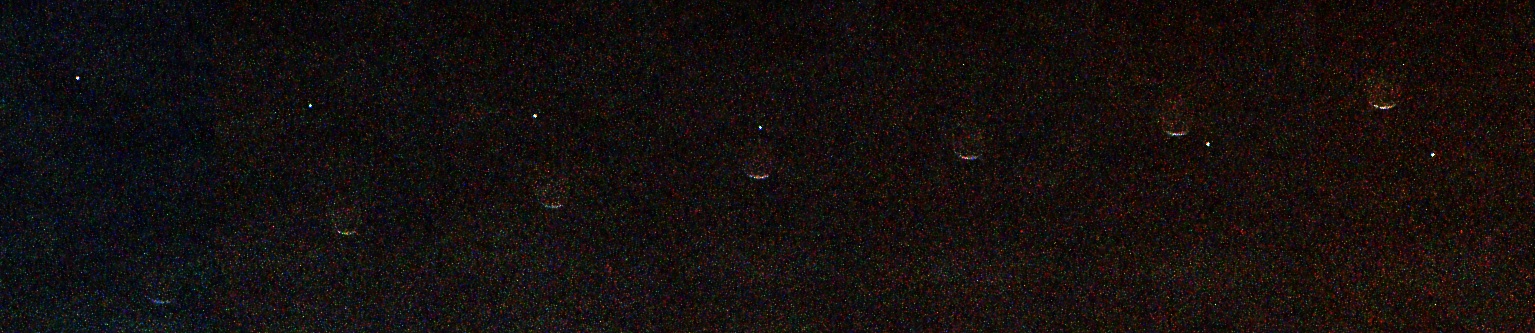 A composite of seven images captured by NASA’s Perseverance rover on July 2, 2026, showing Earth, the small bright dot, passing behind the Martian moon Phobos. (Image: NASA/JPL-Caltech/ASU/MSSS/SSI)