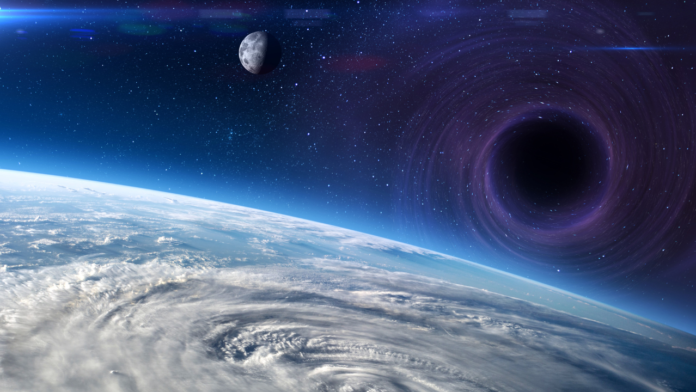

For most of human history, black holes felt like something that only existed in far off corners of the universe, places so distant that they had nothing to do with our little corner of the Milky Way. That changed when a team of astronomers announced they had found earth’s nearest black hole, sitting quietly in our own galactic backyard and hiding in plain sight for who knows how long.
The black hole, now known as Gaia BH1, is located about 1,600 light-years away in the constellation Ophiuchus. To put that in perspective, thats close enough in cosmic terms that scientists have started calling it our “neighbor,” even though 1,600 light-years is still an almost unimaginable distance by human standards. Before this discovery, the closest known black hole to Earth was three times farther away, an X-ray binary sitting out in the constellation Monoceros. Gaia BH1 blew that record out of the water.
How Do You Find a Black Hole You Can’t See?
Here’s the tricky part about black holes, they don’t give off light, so you can’t just point a telescope at one and snap a photo. Researchers had to get clever about it. They used data from the European Space Agency’s Gaia spacecraft, which spends its time tracking the precise movements of over a billion stars across the sky. While combing through that data, scientists noticed something odd about a Sun like star in Ophiuchus. It was wobbling.
That wobble was the giveaway. A star doesn’t just wobble on its own, something has to be tugging on it gravitationally. After follow up observations using the Magellan Baade telescope in Chile and instruments at the Gemini and Keck Observatories, astronomers confirmed the star was locked in orbit around something massive and completely invisible. That invisible object turned out to be a black hole weighing about 10 times the mass of our Sun.
What made this discovery even stranger is how the two objects are arranged. The star orbits its black hole companion at roughly the same distance Earth orbits the Sun, which is unusual for a system like this. Most black holes that formed alongside a companion star end up in tight, close orbits because of the violent process that created them. Gaia BH1 broke the mold, and honestly, scientists are still trying to figure out exactly how a system like this even forms without the star getting swallowed up in the process.
Should You Be Worried?
Short answer, not even a little bit. Even though it holds the title of earth’s nearest black hole, Gaia BH1 is dormant, meaning it isn’t actively pulling in and devouring nearby matter the way black holes are often shown doing in movies. It’s also 1,600 light-years away, a distance so large that nothing happening around it could ever reach us. For reference, that’s thousands of times farther than anything humans have ever traveled, and light itself takes 1,600 years just to cross the gap between us and it.
If you’re curious just how strange the physics gets near an object like this, it’s worth playing around with a black hole time dilation calculator to see how time would behave if you got close enough. It’s a fun way to wrap your head around just how weird gravity gets once you’re near something this massive.
Why This Discovery Matters
Scientists estimate there could be somewhere between 100 million and a billion black holes scattered across the Milky Way, most of them completely undetected because, again, they don’t emit light. Finding Gaia BH1 proves that the method of watching for a wobbling star actually works, and it opens the door to finding a lot more of these hidden objects hiding among the stars we already know.
It also ties into one of the bigger mysteries in astronomy, the search for dark matter, since some scientists have wondered whether a hidden population of black holes could account for at least part of what we can’t otherwise explain in the universe. Gaia BH1 isn’t the answer to that mystery on its own, but every dormant black hole we find teaches us a little more about what’s really out there.
For anyone who wants to dig into the technical side, the original research on Gaia BH1 was published by a team including astronomer Kareem El-Badry, and you can read more about the methodology directly from the Harvard-Smithsonian Center for Astrophysics and the European Space Agency.
So next time you look up at the night sky and try to spot Ophiuchus, know that somewhere out there, quietly orbiting a Sun like star, sits earth’s nearest black hole, a reminder that the universe still has plenty of secrets hiding closer to home than we ever expected.
If you enjoyed this article, don’t forget to drop us a comment, it really helps support the site, and be sure to check out our other articles because we think you’re going to love them too.