
Meta Information
SEO Title: Why Do Some Planets Have More Moons Than Others? Exploring Planetary Satellites
Meta Title: Why Do Some Planets Have More Moons Than Others?
Meta Description: Discover why giant planets have dozens of moons while others have only a few. Learn how gravity, planetary formation, and cosmic collisions shape the fascinating world of natural satellites.
Slug: why-do-some-planets-have-more-moons-than-others
Focus Keyword: Why do some planets have more moons than others
Category: Planets & Solar System
Tags: Moons, Natural Satellites, Solar System, Jupiter, Saturn, Planetary Science, Planet Formation, Gravity, Astronomy, Space Exploration
Why Do Some Planets Have More Moons Than Others?
Have you ever wondered why Earth has just one Moon while Saturn has hundreds of known moons? At first glance, it might seem like pure chance. In reality, the number of moons orbiting a planet depends on a fascinating combination of gravity, planetary formation, cosmic collisions, and billions of years of Solar System evolution.
Scientists continue to discover new moons around the giant planets, revealing that our Solar System is far more dynamic than once believed. Understanding why some planets collect large families of moons while others barely have any offers valuable insights into how planets themselves formed and evolved.
What Is a Moon?
A moon, also called a natural satellite, is an object that orbits a planet or another larger body under the influence of gravity. Moons come in many sizes and compositions.
Some are rocky worlds with mountains and valleys, while others are icy bodies hiding vast underground oceans. A few are even larger than the planet Mercury.
Today, every major planet in our Solar System except Mercury and Venus has at least one known moon.
The Current Moon Count
As astronomers continue making discoveries, the number of known moons changes over time. Giant planets dominate the list.
- Mercury: 0
- Venus: 0
- Earth: 1
- Mars: 2
- Jupiter: More than 90 confirmed moons
- Saturn: More than 140 confirmed moons
- Uranus: More than 25 moons
- Neptune: More than a dozen moons
These totals continue to grow as improved telescopes detect smaller and more distant satellites.
Gravity Is the Biggest Factor
The most important reason some planets have many moons is gravity.
Large planets possess much stronger gravitational fields than smaller planets. This allows them to:
- Capture passing asteroids
- Hold onto moons over billions of years
- Maintain stable orbits for many satellites at different distances
Gas giants like Jupiter and Saturn are hundreds of times more massive than Earth, giving them enormous gravitational influence throughout their surrounding space.
Smaller planets simply cannot retain large numbers of natural satellites as easily.
How Planets Formed Matters
The early Solar System was a chaotic place filled with gas, dust, and countless rocky objects.
The giant planets formed beyond the “snow line,” where temperatures were low enough for water ice and other frozen materials to accumulate. This allowed them to grow rapidly into massive worlds.
As these planets grew, they were surrounded by disks of gas and debris, similar to a miniature version of the disk that formed the Sun.
Many scientists believe numerous regular moons formed directly inside these circumplanetary disks, much like planets formed around the Sun.
This explains why many of Jupiter’s and Saturn’s largest moons travel in nearly circular orbits close to the planet’s equator.
Captured Moons
Not every moon formed alongside its planet.
Some began life as independent asteroids or objects from the outer Solar System before being captured by a planet’s gravity.
Captured moons often have unusual characteristics:
- Highly tilted orbits
- Very elongated paths
- Retrograde motion, meaning they orbit opposite the planet’s rotation
Many of the small, distant moons surrounding Jupiter and Saturn are believed to be captured objects rather than moons that formed with the planets.
Giant Collisions Can Create Moons
Sometimes moons form after catastrophic impacts.
Earth’s Moon is the best-known example.
According to the widely accepted Giant Impact Hypothesis, a Mars-sized object collided with the young Earth around 4.5 billion years ago. Debris from the impact eventually gathered together under gravity to form the Moon.
This model is supported by multiple lines of evidence, including similarities between Earth rocks and lunar samples returned by the Apollo missions, although researchers continue refining details of the impact and subsequent formation process.
Mars may also have acquired its tiny moons, Phobos and Deimos, through either capture or debris generated by ancient impacts. Their exact origin remains an active area of scientific research.
Why Mercury and Venus Have No Moons
Mercury and Venus are unusual because neither planet has a natural satellite.
Scientists think several factors contributed.
Mercury
Mercury orbits very close to the Sun.
The Sun’s strong gravitational pull makes it difficult for Mercury to capture or retain moons over long periods.
Venus
Venus presents a greater mystery.
Some models suggest it may once have had a moon that was eventually lost due to complex gravitational interactions with the Sun.
Others propose that giant impacts either never produced a stable moon or caused any early moon to spiral back into the planet.
At present, there is no definitive answer, and researchers continue investigating Venus’s early history.
Why Jupiter and Saturn Have So Many Moons
Jupiter and Saturn combine nearly every advantage for moon formation.
Enormous Gravity
Their tremendous mass allows them to attract and hold many objects.
Large Regions of Gravitational Control
Each planet dominates an enormous region known as its Hill sphere, where its gravity outweighs the Sun’s influence enough for satellites to remain in stable orbits.
Formation Disks
Both planets likely formed with large disks of gas and dust that produced multiple regular moons.
Captured Objects
Over billions of years, they also captured numerous asteroids and icy bodies that became irregular moons.
The result is a rich and diverse collection of satellites, ranging from tiny kilometer-sized rocks to worlds larger than Mercury.
Not All Moons Are the Same
The Solar System contains an astonishing variety of moons.
Examples include:
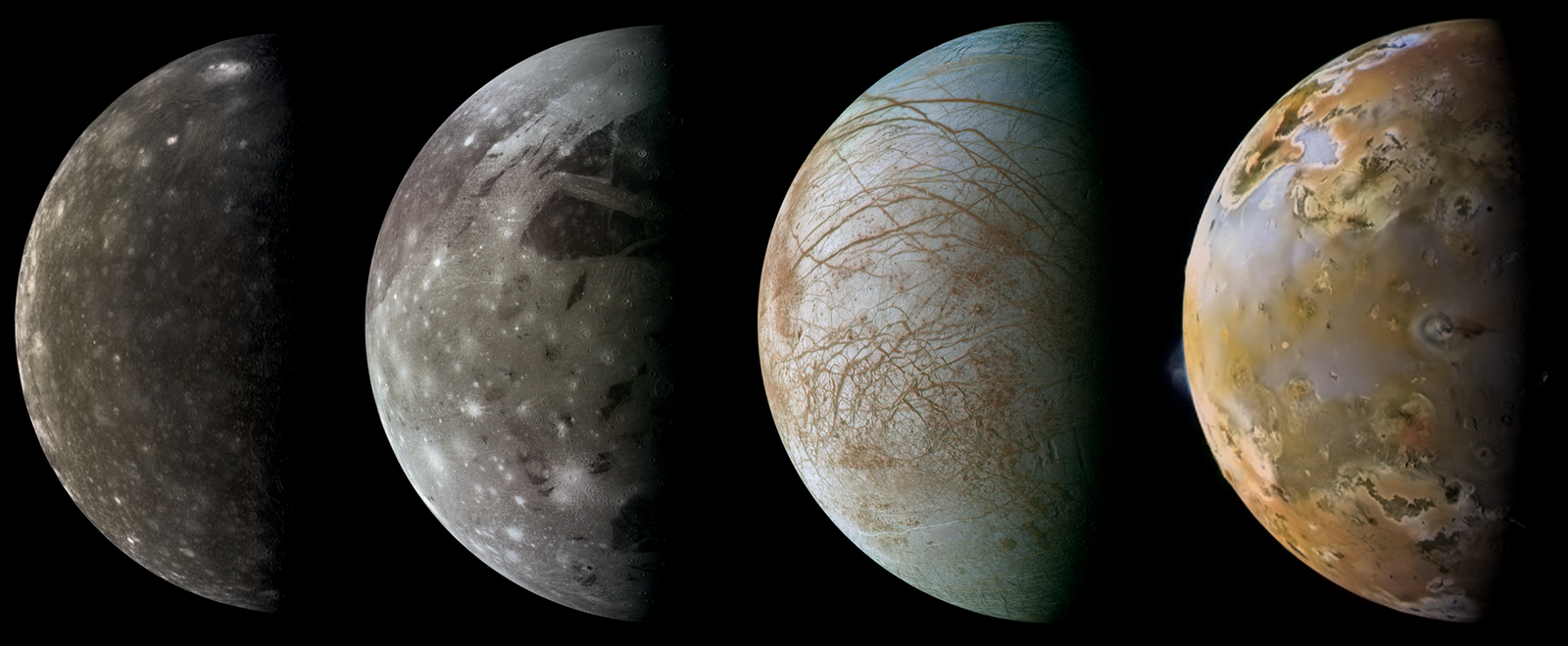
- Europa, which likely hides a global ocean beneath its icy crust.
- Titan, Saturn’s largest moon, with lakes and rivers of liquid methane and ethane.
- Io, the most volcanically active world known.
- Enceladus, which ejects towering plumes of water vapor and ice from beneath its frozen surface.
These worlds have become prime targets for current and future exploration because some may offer environments capable of supporting simple microbial life.
Scientists Keep Discovering New Moons
Advances in telescope technology have dramatically increased the number of known moons.
Modern observatories equipped with sensitive digital detectors can identify extremely faint objects orbiting the giant planets. Follow-up observations are required before astronomers can confirm that these objects are genuine moons rather than passing asteroids.
As observation techniques improve, the official moon counts for the outer planets will likely continue to increase.
Why Moon Counts Matter
Counting moons is more than an interesting statistic.
Every newly discovered moon helps scientists better understand:
- Planet formation
- Gravitational interactions
- The history of collisions in the Solar System
- How planets capture passing objects
- The evolution of planetary systems around other stars
Studying moons also helps researchers search for potentially habitable environments beyond Earth.
Conclusion
The number of moons surrounding a planet is determined by a combination of mass, gravity, formation history, and billions of years of cosmic evolution. Giant planets like Jupiter and Saturn became natural collectors of satellites thanks to their enormous gravitational influence and the conditions under which they formed. Smaller worlds such as Earth and Mars retained only a handful, while Mercury and Venus ended up with none.
As astronomers continue discovering new moons and sending spacecraft to study them up close, these fascinating worlds are revealing important clues about the origins of our Solar System—and perhaps even the conditions needed for life elsewhere in the universe.
SEO FAQs
1. Why does Saturn have more moons than Earth?
Saturn’s immense gravity, large Hill sphere, and history of capturing objects allow it to retain far more moons than Earth.
2. Which planet has the most moons?
Based on current confirmed discoveries, Saturn has the largest known number of natural satellites, although counts continue to change as new moons are confirmed.
3. Why don’t Mercury and Venus have moons?
Mercury’s proximity to the Sun makes stable moon orbits difficult, while Venus’s lack of a moon remains an active area of scientific research.
4. Can planets gain new moons?
Yes. Planets can capture passing asteroids or other objects if conditions allow, although such events are relatively uncommon.
5. Are all moons formed the same way?
No. Some formed alongside their planets, others were captured later, and some likely formed from debris created by giant impacts.