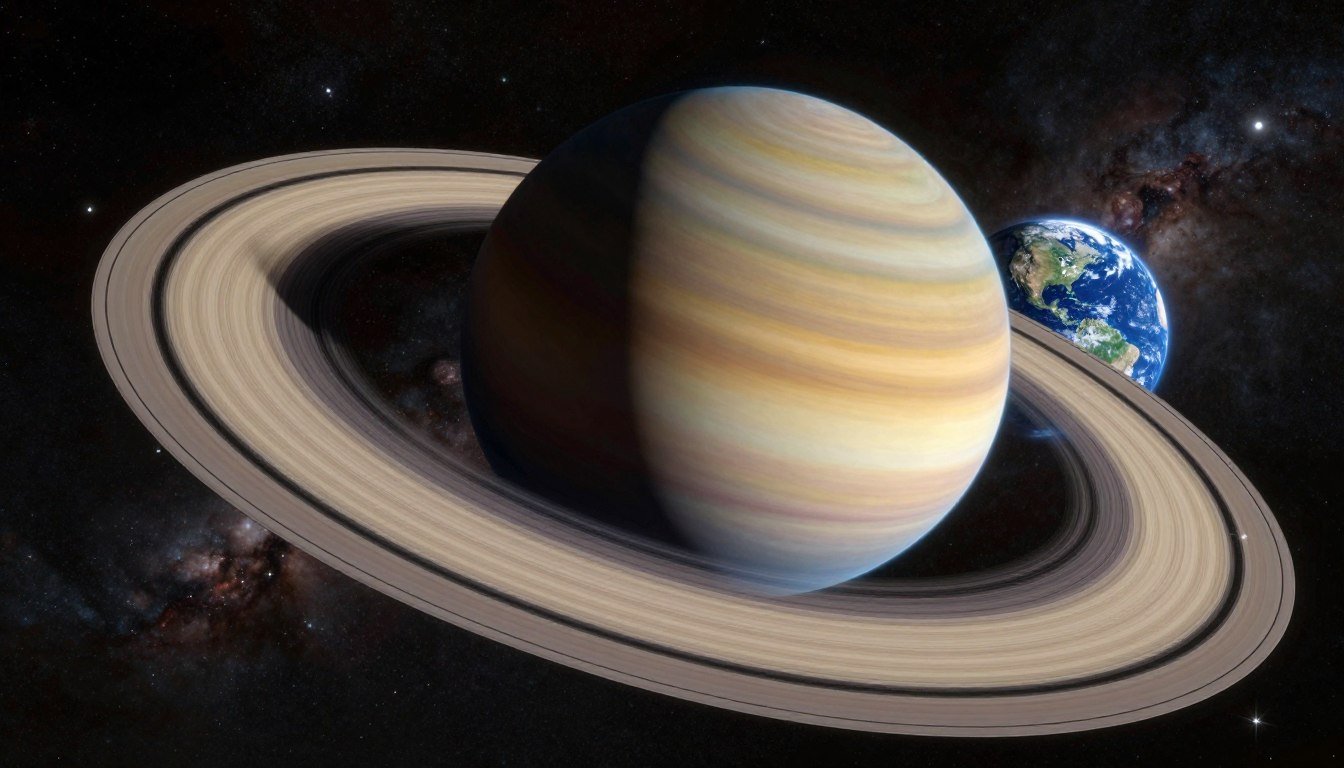

Have you ever gazed at the night sky and wondered about the majestic beauty of our solar system? Many people ask, why does saturn have rings but earth doesn’t, when looking at telescope images. It is a mystery that highlights the incredible diversity of our cosmic neighborhood.
Planetary science reveals that our home world and its gas giant neighbor formed under very different conditions. Gravity, distance from the sun, and material composition all play vital roles in shaping these celestial bodies. Understanding these factors helps us appreciate the unique history of our own planet.
We will explore the gravitational forces and environmental dynamics that dictate the presence of these iconic features. Join us as we uncover the secrets behind these planetary structures and learn what makes each world truly special.
Key Takeaways
- Planetary formation depends on distance from the sun.
- Gravity plays a major role in capturing debris.
- Gas giants possess different materials than rocky planets.
- Orbital mechanics influence the stability of orbiting matter.
- Each planet in our system tells a unique evolutionary story.
The Cosmic Mystery of Planetary Rings
For centuries, the sight of planetary rings has captivated the human imagination and challenged our understanding of the cosmos. When early astronomers first turned their primitive telescopes toward the night sky, they were met with a sight that defied their expectations of the heavens. These structures, once thought to be a unique feature of Saturn, sparked intense debate and curiosity among the greatest scientific minds of the era.

As technology advanced, the mystery deepened. Astronomers eventually realized that these beautiful, swirling bands were not exclusive to one planet. We now know that all the gas giants in our solar system possess some form of ring system. This discovery shifted our perspective, turning a singular curiosity into a broader study of planetary formation and orbital dynamics.
Despite our progress, the question of why some planets retain these rings while others do not remains a significant puzzle. Scientists continue to analyze the delicate balance of gravity and debris that keeps these systems intact. The following table highlights the presence of ring systems across our neighboring planets:
| Planet | Ring System Status | Primary Composition |
|---|---|---|
| Jupiter | Faint/Dusty | Rock and Dust |
| Saturn | Extensive/Bright | Water Ice |
| Uranus | Dark/Narrow | Organic Material |
| Neptune | Fragmented/Thin | Ice and Dust |
This ongoing scientific mystery serves as a reminder of how much we still have to learn about our celestial neighborhood. By comparing these diverse environments, researchers hope to uncover the specific conditions required for rings to form and persist over millions of years.
Why Does Saturn Have Rings But Earth Doesn’t?
When we look at the vastness of space, we naturally ask why does saturn have rings but earth doesn’t. The answer lies in the fundamental differences between a massive gas giant and a smaller, rocky terrestrial planet like our own home.
Saturn possesses an immense gravitational pull due to its sheer size and mass. This colossal gravity allows the planet to capture and hold onto vast amounts of debris, such as ice and rock, within its orbit. These materials are trapped in a delicate balance, forming the iconic rings we see today.

In contrast, Earth is a much smaller terrestrial world. Because of our lower mass, we lack the gravitational strength required to maintain a permanent ring system. Many people wonder why does saturn have rings but earth doesn’t, and the answer often points to the concept of the Roche limit.
The Roche limit is the distance within which a celestial body, held together only by its own gravity, will disintegrate due to a second celestial body’s tidal forces. Saturn’s massive size creates a wide zone where these forces can effectively manage ring material. Earth simply does not have the reach or the debris supply to sustain such a structure.
To better understand these differences, consider the following factors that influence planetary rings:
- Planetary Mass: Gas giants have the gravity to hold onto distant particles.
- Proximity to Debris: Saturn sits in a region of space rich with icy remnants.
- Roche Limit Dynamics: The ability to keep material from forming into moons is crucial.
Ultimately, the reason why does saturn have rings but earth doesn’t is a matter of cosmic scale. While Earth is perfect for life, it lacks the specific conditions needed to host a ring system.
The Composition and Structure of Saturn’s Rings
When we analyze the saturn rings composition, we uncover a vast, swirling collection of material that spans thousands of miles. These rings are not solid structures, but rather a dynamic swarm of billions of individual particles. Each piece follows its own orbital path around the giant planet.

Ice, Dust, and Rock Particles
The primary material found within these rings is water ice. This high concentration of ice explains why the rings appear so bright and reflective when viewed through a telescope. Alongside the ice, scientists have identified varying amounts of rocky material and dark dust grains.
The size of these particles varies significantly, ranging from tiny specks of dust to massive boulders the size of a house. This diversity in size and material creates the complex patterns we observe from Earth. The following table highlights the key characteristics of these ring components:
| Component Type | Primary Material | Reflectivity |
|---|---|---|
| Fine Dust | Silicates/Carbon | Low |
| Small Particles | Water Ice | High |
| Large Boulders | Ice and Rock | Moderate |
The Role of Shepherd Moons
Maintaining such an organized structure in space requires a delicate gravitational balance. This is where shepherd moons play a vital role in the system. These small satellites orbit near the edges of the rings, using their gravity to nudge stray particles back into place.
By acting as gravitational anchors, these moons prevent the ring material from drifting away into space. They effectively carve out gaps and maintain sharp, defined edges within the rings. Without these celestial guardians, the rings would likely disperse and lose their iconic, structured appearance over time.
How Planetary Rings Form in the Solar System
The creation of a ring system is often a story of destruction rather than construction. While we often view the cosmos as a place of steady orbits, planetary ring formation is actually a violent process. It occurs when the delicate balance of gravity is disrupted, leading to the dramatic dismantling of celestial bodies.
The Roche Limit Explained
At the heart of this process lies a critical scientific concept known as the Roche limit. This is the specific distance from a planet where the gravitational pull on the near side of an orbiting object is significantly stronger than on the far side. If a moon or asteroid wanders inside this invisible boundary, the planet’s intense tidal forces begin to overwhelm the object’s own gravity.
Once an object crosses this threshold, it can no longer hold itself together. The internal structural integrity of the moon fails, causing it to stretch and eventually shatter into countless pieces. This is a fundamental aspect of planetary ring formation that explains why many large planets possess these stunning, dusty halos.
Tidal Forces and Celestial Debris
After the initial breakup, the remnants of the destroyed moon do not simply drift away into deep space. Instead, these fragments are pulled into orbit around the planet, spreading out to form a flat, rotating disk. This collection of ice, rock, and dust becomes the material we recognize as a ring system.
The interaction between these tidal forces and the resulting debris is a constant, dynamic dance. Over time, collisions between these particles further grind them down, maintaining the structure of the rings. Understanding this cycle of planetary ring formation allows astronomers to visualize the often destructive history that shapes our vast and beautiful solar neighborhood.
Why Earth Lacks a Ring System
While gas giants boast spectacular rings, Earth remains noticeably bare in the cosmic neighborhood. Many people often ask about the earth ring absence reason when comparing our world to the majestic Saturn. The truth lies in a combination of gravitational forces and the specific history of our solar system.
The Absence of Sufficient Debris
For a planet to develop rings, it needs a steady supply of material, such as icy moons or rocky debris. Earth simply lacks the necessary raw materials in its immediate orbit to form such a structure. Most of the debris that could have formed a ring was likely swept up during the early stages of planetary formation.
Furthermore, the presence of our large Moon acts as a gravitational anchor. It tends to clear out or destabilize potential ring material that might otherwise settle into a stable orbit. This unique lunar influence is a major factor in the terrestrial planets ring absence observed in our inner solar system.
Atmospheric and Orbital Dynamics
Even if debris were present, Earth’s environment is quite hostile to long-term ring stability. Our planet possesses a thick, active atmosphere that creates significant drag on orbiting particles. This drag causes small pieces of rock or ice to lose velocity and eventually spiral down into the atmosphere, where they burn up as meteors.
Several key factors prevent the accumulation of ring material around Earth:
- Atmospheric Drag: Friction slows down particles, causing them to decay from orbit.
- Lunar Gravity: The Moon’s strong gravitational pull disrupts potential ring formation.
- Solar Wind: High-energy particles from the Sun can push away smaller, lighter debris.
- Lack of Captured Moons: Earth does not have the right conditions to capture and shatter moons into ring material.
Ultimately, the combination of these physical constraints ensures that our planet remains ring-free. While we might envy the beauty of Saturn, Earth’s current orbital state is perfectly balanced for life as we know it.
Comparing Gas Giants and Terrestrial Planets
The architecture of our solar system reveals a stark divide between the massive gas giants and the smaller, rocky worlds. This structural difference explains why gas giants ring presence is a common feature in the outer reaches of our neighborhood, while inner planets remain largely barren.
Gravity and Mass Differences
The sheer scale of gas giants provides them with an immense gravitational reach. This powerful pull allows these planets to capture and maintain vast amounts of icy debris and rock particles in stable orbits.
In contrast, terrestrial planets possess significantly less mass and weaker gravitational fields. When we analyze saturn vs. earth rings, it becomes clear that Earth lacks the gravitational “anchor” needed to hold onto a complex system of orbiting material over geological timescales.
The Influence of Solar Wind
Beyond gravity, the proximity of a planet to the Sun plays a critical role in its ability to host rings. Terrestrial planets are much closer to the Sun, where the solar wind is far more intense and energetic.
This constant stream of charged particles acts like a cosmic broom, sweeping away loose dust and gas that might otherwise form a ring. Because gas giants reside in the colder, outer solar system, they are shielded from these harsh effects, allowing their rings to persist for millions of years.
Ultimately, the gas giants ring presence is a result of both their massive size and their distant, protected location. While Earth might have had temporary debris in its past, the combination of solar wind and lower gravity makes a permanent ring system nearly impossible.
The History of Saturn’s Ring Formation
When we study astronomical ring origins, we uncover a history of cosmic destruction and renewal. The solar system is a violent, active place where celestial bodies frequently interact through gravity and impact. Saturn’s rings are not static monuments; they are the result of complex events that occurred over millions of years.
Ancient Collisions and Captured Moons
Many scientists believe that the rings formed from the debris of moons that wandered too close to the planet. When a moon crosses the Roche limit, the tidal forces of the gas giant become stronger than the moon’s own gravity. This process effectively shreds the moon into countless pieces of ice and rock.
Beyond simple tidal destruction, other theories suggest that massive collisions played a major role. These events likely involved:
- Captured objects from the outer solar system colliding with existing moons.
- Large-scale impacts that pulverized icy satellites into fine dust.
- The gradual accumulation of debris from passing comets and asteroids.
The Temporary Nature of Ring Systems
It is important to recognize that ring systems are likely transient features on a cosmic timescale. While they appear permanent to us, they are constantly evolving, spreading out, and losing material to the planet’s atmosphere. This means that Saturn may not have always had its iconic rings, and it might not have them forever.
The material within the rings is constantly being recycled or lost. As particles collide and drift, the rings slowly dissipate or change their density. This perspective reminds us that the solar system is a dynamic environment where structures are created and destroyed in a continuous cycle of change.
Could Earth Have Ever Had Rings?
The history of Earth is written in its rocks, but could that story include a temporary ring system? While we often look to the gas giants for inspiration, our own planet may have experienced similar phenomena during its violent youth. Scientists continue to explore whether massive impacts could have briefly surrounded our world with a halo of debris.
Geological Evidence and Ancient Impacts
Massive asteroid impacts are known to eject vast amounts of material into space. If an impact is powerful enough, some of this debris might enter a stable orbit rather than falling back to the surface immediately. Geological evidence, such as specific crater patterns and unusual sediment layers, provides clues about these high-energy events.
Researchers analyze these debris fields to understand the scale of ancient collisions. If a significant amount of rock and ice was launched into orbit, it could have formed a temporary ring around the planet. These structures would have been short-lived, eventually succumbing to atmospheric drag or gravitational perturbations.
The Possibility of Future Ring Formation
Could such a spectacle happen again in the future? While the likelihood of a massive impact is low, it remains a theoretical possibility within the context of solar system dynamics. A sufficiently large collision could once again create a temporary ring system, changing the appearance of our night sky for a brief period.
These rings would not be permanent, as Earth’s proximity to the sun and its dense atmosphere would eventually pull the material down. Thinking about our planet’s future in this way helps us appreciate the dynamic nature of our solar system. It reminds us that Earth is not a static object, but a world shaped by constant interaction with the cosmos.
The Role of Gravity in Maintaining Ring Stability
The architecture of a ring system is far more complex than a simple collection of orbiting debris. Understanding why planetary ring systems differ requires a deep look at the gravitational mechanics at play around massive gas giants. These structures rely on a delicate balance of forces to prevent particles from drifting into space or crashing into the planet.
Orbital Resonance and Ring Gaps
One of the most fascinating aspects of Saturn’s rings is the presence of distinct gaps, such as the famous Cassini Division. These empty spaces are not truly empty; they are the result of gravitational interactions between the ring particles and Saturn’s moons. When a moon’s orbital period shares a simple mathematical ratio with the particles in the ring, a phenomenon known as orbital resonance occurs.
This resonance acts like a rhythmic push, repeatedly tugging on the particles at the same location. Over time, this gravitational influence clears out the material, creating the sharp, clean gaps we observe from Earth. It is a perfect example of how gravity acts as an invisible sculptor in the vacuum of space.
How Saturn Keeps Its Rings Organized
Beyond the gaps, Saturn maintains the overall structure of its rings through the presence of shepherd moons. These small satellites orbit near the edges of the rings, using their own gravity to nudge stray particles back into the main stream. This constant correction ensures that the rings remain tightly defined rather than spreading out into a thin, invisible haze.
The stability of these rings depends on several key factors that keep the system in check:
- Gravitational Tethering: Saturn’s immense mass keeps the particles locked in a stable orbital plane.
- Shepherd Moons: These bodies act as gravitational “policemen” that confine ring edges.
- Resonance Patterns: Periodic gravitational nudges from larger moons maintain the structural gaps.
- Tidal Balance: The distance from the planet prevents particles from clumping together into larger moons.
Without these precise gravitational interactions, the rings would eventually disperse or collapse. The longevity of these structures is a testament to the remarkable precision of orbital mechanics. It is this unique gravitational environment that allows Saturn to maintain such a massive and iconic feature for millions of years.
Observing Planetary Rings from Earth
Our ability to study comparative planetary rings has transformed significantly over the last few centuries. What began as blurry, confusing shapes in early lenses has evolved into a precise science. We now possess the tools to map these celestial structures with incredible detail.
The Evolution of Telescopic Discovery
When Galileo Galilei first turned his primitive telescope toward Saturn in 1610, he was baffled by what he saw. He famously described the planet as having “ears” because his equipment could not resolve the thin, flat structures we now recognize as rings. It took decades of improved optics for astronomers like Christiaan Huygens to correctly identify these features as a distinct ring system.
As technology advanced, our understanding of these distant objects grew alongside our hardware. We moved from simple sketches to high-resolution photography, allowing us to distinguish between the major gaps and divisions within the rings. This progress laid the groundwork for the comparative planetary rings research that defines modern astronomy today.
What Modern Space Missions Have Taught Us
The era of space probes completely revolutionized our perspective on ring dynamics. Missions like Cassini provided us with close-range data that ground-based telescopes could never capture. By flying directly through or near these systems, probes have sent back invaluable information about their composition and age.
We have learned that these rings are not solid, uniform structures but are instead composed of billions of individual particles. These particles range from tiny grains of dust to massive chunks of ice. Key takeaways from these missions include:
- Dynamic Composition: Rings are primarily made of water ice, dust, and rocky debris.
- Shepherd Moons: Small moons play a vital role in maintaining the sharp edges of ring gaps.
- Constant Change: Ring systems are temporary features that evolve through collisions and gravitational interactions.
By analyzing this data, scientists can perform a comparative planetary rings analysis to see how different environments shape these systems. We are no longer just guessing what lies in the outer solar system. Instead, we are actively deciphering the complex history of our cosmic neighborhood through the lens of modern exploration.
Conclusion
Saturn stands out in our night sky because of its brilliant ring system. This feature relies on the massive gravity and specific orbital dynamics of a gas giant. Earth lacks these icy bands because our planet sits closer to the Sun and possesses a different mass profile.
Our home planet tells a unique story through its geological record and atmospheric evolution. While we do not have rings, the history of Earth remains just as complex and captivating as the outer planets. Every celestial body follows a distinct path shaped by the forces of space.
Understanding these differences helps us appreciate the diversity found within the solar system. NASA missions continue to provide data that reveals the secrets of planetary formation. Keep looking up at the stars to discover more about the wonders of our cosmic neighborhood.
FAQ
Why does Saturn have rings but Earth doesn’t?
The main reason comes down to mass and gravity. Saturn is a massive gas giant with a gravitational pull strong enough to capture and hold onto vast amounts of debris. In contrast, Earth is a smaller terrestrial planet with much weaker gravity, making it difficult to maintain a permanent ring system. Additionally, Saturn’s position in the cold outer solar system allows water ice—the primary component of its rings—to remain stable, whereas it would sublimate or melt closer to the Sun near Earth.
What is the primary Saturn rings composition?
Saturn’s rings are remarkably bright because they are composed of about 99.9% pure water ice mixed with a tiny bit of rocky dust. These particles range in size from microscopic grains to boulders as large as mountains. This composition was studied in incredible detail by NASA’s Cassini spacecraft, which provided insights into how these icy particles collide and interact within the ring plane.
How does the Roche limit affect planetary ring formation?
The Roche limit is the critical distance from a planet where its tidal forces are stronger than the gravity holding a satellite (like a moon) together. If a moon or asteroid wanders inside this limit, it is torn apart into billions of pieces. These fragments then spread out to form a ring. This is the fundamental process behind most astronomical ring origins in our solar system.
What is the most significant earth ring absence reason?
Beyond our smaller size, Earth’s atmospheric drag plays a huge role. Any small particles orbiting Earth at a low altitude would eventually collide with our atmosphere, slow down, and burn up. Furthermore, the gravitational influence of our large Moon tends to destabilize potential ring material, “cleaning up” the space around our planet and preventing the accumulation of debris.
Why is gas giants ring presence more common than rings around terrestrial planets?
When we look at comparative planetary rings, we see that all four gas giants—Jupiter, Saturn, Uranus, and Neptune—possess ring systems. This is because gas giants ring presence is favored by their immense mass and their distance from the Sun. Being far from the Sun protects ring material from the stripping effects of solar wind, which is much stronger near terrestrial planets, contributing to the general terrestrial planets ring absence.
How do planetary ring systems differ across the solar system?
While Saturn has the most visible and spectacular rings, other planets have very different structures. For example, Jupiter’s rings are dark and made of dust, while Uranus has narrow, dark rings likely made of organic material. These planetary ring systems differ based on the type of debris available and the specific gravitational interactions with nearby “shepherd moons” that keep the rings organized.
Could Earth have ever had a ring system in the past?
It is highly likely! Many scientists believe that when a Mars-sized object named Theia collided with the early Earth, a massive debris ring formed around our planet. Most of that material eventually coalesced to form our Moon, but for a brief geological period, Earth would have looked quite similar to a ringed planet. Exploring saturn vs. earth rings history shows that while rings are temporary on a cosmic scale, they can define a planet’s appearance for millions of years.
What role do shepherd moons play in Saturn’s rings?
Shepherd moons, such as Prometheus and Pandora, act as gravitational anchors. They orbit near the edges of certain rings and use their gravity to “herd” ring particles back into place, preventing them from drifting away. This delicate gravitational dance is what creates the sharp edges and complex gaps, like the Cassini Division, that we observe through telescopes today.