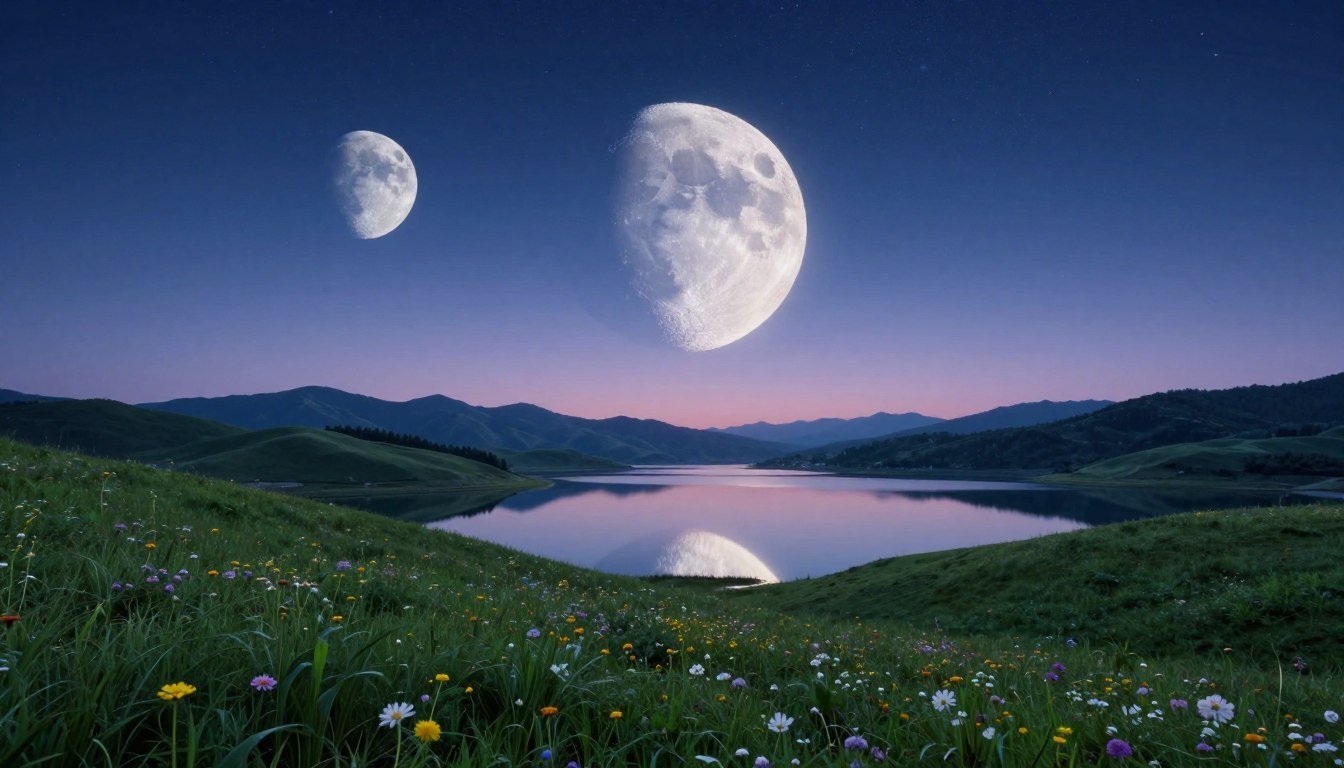

Imagine stepping outside on a crisp autumn evening. Look up and see a second glowing orb in the sky. For centuries, we’ve looked at our single moon with wonder. But adding a companion to our orbit changes everything.
This thought experiment makes us rethink the balance that keeps our world stable. It’s a delicate dance of gravity that sustains us.
What would happen if earth had two moons? The effects go beyond just looks. It would change our tides, climate, and night sky forever. By exploring this idea, we learn more about the balance that makes our planet liveable.
Key Takeaways
- A secondary satellite would drastically amplify tidal forces, leading to massive coastal changes.
- The gravitational interaction between multiple bodies could destabilize existing orbital paths.
- Climate stability might suffer as the extra light and gravity influence atmospheric circulation.
- Our night sky would become significantly brighter, impacting nocturnal wildlife and human sleep cycles.
- This scenario serves as a vital lesson in the fragility of our current planetary environment.
The Mechanics of a Two-Moon System
Looking into a hypothetical two moons earth scenario shows us the complex dance of celestial mechanics. Our planet is stable with one moon, but adding a second moon brings big gravitational challenges. Scientists must figure out how these objects can interact without causing harm or losing their orbits.

Orbital Dynamics and Stability
To keep things stable, both moons must follow specific paths to avoid crashing into each other. One way to solve this is by using Lagrange points. These are spots in space where the gravity of two big masses cancels out. Moons in these spots could orbit Earth for millions of years.
But, making this work is very hard. For long-term stability, we need:
- Orbital Resonance: The moons’ orbits must be in simple ratios to avoid gravitational problems.
- Mass Distribution: The moons must be small to avoid messing with Earth’s rotation.
- Distance Management: There must be enough space between the moons to avoid too much gravitational pull.
Gravitational Interactions Between Moons
In a hypothetical two moons earth scenario, there’s a constant tug-of-war between the moons. If one moon is much bigger, it could kick the smaller one out of orbit or make them crash. This balance is a tricky puzzle that shows how precise our solar system is.
Gravitational resonance helps keep moons in their paths in many systems. Without it, the moons’ paths would be chaotic. Keeping such a system stable for a long time requires a level of perfection that’s rare in nature.
The success of a hypothetical two moons earth scenario depends on the initial setup and mass of the second moon. If it’s not just right, the system will fail, ending up with one moon or a field of debris. Understanding these dynamics helps us see how special our current situation is.
What Would Happen If Earth Had Two Moons?
To understand the impact of a second satellite, we must first define its size and distance. Scientists often use models to explore how such a celestial companion would alter our environment. What would happen if earth had two moons? This question invites us to look at the delicate balance of our current orbital neighborhood.

Defining the Hypothetical Scenario
In this scenario, we assume the second moon is significantly smaller than our primary satellite. It would likely occupy a stable orbit closer to the planet to avoid immediate collision or ejection. Defining these parameters is essential for predicting how the two bodies would interact with Earth’s gravity.
A smaller, closer moon would exert a much stronger localized pull than our current, distant moon. This shift in gravitational force would change how we perceive the night sky and our oceans. By establishing this baseline, we can better visualize the physical changes that would occur.
The Size and Distance of a Second Moon
If a second moon were roughly one-third the size of our current moon, its proximity would be the deciding factor in its influence. A closer orbit means it would move across the sky much faster than the moon we know today. What would happen if earth had two moons? The answer lies in the complex dance of these two bodies as they exert varying tidal forces on our planet.
This secondary body would not just be a static light in the sky. Its dynamic movement would create a unique rhythm of gravitational tugs. Understanding these variables is the first step toward mapping out the dramatic environmental consequences that would follow.
Dramatic Shifts in Oceanic Tides
Having two moons would change our tides a lot. The extra moon would pull on the water in new ways. This would make the water move differently across our planet.

Tidal Resonance and Amplification
When two moons orbit a planet, their pulls can sometimes work together or against each other. This is called tidal resonance. It could make the water levels surge in ways we’ve never seen before.
Our oceans would no longer have the simple twice-daily tide we know. Instead, they would face complex, overlapping waves. These chaotic interactions would make it hard to predict when and how high the tides will be.
Coastal Geography and Tidal Flooding
Our coastlines would change fast and violently. The constant, strong tidal action would wear down beaches and cliffs. This would change the shape of our continents forever.
Many places would flood often and badly. The Earth’s two moons effects would make us rethink how we build near the water. We’d need to find new ways to protect our homes.
The Risk to Low-Lying Cities
Cities like Miami, New Orleans, or Amsterdam are in big danger. They’re built to handle today’s tides, but not the stronger ones from two moons. Their defenses might not hold up.
Fixing these defenses would cost a lot. It might even mean leaving some coastal areas behind. Adaptation would be mandatory for these cities to survive.
Changes in Marine Ecosystems
Many sea creatures rely on the tides for important life events. A change in the tides could harm their delicate biological cycles. This could lead to fewer sea creatures.
Places where the sea meets the land, known as intertidal zones, would face huge challenges. The quick changes in water depth and salt levels would be hard for many to adapt to. Some might even disappear.
Impact on Earth’s Rotation and Day Length
When we think about the Earth’s two moons effects, the biggest change is how fast our planet spins. Our day is steady, but a second moon brings new forces. These forces act like a hidden anchor on Earth’s spin.
Gravitational Drag and Rotational Speed
Tidal friction is behind this change. The two moons’ gravity pulls on Earth’s oceans and crust. This creates a drag force that slows our rotation.
This drag is stronger because of the two moons. It makes Earth lose energy slowly. So, our daily rotation would slow down.
Long-term Effects on the Length of a Day
Over millions of years, Earth’s spin would slow down more. This would make our day longer. The change might seem small, but it would affect timekeeping a lot.
Understanding these changes needs a good grasp of space and orbits. If the second moon stays in place, Earth’s spin would slow down until it finds a new balance. This would change how we see time, making our day-night cycle much slower.
Climate and Atmospheric Consequences
Imagine a world with two moons in the sky. This would change our weather patterns a lot. The double moons impact on earth would affect our atmosphere deeply. It would make our environment more unstable for all living things.
Orbital Obliquity and Seasonal Changes
Earth’s tilt is why we have different seasons. A second moon would pull on Earth, making this tilt wobble. Such instability could make our seasons much more extreme.
If the tilt grew, summers could get very hot and winters very cold. Or, a smaller tilt might give us mild seasons all year. Either way, our ecosystems would have to adapt quickly to a constantly evolving climate.
Impact on Global Weather Patterns
Our atmosphere needs a balance of heat to stay stable. The double moons impact on earth would mess with this balance. We might see stronger storms and unpredictable rain.
Climate zones could change a lot, making some areas dry and others wet. This increased volatility means we’d need new weather models. Understanding these effects helps us see how our planet’s orbit supports life.
The Night Sky and Human Culture
A hypothetical two moons earth scenario would change our night sky into a stunning sight. Having a second moon would alter the light on Earth and how we see the universe.
People would see a sky with moving lights and changing shadows. This would make our nights feel more alive than they do now.
Visual Changes in the Nocturnal Landscape
With two moons, nights would rarely be dark. The light from both moons would create unique shadows on the ground. This would give us a surreal view of the world.
The moons might show different phases at the same time. This could mean we wouldn’t need as much artificial light in the countryside.
Influence on Mythology and Modern Astronomy
Humans have always used the stars to tell stories and understand our world. In a hypothetical two moons earth scenario, myths might include stories of two moon gods or celestial battles.
Early scientists would face a big challenge in studying the sky. They would need to learn advanced math and observation skills sooner than we did.
| Feature | Single Moon | Two Moons |
|---|---|---|
| Night Illumination | Moderate | High/Variable |
| Shadow Patterns | Single source | Complex/Overlapping |
| Cultural Impact | Lunar cycles | Dual-cycle complexity |
| Scientific Study | Standard | Advanced orbital mechanics |
Geological Stability and Volcanic Activity
A second moon would change our planet in many ways. The double moons impact on earth affects the planet’s core. This would make our world’s internal structure more complex.
Tidal Heating and Internal Earth Dynamics
Two moons would put more stress on Earth’s mantle. This is called tidal heating. The planet’s interior would stretch and compress constantly.
This movement creates a lot of heat in the mantle. It could change how tectonic plates move. The double moons impact on earth might speed up the movement of continents.
Increased Seismic and Volcanic Risks
The Earth’s crust would face more stress. This would lead to more earthquakes. Earthquakes would become more frequent and intense.
Volcanic eruptions would also happen more often. Magma chambers would be constantly agitated. The double moons impact on earth would be a big safety concern. It’s important to understand these risks for our planet’s stability.
Challenges for Space Exploration and Satellites
The effects of having two moons orbiting Earth go beyond just tides. They touch our space technology deeply. Space agencies use the Earth’s gravity to launch rockets and keep satellites in line. A second moon would make these tasks much harder.
Navigating a Crowded Orbital Environment
Space near Earth would become a challenging place to navigate. A second moon would create new gravitational forces. This would make it hard for engineers to keep rockets and satellites on track.
Collision risks would also go up. This is because the paths of space debris would change with the new moon’s pull.
- Increased fuel requirements for station-keeping maneuvers.
- Higher probability of orbital debris accumulation.
- Need for advanced, real-time tracking systems.
Impact on Global Communication Networks
Our global communication systems rely on satellites in stable orbits. The pull of two moons could disrupt these orbits. This would cause frequent outages in our communication services.
We would have to rethink our communication infrastructure. This is because of the effects of having two moons orbiting Earth.
| Satellite Type | Current Stability | Two-Moon Impact |
|---|---|---|
| Geostationary | High | Severe Drift |
| Low Earth Orbit | Moderate | Increased Drag |
| Deep Space Relay | Stable | Complex Alignment |
We would need to keep our communication systems running all the time. This would mean replacing satellites more often. We would have to create smarter satellites that can adjust to the changing gravity.
In the end, exploring space would become much more expensive. We would have to adapt to a crowded and changing environment.
Conclusion
Our planet is in a delicate balance that supports life. Having just one moon is key for our climate and tides to stay steady. Thinking about two moons shows how important this single moon is for us.
We often overlook the beauty of the night sky. This idea shows the intricate dance of gravity that keeps our world stable. It makes us realize how crucial one moon is for life to flourish everywhere.
Studying the universe teaches us about our place in it. Tonight, look at the moon with new eyes. Think about how having two moons might change your life or your view of the stars.
FAQ
What would happen if Earth had two moons?
If Earth had two moons, it would change a lot. Our oceans would have bigger, more unpredictable tides. The night sky would also be much brighter.Over time, the Earth’s rotation might slow down. This could make our days longer.
How would earth’s two moons effects impact our tides and coastal cities?
Two moons would make our tides much higher. This could flood cities like New York City and Miami. It might even change the shape of our planet.
Would a second moon change the length of a day on Earth?
Yes, it would. NASA says the moon slows Earth down. With two moons, this effect would be stronger. Our days would get longer, affecting plants and animals.
Is it possible for two moons to have stable orbits around Earth?
It’s possible, but tricky. The moons would need to be in a special balance. Without it, they might crash or one could leave orbit. Scientists study Jupiter’s moons to understand this.
How would a second moon affect Earth’s geological stability?
The Earth’s inside would feel the strain. The moon’s pull would heat up the Earth’s mantle. This could cause more earthquakes and volcanoes.
What would the night sky look like with two moons?
The night sky would be much brighter. With two moons, dark nights would be rare. This would change how we see the world and how animals hunt at night.
How would a second moon complicate modern space exploration?
Space travel would get harder. The extra moon would make it tough to plan orbits. It would also mess with our GPS and communication systems.
Would earth’s two moons effects impact our climate and seasons?
Yes, it’s likely. The second moon could change how the Earth tilts. This could make our seasons more extreme. It could also mess with our weather, forcing plants and animals to adapt.