
Astronomers have a habit of naming things exactly what they look like, and Green Pea galaxies earned their nickname honestly, small, round, and distinctly green when viewed through a telescope. One of these unassuming little galaxies just turned out to be hiding something nobody had ever confirmed in this class of object before, two supermassive black holes, both actively feeding at the same time.
Small, Green, and a Genuine Stand-In for the Early Universe
Green Pea galaxies get their color from an unusually strong emission line produced by doubly ionized oxygen, and they’re compact, low in heavy elements, and packed with intense star formation, traits that make them close, present-day analogs for the kind of galaxies that dominated the very early universe. Because they’re relatively nearby, astronomers can study them in far more detail than anything actually sitting billions of light-years away, making them a genuinely useful stand-in for understanding how galaxies grew when the universe itself was young.
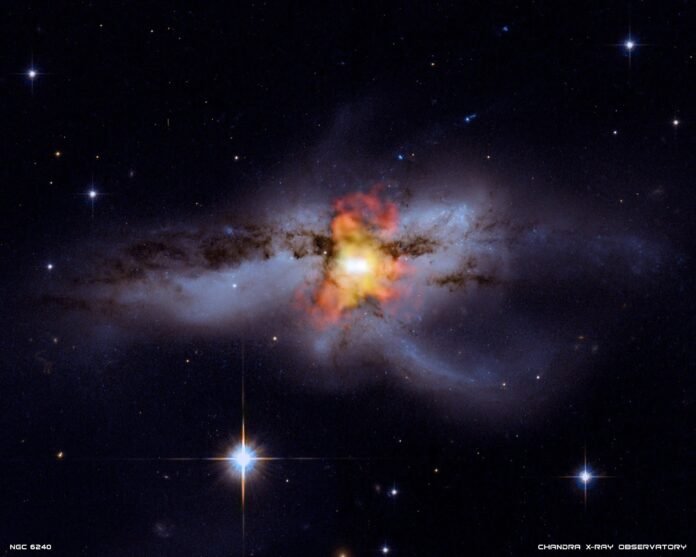
A team led by Konstantinos Kouroumpatzakis targeted one such galaxy, formally cataloged as SDSS J162209.41+352107.5, using NASA’s Chandra X-ray Observatory. What they found were two separate, luminous, hard X-ray sources, separated by 8.4 kiloparsecs, roughly 27,000 light-years, both showing the unmistakable signature of an actively accreting supermassive black hole.
Confirming It Wasn’t a Coincidence
Finding two bright X-ray sources near each other isn’t automatically proof of two black holes belonging to the same system, they could, in principle, be entirely unrelated objects that simply happen to line up from Earth’s point of view. To rule that out, the team turned to the W.M. Keck Observatory, using spectroscopy to confirm both sources genuinely belong to the same merging galaxy, not a chance alignment. Combined, the evidence marks the first confirmed dual active galactic nucleus ever identified within a Green Pea galaxy specifically.
The team also compared their find against a separately discovered object nicknamed an “X-ray-detected Red Dot,” and found the two systems follow the same underlying physical relationship between their X-ray and other emitted light, despite existing at wildly different distances and cosmic epochs. That agreement suggests compact, rapidly feeding supermassive black holes might follow one consistent set of physical rules across a huge range of scales and eras. If you’re curious about another recent example of multiple black holes crowding into a single early galaxy, our piece on three actively feeding supermassive black holes found sharing one galaxy covers an even more crowded system from deep in the early universe.
A Small Package With Big Implications
What makes this discovery genuinely significant is what it implies about galaxy mergers generally. Astronomers have long suspected that when galaxies collide, their central black holes can end up growing simultaneously, feeding side by side before eventually spiraling together. Actual direct evidence of that happening inside a small, compact, low-mass galaxy system, rather than a large one, had been missing until now. That gap matters because compact, actively star-forming systems like this one are thought to closely resemble the kind of galaxies responsible for building up the earliest generation of supermassive black holes, the same objects behind puzzling, unexpectedly massive black holes Webb keeps finding from just a few hundred million years after the Big Bang.
Confirming that mergers can trigger dual black hole growth even in small galaxies gives researchers a genuine, testable local laboratory for a process otherwise only visible at the very edge of what any telescope can currently observe.
For more on the discovery, check out the full research summary from Phys.org and the published study on arXiv.