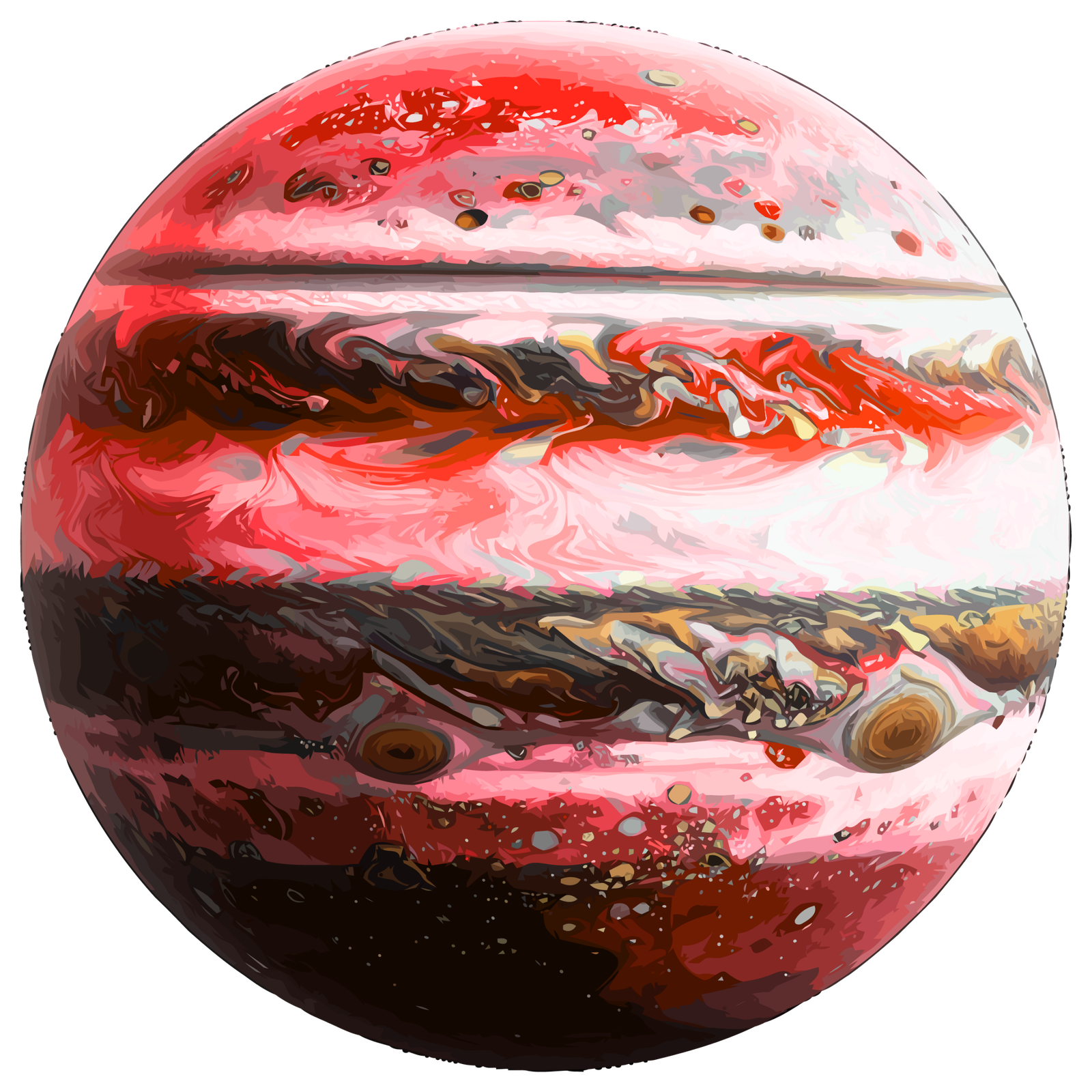

Jupiter took most of the leftover material from the Sun’s own formation, ending up with more mass than every other planet in the solar system combined, twice over. Here’s what that actually means in numbers, how far it sits from the Sun, and why a single Jupiter day is barely 10 hours long.
Big Enough to Swallow a Thousand Earths
Jupiter has a radius of about 43,440 miles, roughly 11 times wider than Earth. NASA puts it simply, if Earth were the size of a grape, Jupiter would be about as big as a basketball. Hollow it out, and you could fit roughly 1,000 Earths inside.
Despite that staggering size, Jupiter isn’t solid at all. It’s built almost entirely from hydrogen and helium, the same basic ingredients as the Sun itself, and in fact took on so much leftover material after the Sun formed that it very nearly became a star of its own, just without ever growing massive enough to ignite fusion.
Five Times Farther From the Sun Than Earth
Jupiter orbits the Sun at an average distance of about 484 million miles, or 5.2 astronomical units, meaning it sits more than five times farther from the Sun than Earth does. Sunlight that reaches Earth in about 8 minutes takes roughly 43 minutes to make the same trip out to Jupiter.
That distance keeps Jupiter firmly in the outer solar system, past the asteroid belt separating it from the four smaller, rocky inner planets, and it’s part of why Jupiter ended up as a gas giant in the first place. Far enough from the Sun’s heat, ice and light gases could stick around and accumulate in massive quantities rather than boiling away the way they did closer in.
The Shortest Day, One of the Longest Years
Jupiter spins remarkably fast for its size, completing a full rotation in just 9.9 hours, the shortest day of any planet in the solar system. That rapid spin flattens the planet slightly at the poles and helps generate ferocious jet stream winds, some clocked at over 335 miles per hour at the equator.
Covering that much orbital distance takes considerably longer, though. A single trip around the Sun, one Jovian year, takes almost 12 Earth years, or 4,333 Earth days. Jupiter’s axis is tilted just 3 degrees relative to its orbit, nearly upright compared to Earth’s 23.4 degree tilt, so unlike Earth, Jupiter doesn’t experience dramatic seasons.
A Storm Older Than the Telescope Itself
Jupiter’s most recognizable feature, the Great Red Spot, is a swirling storm twice as wide as Earth that has been continuously observed for more than 300 years. NASA’s Juno spacecraft found the storm extends far deeper than expected, reaching at least 200 miles below the cloud tops. Nobody fully understands why it’s persisted this long, but with no solid surface underneath to slow it down, there’s genuinely nothing stopping it.
If you’re curious about the moons orbiting this massive planet, our full count of Jupiter’s 115 confirmed moons covers the four giant Galilean moons and the swarm of much smaller ones discovered since.
Why the Numbers Matter
Jupiter’s mass and distance shape more than just its own atmosphere, its gravity plays a genuine role in the architecture of the entire solar system, deflecting or capturing countless asteroids and comets that might otherwise threaten the inner planets, Earth included. For a planet this large, that gravitational influence reaches remarkably far.
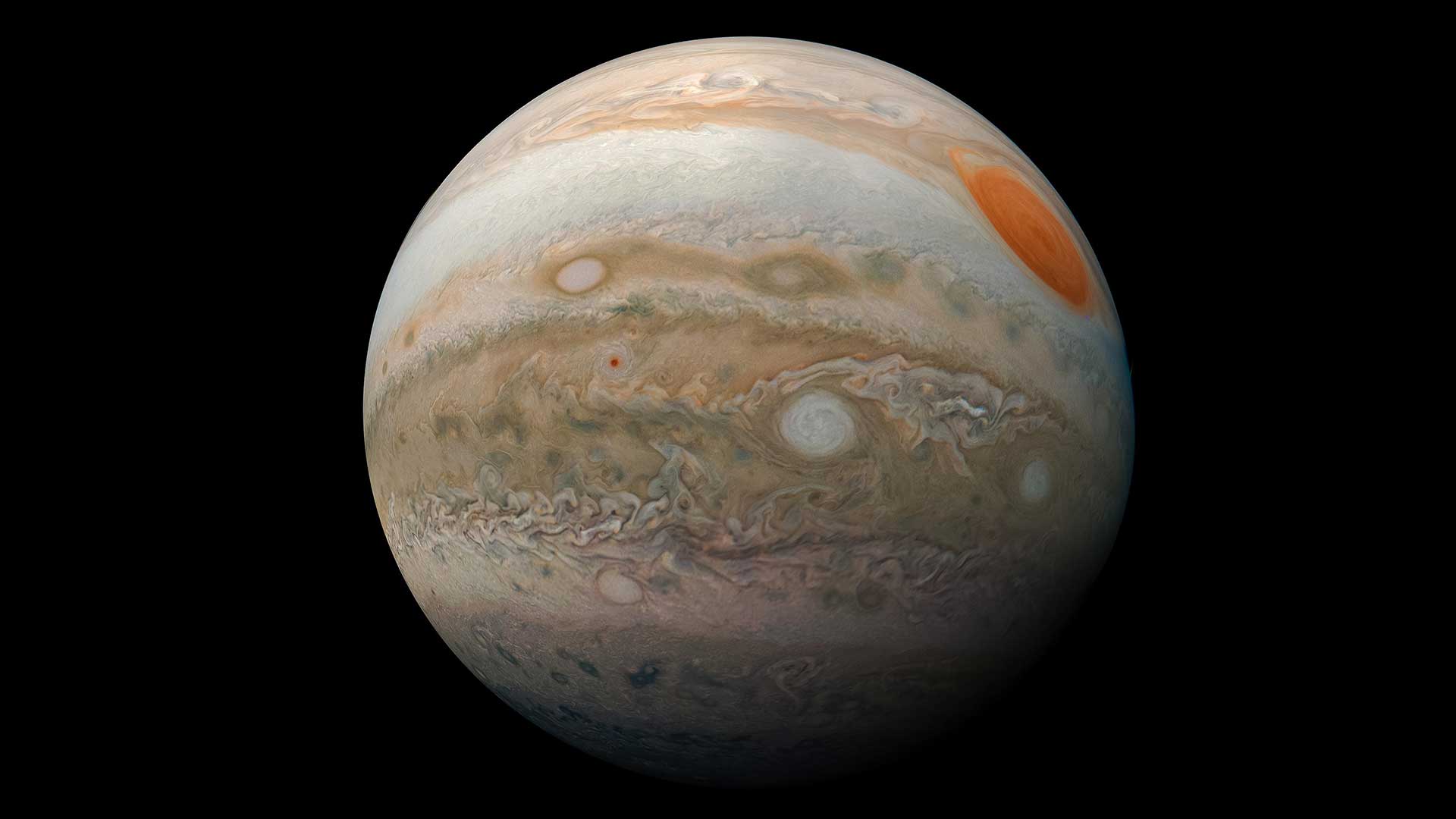 Jupiter’s Great Red Spot and colorful cloud bands, photographed by NASA’s Juno spacecraft in February 2019. (Image: NASA/JPL-Caltech/SwRI/MSSS, enhanced by Kevin M. Gill)
For more detailed data straight from the source, check out NASA’s Jupiter Facts page and the additional overview from Britannica.
If you enjoyed this article, don’t forget to drop us a comment, it really helps support the site, and be sure to check out our other articles because we think you’re going to love them too.