
Point the Hubble Space Telescope at what looks like a completely empty patch of sky, hold it steady for eleven days straight, and you’ll find it isn’t empty at all, it’s packed with thousands of galaxies. Scaling that single tiny snapshot up to cover the entire sky is exactly how astronomers estimate the total galaxy count, and the answer has changed dramatically over just the past decade.
From Billions to Trillions
For most of the 20th century, astronomers estimated the observable universe held somewhere around 100 to 200 billion galaxies, based on what telescopes like Hubble could directly image. That changed in 2016, when a team led by Christopher Conselice at the University of Nottingham reanalyzed deep-field Hubble images using better statistical methods for inferring galaxies too small and faint to see directly. Their revised estimate came out roughly ten times higher, around 2 trillion galaxies.
Why the Number Keeps Shifting
That 2 trillion figure made headlines for years, but it isn’t the final word either. A 2021 study using data from NASA’s New Horizons spacecraft, measuring total background light across several patches of sky from a vantage point far from Earth’s own light pollution, suggested the real number is more likely in the hundreds of billions rather than trillions. The gap between these estimates comes down to a genuinely hard problem, distinguishing faint, distant galaxies from background noise, and correcting for overlapping or double-counted objects in earlier deep-field surveys.
Since 2022, the James Webb Space Telescope has been adding fresh data to this ongoing debate. Its COSMOS-Web survey has already mapped over 164,000 individual galaxies across nearly the full history of the universe, tracing large-scale cosmic structure back to when the universe was under a billion years old, work that’s actively helping refine which of these competing estimates holds up.
Why We’ll Never Get an Exact Count
Part of the challenge is fundamental, not just technical. The observable universe has a hard physical boundary, a sphere roughly 92 billion light-years across, beyond which light simply hasn’t had time to reach Earth since the Big Bang. Even within that boundary, no telescope can image every single galaxy directly, some are too faint, too small, too distant, or hidden behind gas and dust, so every galaxy count is ultimately a statistical extrapolation rather than a literal tally.
If you’re curious about the very beginning that set this entire expanding cosmic stage, our explainer on what the Big Bang actually was covers the origin point every one of these galaxies traces back to.
Somewhere Between Big and Almost Incomprehensible
Whether the true number turns out closer to a few hundred billion or a couple trillion, the honest answer to how many galaxies exist is still evolving as better instruments come online. What hasn’t changed is the underlying scale, even the most conservative modern estimate still puts the observable universe’s galaxy count somewhere in the hundreds of billions, each one containing anywhere from a few million to over a trillion stars of its own.
For more on the ongoing research, check out the detailed overview from BBC Sky at Night Magazine and the JWST cosmic web survey findings reported by Phys.org.
If you enjoyed this article, don’t forget to drop us a comment, it really helps support the site, and be sure to check out our other articles because we think you’re going to love them too.
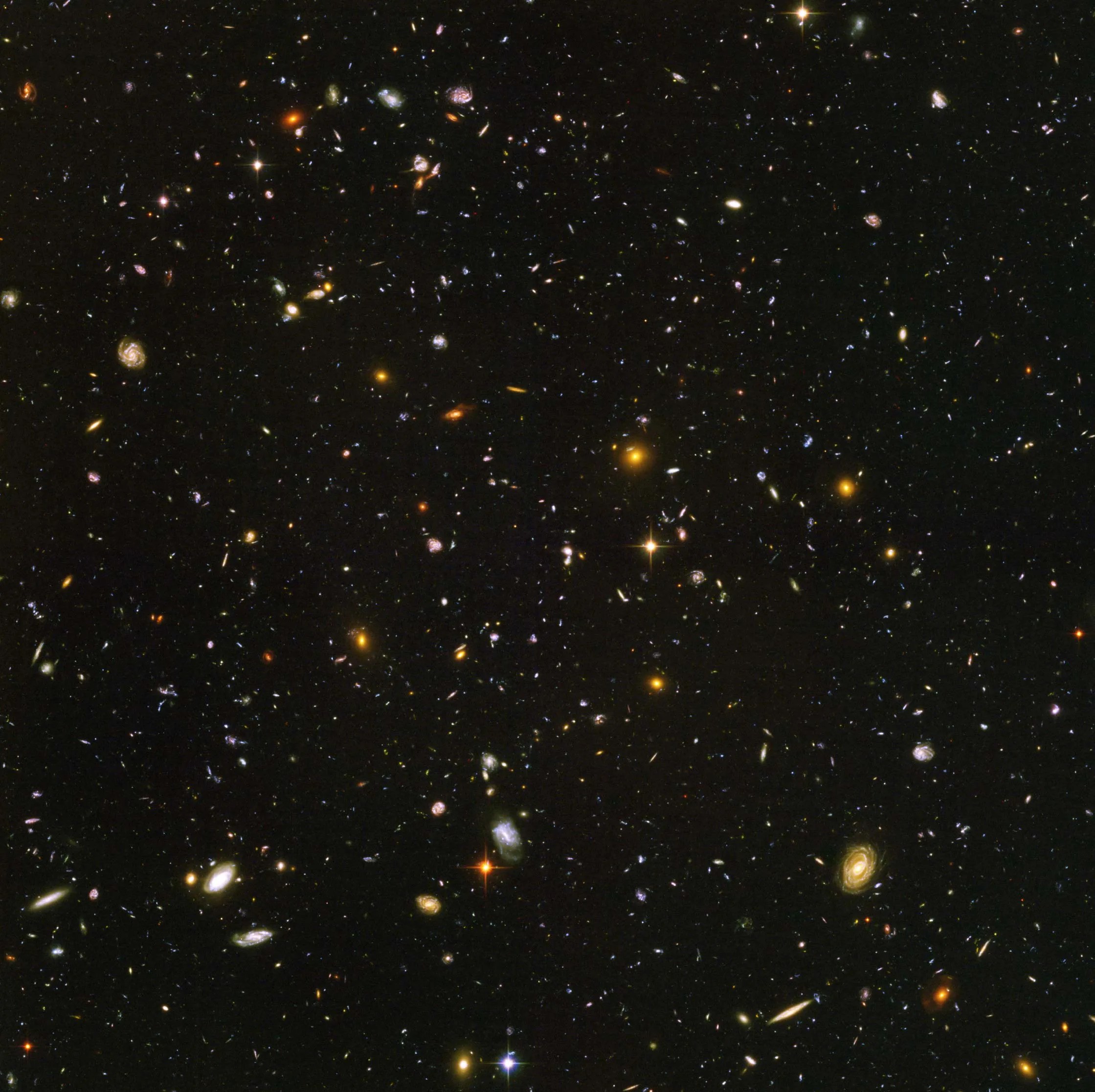 The Hubble Ultra Deep Field, assembled from roughly 11 days of cumulative exposure time pointed at a single, seemingly empty patch of sky. Nearly 10,000 galaxies are visible in this one small window into the universe. (Image: NASA, ESA, S. Beckwith/STScI and the HUDF Team)