

A quantum physics prediction sitting untested for 90 years may have finally found its proof, and it came from one of the most extreme objects in the universe. NASA’s IXPE telescope just captured the strongest evidence yet that empty space itself behaves like a lens under a strong enough magnetic field, exactly as physicists Werner Heisenberg and Hans Euler predicted back in 1936.
An Impossible Experiment, Solved by a Dead Star
Testing this theory, known as vacuum birefringence, the idea that a strong enough magnetic field can bend and filter light passing through supposedly empty space, requires a magnetic field roughly 100 million times stronger than anything humans have ever built on Earth. Since that’s simply not achievable in any lab, scientists went looking for a natural laboratory instead, and found one in a magnetar, an extreme type of neutron star with the strongest magnetic fields anywhere in the observable universe.
Between March and April 2025, researchers pointed NASA’s IXPE (Imaging X-ray Polarimetry Explorer), NASA’s NICER instrument on the space station, and Australia’s Parkes radio telescope at a magnetar called 1E 1547-5408, logging more than 140 hours of observations in the first-ever coordinated radio and X-ray polarization study of a magnetar.
A Signal That Shouldn’t Have Been So Strong
This particular magnetar spins once every 2.1 seconds and consistently emits both bright radio and X-ray light. What caught researchers off guard was the X-ray polarization, the alignment of the incoming light waves, which came back nearly three times stronger than similar sources typically show. Based on the geometry of the magnetar’s magnetic field alone, that measurement should have been close to zero at certain points in its rotation.
Standard models of how a neutron star’s surface emits radiation couldn’t explain the gap. Something else had to be boosting that polarization, and vacuum birefringence fit the data.
What It Means for Physics
Vacuum birefringence proposes that under an extreme enough magnetic field, empty space itself starts acting like a prism or lens, filtering light depending on the direction it’s traveling and increasing its overall polarization in the process. Simulations run by the research team, published August 5 in the journal Nature, support that vacuum birefringence is genuinely the best explanation for what IXPE observed. As Rice University postdoctoral researcher Hoa Dinh Thi put it in NASA’s announcement, reproducing the signal while also satisfying the separate radio observations required the presence of vacuum birefringence in the magnetar’s surrounding environment.
Study lead author Rachael Stewart, a PhD candidate at George Washington University, called it proof of just how interdisciplinary astrophysics can be, extracting clues about the fundamental fabric of reality from a distant, collapsed stellar core.
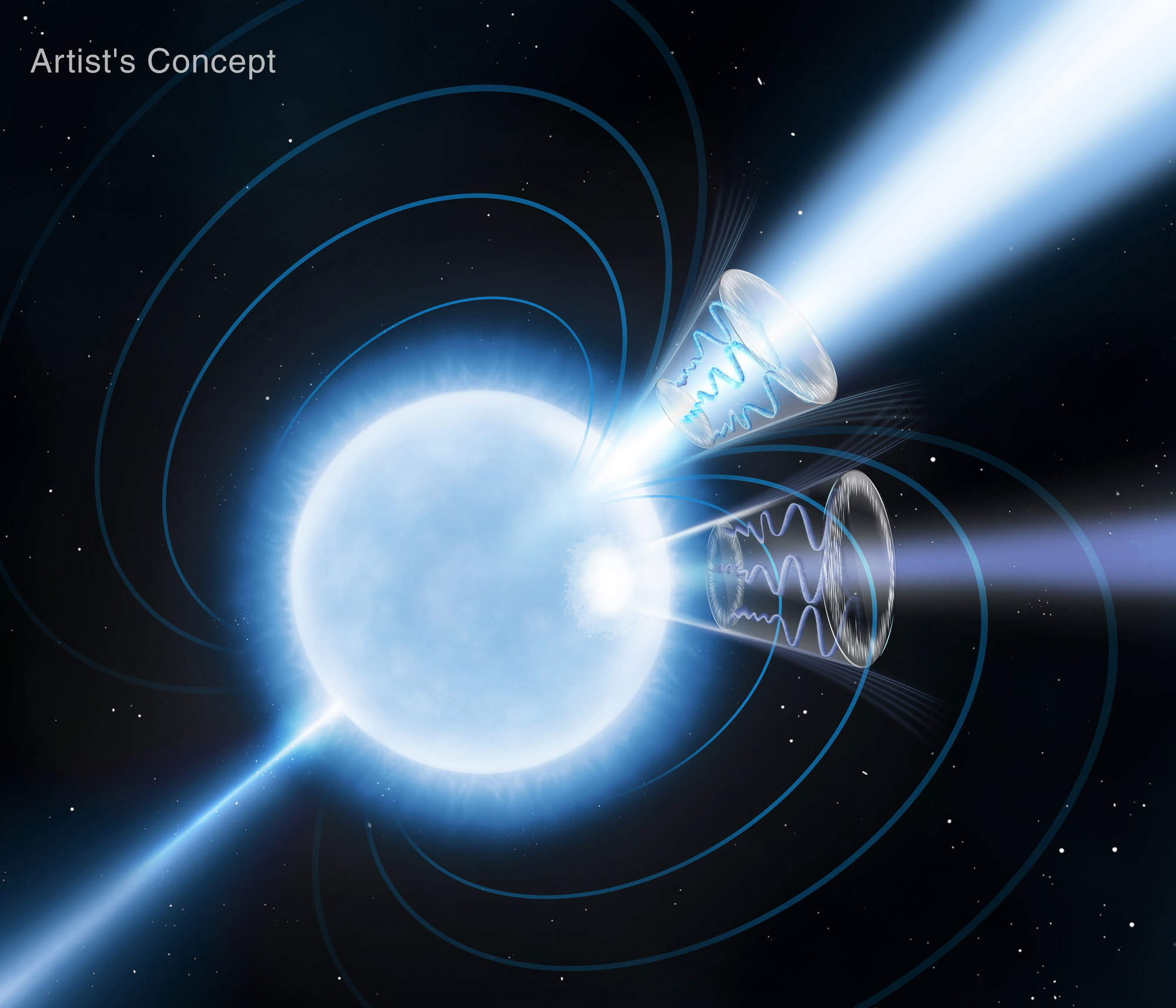 An artist’s concept of magnetar 1E 1547.0-5408, whose magnetic field is over a trillion times stronger than Earth’s. The cone-shaped beams represent its radio and X-ray emissions, whose unusually high polarization gave scientists the clearest signal yet of vacuum birefringence. (Image: NASA/Pablo Garcia)
Not Quite a Closed Case Yet
NASA describes this as the most definitive signal to date for vacuum birefringence, not an absolute confirmation, researchers are already planning further IXPE observations of this same magnetar and others to verify the result and potentially uncover additional exotic quantum effects along the way. It’s a reminder that some of physics’ deepest, most fundamental questions about the universe still get answered not in a lab on Earth, but by pointing a telescope at the wreckage of a star that died long ago.
For more on the discovery and the IXPE mission, check out NASA’s official announcement and the published research in Nature.
If you enjoyed this article, don’t forget to drop us a comment, it really helps support the site, and be sure to check out our other articles because we think you’re going to love them too.