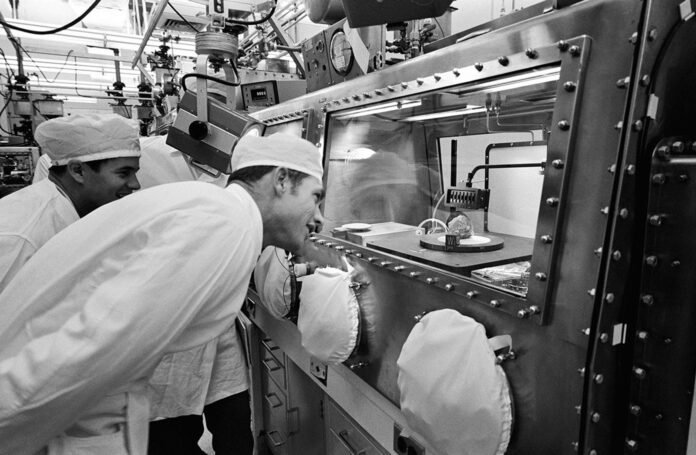

One of the very first things Neil Armstrong did after climbing down the ladder in July 1969 was scoop up a handful of lunar dirt and stuff it into his pocket, a quick, almost improvised backup sample in case the mission had to be cut short. It turned out to be one of the most consequential pocketfuls of dirt in scientific history. Over six Apollo missions, astronauts hauled 842 pounds of moon rock, core samples, and lunar soil back to Earth, and more than fifty years later, scientists are still learning new things from it.
A Careful, Deliberate Collection Effort
Apollo 11’s sample gathering was fairly quick and improvised, but the missions that followed got dramatically more methodical. Later crews, especially on Apollo 15, 16, and 17, trained for months with actual geologists, visiting volcanic fields in Hawaii, impact structures in the American Southwest, and mountain ranges chosen specifically to resemble the terrain they expected to find on the Moon. Armed with rakes, tongs, scoops, and hammers, astronauts learned to identify promising rocks on sight and document exactly where and how each sample was collected.
By the time Apollo 17 wrapped up the program in December 1972, six missions had returned 2,196 individual samples. That collection remains, to this day, the single richest source of information humanity has ever had about a world beyond Earth.
The Rock That Made the Mission
At about 4 billion years old, the Genesis Rock ended up being younger than the astronauts initially hoped, but it still offered a genuinely rare glimpse into the Moon’s earliest crust, material that formed practically at the dawn of the solar system.
Solving the Mystery of Where the Moon Came From
If theres one single takeaway from decades of moon rock research, its this, the Apollo samples finally answered the question of where the Moon actually came from. Radiometric dating, using techniques like uranium-lead and rubidium-strontium decay, consistently placed the Moon’s formation at around 4.5 billion years ago, essentially the same age as Earth itself. Even more telling, the isotopic composition of lunar rocks, especially their oxygen isotopes, turned out to closely match Earth’s own mantle.
That similarity became one of the strongest pieces of evidence for whats now called the Giant Impact Hypothesis, the idea that a Mars-sized object slammed into the young Earth, and the debris from that collision eventually coalesced into the Moon. If you want the full breakdown of exactly how that violent origin story plays out, our piece on the diameter and impact origins of our Moon covers the collision theory in much more depth.
Interestingly, more recent reanalysis of Apollo 17 zircon crystals, some of the very first minerals to solidify after the Moon’s formation, has pushed that estimated age slightly further back, to around 4.46 billion years, refining a figure that had stood largely unchanged for decades.
What the Rocks Are Actually Made Of
Lunar samples generally sort into three broad categories. Basalts are dark, iron and magnesium rich rocks that filled the Moon’s large, smooth mare basins, the dark “seas” visible from Earth with the naked eye, and most date to between 3 and 4 billion years old. Anorthosites, like the Genesis Rock, are lighter colored and make up the Moon’s older, more heavily cratered highlands, some pushing 4.4 billion years old. Breccias are a mix of both, composite rocks fused together from smaller fragments during the violent heat and pressure of ancient meteorite impacts.
Taken together, these three rock types let geologists piece together a surprisingly detailed timeline of lunar history, one that, because the Moon lacks any weather, plate tectonics, or erosion to erase the record, has stayed remarkably well preserved compared to Earth’s own constantly recycled surface.
A Lifeless, Bone-Dry World, With One Surprise
Extensive testing on the Apollo samples turned up no evidence of life, past or present, and even non-biological organic compounds were essentially absent, aside from trace contamination from meteorite impacts. For decades, the Moon was considered bone dry, a conclusion baked into geology textbooks almost from the moment the first samples arrived.
That assumption eventually got overturned. Decades after the original missions, scientists reanalyzing some of the same Apollo 11 samples using far more sensitive modern instruments discovered trace amounts of water trapped inside volcanic glass beads, evidence researchers now believe was delivered by ancient impacts. It was a genuine reminder that even material sitting in storage for fifty years can still yield brand new discoveries once technology catches up.
A Sample From Earth, Hiding on the Moon
Perhaps the strangest finding buried in the Apollo collection came from a breccia gathered during Apollo 14. Researchers analyzing one small fragment within the rock found a chemical signature strikingly similar to granite, a rock type strongly associated with plate tectonics here on Earth, and nothing like typical lunar material. The leading theory now is that this two-gram fragment is actually a piece of ancient Earth, blasted into space by a massive impact roughly 4 billion years ago and eventually landing on the lunar surface, where it sat undisturbed until an Apollo astronaut happened to pick it up.
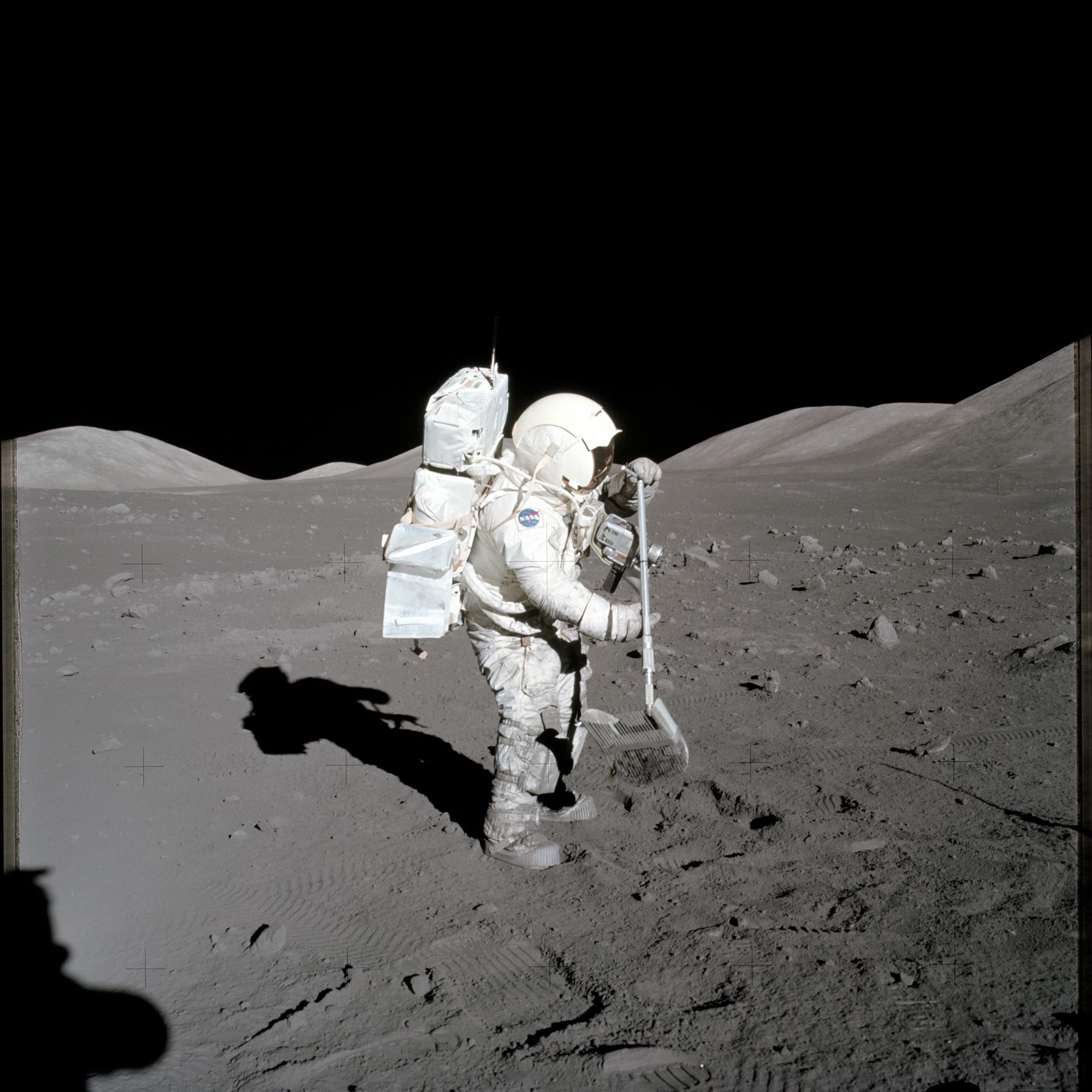 Astronaut Harrison Schmitt collects lunar samples using a rake tool during Apollo 17 in December 1972, the final crewed mission to the Moon. (Image: NASA)
If confirmed, it would represent the oldest known Earth rock ever found, ironically discovered not on Earth at all, but preserved in the one place with no weather or geological activity to destroy it.
The Research Never Really Stopped
NASA didn’t study every Apollo sample right away. A handful were deliberately left completely sealed, untouched, on the bet that future scientists with better instruments would eventually get more out of them than 1970s technology ever could. That bet paid off. In 2022, curators finally opened one of the last sealed Apollo 17 core samples, using modern techniques to examine it layer by layer for the very first time.
More Apollo samples remain in careful storage today, still awaiting new rounds of analysis as instruments keep improving. With NASA’s Artemis program now aiming to return astronauts to the Moon, specifically its south pole, where scientists hope to find deposits of water ice, this decades-old collection of moon rock is also serving as a training resource, helping prepare a new generation of researchers before the next round of lunar samples ever leaves the surface. If you’re curious about that upcoming chapter of lunar exploration, our recap of the Artemis 2 mission covers the most recent crewed step back toward the Moon.
Fifty Years of Answers, and Still Counting
What started as a handful of gray rocks stuffed into sample bags turned into the foundation of virtually everything we know about the Moon’s origin, its ancient geology, and by extension, the early history of our own planet. The Apollo moon rock collection has already outlived the missions that gathered it by half a century, and given how many surprises have turned up simply from revisiting old samples with new tools, theres a good chance it still has more to teach us before the next astronaut ever sets foot back on the lunar surface.
For more detailed research and imagery from the Apollo sample collection, check out the full breakdown from Astronomy.com and the in-depth coverage from Scientific American.
If you enjoyed this article, don’t forget to drop us a comment, it really helps support the site, and be sure to check out our other articles because we think you’re going to love them too.