
Black holes have a reputation for being distant, exotic objects, the kind of thing you’d expect to find swirling at the center of some galaxy millions of light-years away. So it tends to catch people off guard when they learn theres actually a small collection of black holes sitting relatively close to home, some of them practically next door in cosmic terms. Lets run through what astronomers currently consider the nearest black hole to Earth, along with the handful of runners up rounding out our local neighborhood.
Gaia BH1: The Current Record Holder
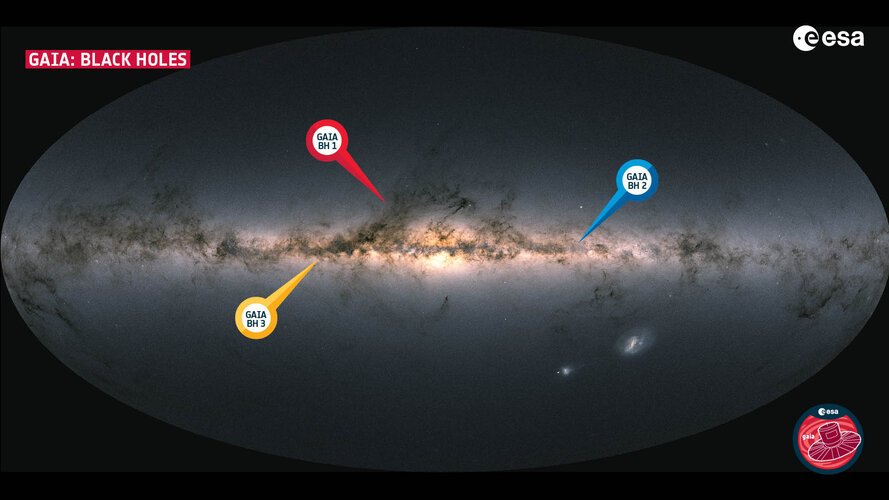
Topping the list is Gaia BH1, discovered in 2022 and confirmed as the nearest black hole to Earth ever found. Its located about 1,560 light-years away in the constellation Ophiuchus, and it weighs in at roughly 9.6 times the mass of our Sun. What makes Gaia BH1 stand out isn’t just its distance, its the way it was found. Unlike most known black holes, which give themselves away by actively pulling in and heating up gas from a companion star, Gaia BH1 is dormant, meaning its not feeding on anything and gives off no telltale glow.
Astronomers instead spotted it by watching a Sun-like star wobble in a suspiciously precise pattern, tugged by the gravity of something completely invisible. That companion star orbits the black hole at roughly the same distance Earth orbits the Sun, an arrangement researchers have described as almost eerily similar to our own solar system, just with a black hole standing in where the Sun should be.
Gaia BH3: The Heavyweight Neighbor
Not far behind in distance is Gaia BH3, sitting about 1,926 light-years away in the constellation Aquila. Discovered in 2024, this one holds a different kind of record, its the most massive stellar mass black hole ever confirmed in the Milky Way, weighing in at around 33 times the mass of the Sun. Thats an enormous jump compared to Gaia BH1, and it’s forced astronomers to rethink some assumptions about how black holes this heavy can form without immediately being swallowed into a tight, destructive orbit with their companion star. Gaia BH3 orbits an ancient giant star on a wide, slow path, taking over 11 years to complete a single loop.
Gaia BH2: Rounding Out the Trio
The third member of this recently discovered family is Gaia BH2, located about 3,800 light-years away in the constellation Centaurus. Its mass sits close to Gaia BH1, around 9 solar masses, but instead of orbiting a Sun-like star, Gaia BH2 has a red giant as its companion. All three of these black holes were found using data from the European Space Agency’s Gaia spacecraft, which spends its mission quietly tracking the precise positions and movements of over a billion stars, exactly the kind of dataset needed to catch a star being tugged by something you otherwise can’t see at all.
If comparing distances like these across the galaxy interests you, our light travel time calculator is a handy tool for putting numbers like 1,560 light-years into a little more perspective.
A0620-00: The Former Champion
Before Gaia BH1 came along, the title of nearest black hole to Earth belonged to A0620-00, also known as V616 Monocerotis, sitting about 3,300 light-years away in the constellation Monoceros. This one is a very different kind of system, an active X-ray binary where the black hole is actively pulling material off a companion star, forming a glowing accretion disk that occasionally erupts in dramatic outbursts. One such outburst in 1975 briefly made it the brightest X-ray source in the entire sky. Unlike the quiet, dormant Gaia black holes, A0620-00 announces its presence pretty loudly whenever its feeding.
The Rest of the Local Lineup
A few more nearby black holes round out the list worth knowing about. MOA-2011-BLG-191, sometimes called OGLE-2011-BLG-0462, sits around 5,000 light-years away and is unusual in that its a completely isolated black hole, not orbiting any companion star at all, detected purely through a gravitational lensing effect as it passed in front of a much more distant background star. Then theres GRS 1124-683, about 5,400 light-years out in the constellation Musca, another X-ray binary system first spotted through a dramatic outburst back in 1991.
Why “Nearest” Doesn’t Mean Nearby
Its worth pausing here for a second, because even the record holding nearest black hole to Earth is still 1,560 light-years away, a distance so vast that light itself needs over fifteen centuries just to make the trip. Nothing happening around Gaia BH1 could ever pose any kind of risk to us, its dormant, its unimaginably distant, and its effects on anything nearby are limited entirely to its own small orbital system.
Compare that to Sagittarius A*, the supermassive black hole sitting at the very center of our own Milky Way galaxy, roughly 26,000 light-years away, and you start to get a sense of scale. Even the “nearest” black holes are still separated from us by distances that make ordinary human measurements feel almost meaningless.
Why Astronomers Keep Looking
Scientists estimate the Milky Way could be home to anywhere between 100 million and a billion black holes, the overwhelming majority of them completely undetected since most, like Gaia BH1, BH2, and BH3, give off no light at all. The methods used to find these dormant black holes, watching for the subtle gravitational wobble of a companion star, are relatively new, and astronomers expect plenty more discoveries as missions like Gaia continue mapping the galaxy in ever finer detail.
Each new find also chips away at a bigger mystery, understanding exactly how many black holes are quietly scattered throughout our galaxy, and how such a wide range of masses, from Gaia BH1’s modest 9.6 solar masses to Gaia BH3’s massive 33, actually come to exist in the first place.
If you’re curious how black holes compare to other extreme objects that shape our understanding of the universe, our piece on how vast the universe actually is is worth a read for putting these kinds of distances into even bigger perspective.
The Bottom Line
For now, Gaia BH1 holds the title of nearest black hole to Earth, sitting quietly about 1,560 light-years away in Ophiuchus, with Gaia BH3 and Gaia BH2 following close behind as the next two entries in this small but growing local collection. Given how recently astronomers cracked the method for finding these dormant, invisible objects, theres a good chance the current record won’t stand forever, and whatever comes next promises to be just as strange as the black holes we’ve already found hiding in our own cosmic backyard.
For more detailed data on each of these systems, check out the research summary from the Center for Astrophysics at Harvard & Smithsonian and the full rundown from Astronomy.com.
If you enjoyed this article, don’t forget to drop us a comment, it really helps support the site, and be sure to check out our other articles because we think you’re going to love them too.