
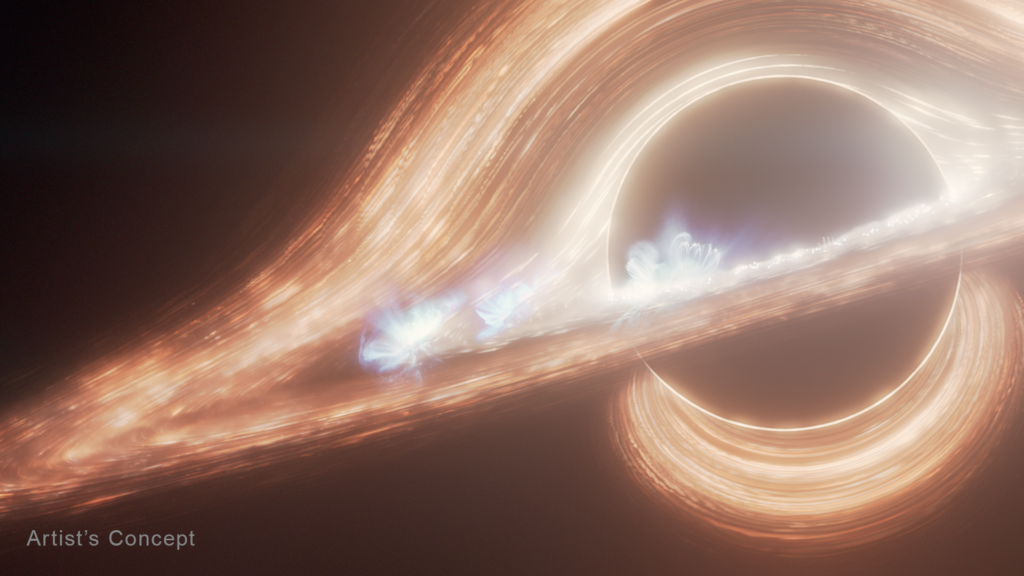
Black holes have this reputation as the ultimate cosmic bullies. They swallow stars, rip apart anything that gets too close, and once something crosses the event horizon, its gone for good, not even light escapes. So it kinda makes sense that most people assume black holes are forever, that they’re the last thing standing once everything else in the universe has burned out. But will black holes die? Turns out the answer is actually yes, and the way it happens is one of the weirdest ideas in modern physics.
Its not gonna happen anytime soon though. Like, not even close.
The Idea That Changed Everything
Back in 1974, physicist Stephen Hawking dropped a bombshell on the scientific community. Up until that point, everyone assumed black holes only grew bigger, that they were basically one way streets, matter goes in and nothing ever comes back out. Hawking showed that quantum mechanics tells a different story. Right at the edge of a black holes event horizon, empty space isn’t really empty. Pairs of particles are constantly popping into existence out of nowhere and then annihilating each other almost instantly, this is just how the vacuum of space behaves on a quantum level.
But every once in a while, one of these particle pairs forms right on the edge of the event horizon. One particle falls in, and the other escapes outward into space. From far away, it looks like the black hole itself is emitting radiation, so scientists named it Hawking radiation after the man who figured it out. And here’s the kicker, every time this happens the black hole loses a tiny sliver of mass. Do that enough times, over an unimaginable stretch of time, and the black hole eventually shrinks down to nothing and disappears completely.
So yeah, will black holes die? According to Hawking radiation, every single black hole in the universe is technically evaporating right now, this very second, even the supermassive one sitting at the center of our own galaxy.
So How Long Are We Talking Here
This is where things get almost impossible to wrap your head around. A black hole about the same mass as our sun would take roughly 10^67 years to fully evaporate. For context, the entire universe has only existed for about 13.8 billion years, which is 10 with 10 zeros after it. We’re talking about a number so much bigger that comparing the two barely makes sense anymore.
And it gets worse the bigger the black hole is. Supermassive black holes, like the ones sitting at the center of most galaxies including our own Milky Way, could take somewhere around 10^100 years to evaporate. Thats a number so massive it actually has its own nickname in math circles, a googol. Basically, if you were hoping to stick around and watch a black hole finally disappear, you’d need to outlive not just humanity, not just the sun, but every star that will ever exist in the observable universe, and then wait a whole lot longer after that.
The one silver lining is that smaller black holes evaporate faster than bigger ones. The math works out so that the tinier a black hole gets, the quicker it loses the rest of its mass, so the final moments of a black holes life would actually speed up dramatically right before it vanishes, possibly ending in one last burst of energy.
Why Hasn’t Anyone Actually Seen This Happen
Honestly, because Hawking radiation is ridiculously faint. We’re talking about a signal so weak that even our most sensitive instruments can’t pick it up, especially since most black holes are still actively pulling in gas, dust, and radiation from their surroundings, which adds mass way faster than Hawking radiation could ever take it away. A black hole has to be sitting in a truly empty patch of space, with nothing feeding it, before evaporation can even start winning that tug of war.
Scientists have tried to recreate a version of this effect in laboratory conditions using sound waves in specially cooled fluids, which mimic some of the same physics as an event horizon. Those experiments have given researchers a bit more confidence that Hawking’s original math holds up, even though we still havent detected the real thing coming from an actual black hole out in space.
If you’re into the science behind black holes generally, NASA has a solid overview of how these objects form and behave that’s worth checking out, and if you want to dig into the physics of Hawking radiation specifically, this breakdown from Big Think does a pretty good job explaining what’s really going on near the event horizon.
What This Means for the Universe’s Final Chapter
Here’s the wild part. Once every star has burned out, every galaxy has drifted apart, and the universe has gone dark and cold, black holes will still be out there for an absurdly long time, quietly leaking away into nothing. Some researchers even think black holes will end up being the very last structures left in existence, outlasting stars, planets, and even the faint glow of dying white dwarfs. In a weird way, the objects that seem the most indestructible right now are actually on borrowed time too, just on a scale so long that it barely means anything to us as humans.
So will black holes die? Yes, eventually, every last one of them. Its just that “eventually” here means longer than pretty much anything else that has ever happened or will ever happen. The universe as we know it will be long gone before a single black hole finishes fading away.
If this got you curious about how everything else out there wraps up, check out our piece on how life on Earth might eventually end, or if you wanna understand what’s actually pulling galaxies together in the first place, our guide on dark matter breaks it down in plain English. You can also play around with our black hole time dilation calculator to see how insanely different time would feel near one of these things.
If you enjoyed this article, don’t forget to drop us a comment below, it really helps us out, and be sure to check out our other articles because we think you’re gonna like them too.