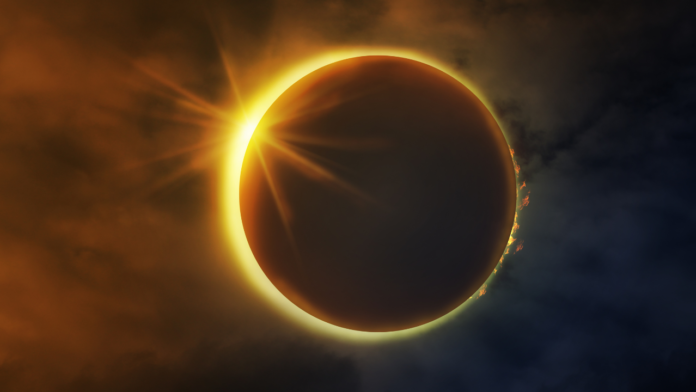

If you were anywhere in the path of totality back in April 2024, theres a good chance the memory still sticks with you, the sky going dark in the middle of the afternoon, the temperature dropping, birds going quiet like its suddenly nighttime. Its one of those experiences that makes people become lifelong eclipse chasers. But once the excitement fades, a pretty natural question pops up, how often does an eclipse of the sun occur, and when’s the next one actually happening?
What Is a Solar Eclipse, Exactly?
A solar eclipse happens when the Moon slides directly between the Sun and Earth, blocking some or all of the Sun’s light from reaching a specific part of our planet. This can only happen during a new moon, since thats the one point in the lunar cycle when the Moon sits on the same side of Earth as the Sun. Even though we get a new moon roughly every 29 and a half days, we don’t get an eclipse every single month, and that comes down to the Moon’s orbit being slightly tilted compared to Earth’s orbit around the Sun. Most months, the Moon’s shadow just misses Earth entirely, passing above or below us.
There are actually a few different flavors of solar eclipse depending on the alignment. A total solar eclipse happens when the Moon completely covers the Sun’s face, turning day into a strange twilight for a few precious minutes. A partial eclipse happens when the alignment isn’t perfect, so the Moon only covers part of the Sun. An annular eclipse occurs when the Moon is near the farthest point in its orbit from Earth, making it appear too small to fully cover the Sun, leaving a glowing ring, often called a “ring of fire,” around the edges.
So How Often Does an Eclipse of the Sun Occur?
Globally speaking, solar eclipses happen more often than most people assume. According to NASA, there are at least two solar eclipses somewhere on Earth every single year, and the maximum possible in any given year is five, though that’s a rare occurrence. On average, Earth experiences somewhere around two to five solar eclipses of some kind each year, whether total, partial, or annular.
Total solar eclipses specifically happen roughly once every year or two somewhere on the planet. That might sound fairly frequent, and globally it is, but heres the catch, the path where you can actually witness totality is incredibly narrow, often only about 100 to 170 miles wide, and it only sweeps across a small slice of the Earth’s surface each time.
That narrow path is exactly why, for any single spot on Earth, total solar eclipses feel so rare. Researchers who’ve crunched thousands of years of eclipse data have found that a random location on Earth can expect a total solar eclipse only about once every 375 years on average. Annular eclipses show up a bit more often for a given spot, roughly once every 226 years, and partial eclipses, which are easier to catch since you just need to be somewhere in the wider shadow zone, happen closer to once every two and a half years for any particular location.
If you want to get a feel for how these massive cosmic distances and timing cycles play out, our moon phase and supermoon calculator is a great tool for understanding exactly where the Moon sits in its cycle on any given night.
Why Totality Feels So Rare If You Live in One Place
The math behind eclipse frequency explains why so many serious skywatchers end up traveling the world chasing totality instead of just waiting for it to come to them. Because the zone of totality is so thin, most people go their entire lives without ever seeing one unless they intentionally travel to be in the right spot. The 2017 and 2024 total eclipses crossing the United States were unusually convenient for American skywatchers precisely because you didn’t have to fly to a remote corner of the globe to catch one, the path came right through the country both times.
Interestingly, eclipses do follow a repeating pattern called the Saros cycle. Roughly every 18 years and 11 days, a nearly identical eclipse repeats, just shifted to a different part of the globe because of how the geometry lines up. Its a pattern ancient astronomers noticed and used to predict eclipses long before anyone understood the orbital mechanics behind why it worked.
When’s the Next One?
For skywatchers in the United States specifically, the wait for the next total solar eclipse crossing the country is a bit longer this time. After 2024’s coast to coast eclipse, the next one visible from the contiguous United States isn’t expected until 2044, followed by another with a wider path in 2045. In the meantime, partial and annular eclipses will still pass through parts of North America periodically, so its worth keeping tabs on upcoming space events so you don’t miss a viewing opportunity closer to home.
Watching Safely
One thing worth repeating every single time this topic comes up, never look directly at the Sun during a partial or annular eclipse without proper certified solar filters. The only moment its safe to look with the naked eye is during the brief window of full totality itself, when the Moon has completely blocked the Sun’s disk. Regular sunglasses, no matter how dark, don’t cut it, you need eclipse glasses that meet the ISO 12312-2 safety standard.
The Bottom Line
So the next time someone asks how often does an eclipse of the sun occur, you’ll have a solid answer, frequently across the globe, but genuinely rare for any one specific location. Its exactly that rarity that makes catching one worth the planning, the travel, and the slightly awkward eclipse glasses everyone ends up wearing for a few unforgettable minutes.
For more detailed eclipse data and upcoming dates, check out the breakdown from NASA and the frequency study from timeanddate.com.
If you enjoyed this article, don’t forget to drop us a comment, it really helps support the site, and be sure to check out our other articles because we think you’re going to love them too.