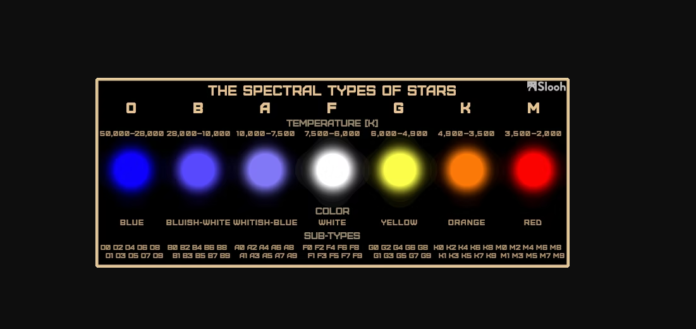

Take a good look at the night sky sometime and you’ll notice stars come in a handful of colors. Theres reddish ones like Betelgeuse, orangeish ones like Arcturus, bright white ones, and cool blue ones like Rigel. But no matter how long you stare, you’re never going to spot a green star. Not one. Its kind of a strange gap when you think about it, green sits right in the middle of the visible light spectrum, and yet stars seem to skip right over it entirely. So whats the deal, why are there no green stars out there?
Stars Are Basically Giant Blackbodies
To understand whats going on, you first have to understand how stars actually produce their color in the first place. Stars behave almost exactly like something physicists call a blackbody, which is just a fancy way of describing an object that radiates light based purely on its temperature. The hotter an object gets, the more it shifts its glow toward the blue end of the spectrum. Cooler objects glow more red. This is the exact same principle you see when you heat up a piece of metal, it starts out glowing a dull red, then orange, then yellow, and eventually white hot if it gets hot enough.
Stars work the same way, just on a scale thats almost impossible to picture. A relatively cool star, something around 3,000 Kelvin, glows red. Crank the temperature up toward 6,000 Kelvin, roughly what our own Sun runs at, and the star shifts toward yellow and white. Push it even hotter, past 10,000 Kelvin, and you start getting those bright blue stars that look almost electric in photos taken by powerful telescopes.
So if temperature alone was the only factor, you’d expect a star running right around the temperature that lines up with green light to actually look green. Except that never happens. And the reason why comes down to something most people don’t think about, the physics of light emission, and the biology of your own eyes.
The Real Reason Green Stars Don’t Exist
Heres the part that trips people up. Stars don’t emit light at just one single wavelength. A blackbody radiator, which again, is basically what a star is, pumps out light across a huge range of wavelengths all at once, not just one narrow slice of color. Even when a star’s peak output happens to fall right in the green part of the spectrum, its still cranking out a ton of red light and a ton of blue light at the exact same time.
When all of that reaches your eye, red, green, and blue light mixed together doesn’t register as green at all. It registers as white. Your eyes are combining every wavelength the star is throwing out, and that combination essentially cancels out any strong hint of green, leaving you with something closer to white or maybe a pale yellowish white instead.
Its kind of like mixing paint, except backwards. Mixing colored light together tends to move things toward white, not toward a specific hue, especially when the light is as spread out across the spectrum as starlight tends to be. A star that theoretically peaks in green just doesn’t have a narrow enough output to actually look green once your eyes get done blending everything together.
Your Eyes Are Part of the Story Too
Theres also a biological piece to this whole puzzle. Human eyes see color using three types of cone cells, each one tuned to respond most strongly to red, green, or blue light. These cone types overlap a lot in what wavelengths they respond to, especially the ones tuned for green and red. Because of that overlap, even when green light is genuinely the dominant wavelength coming from a star, your brain still ends up perceiving a blended, washed out color rather than a pure, saturated green.
Its worth pointing out that pure blue stars don’t really exist either, for pretty much the same reason. Even the hottest stars in the universe still put out plenty of light across the rest of the spectrum, so what you actually see tends to be more of a blue white than a true, deep blue.
If digging into how starlight and color actually work has you curious about the stars overhead tonight, our telescope magnification calculator can help you figure out what kind of setup you’d need to start picking out subtle color differences between stars yourself.
So What Colors Can You Actually See?
Since true green stars are basically off the table, the colors you’ll actually spot while stargazing run from deep red, through orange and yellow, up to white, and finally into blue. Each color is a direct clue to a star’s surface temperature, red stars run cool, blue stars run scorching hot, and everything else falls somewhere in between. Next time you’re out looking up, try picking out a few different colored stars and see if you can guess which ones are the hottest just based on their glow.
For a deeper technical breakdown of blackbody radiation and star colors, check out the explainer from Las Cumbres Observatory.
If you enjoyed this article, don’t forget to drop us a comment, it really helps support the site, and be sure to check out our other articles because we think you’re going to love them too.