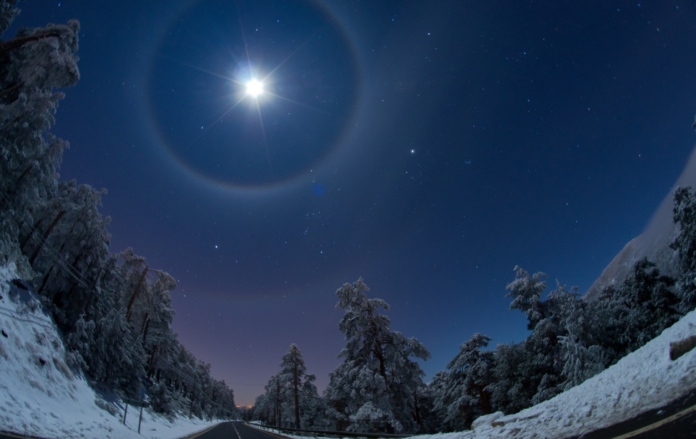

Step outside on a cold, clear night sometime this winter and look up. If the moon is out and bright, theres a decent chance you’ll catch it wearing a giant glowing ring, like something straight out of a fantasy movie. Its one of those sights that stops people in their tracks, and honestly, it’s happened to almost everyone at least once without them really knowing what they were looking at. So whats actually going on up there when you see a ring around the moon?
It’s Not Magic, It’s Ice
As cool as it looks, the ring around the moon has a pretty simple explanation once you break it down. Its officially called a lunar halo, or sometimes a 22 degree halo, and its caused by moonlight passing through tiny ice crystals floating way up in the atmosphere. These crystals live inside thin, wispy clouds called cirrus or cirrostratus clouds, which usually sit somewhere between 20,000 and 40,000 feet above the ground, way higher than your typical rain cloud.
Each one of those ice crystals is shaped like a tiny hexagon, kind of like a miniature six sided pencil. When moonlight hits one of these crystals, it doesn’t just pass straight through, it bends, or refracts, the same way light bends when it passes through a prism. Because the crystals are hexagonal, that bending always happens at almost exactly the same angle, about 22 degrees. Multiply that by millions of ice crystals scattered across a thin cloud layer, and what you end up seeing from the ground is a clean, glowing circle sitting neatly around the moon.
That 22 degree number is actually kind of a fun party trick. If you hold your hand up at arms length toward the moon with your fingers spread out, the distance from your thumb to your pinky is roughly 22 degrees. Line your thumb up with the moon, and your pinky should land right about where the halo appears.
Why Does This Happen Mostly in Winter?
You can technically see a ring around the moon during any season, but its way more common during the colder months, and there’s a good reason for that. Cirrus clouds, the thin, icy clouds responsible for the whole effect, tend to show up more often in winter weather patterns, especially ahead of storm systems moving through. Cold air holds moisture differently than warm air, and the atmospheric setup that produces these high, icy clouds just lines up more frequently when temperatures drop.
Thats part of why the phenomenon earned the nickname “winter halo” even though meteorologists will tell you it can technically happen year round if the conditions are right.
Does It Really Mean Bad Weather Is Coming?
Theres an old piece of weather folklore that goes “ring around the moon means rain or snow soon,” and it turns out that saying isn’t just superstition, theres some real science backing it up. Cirrus and cirrostratus clouds often show up as the very first sign of an approaching weather system, arriving well ahead of the thicker, lower clouds that actually bring rain or snow. So when you spot that halo, what you’re really seeing is often the leading edge of a storm system still hundreds of miles away, moving in your direction.
Its not a guaranteed forecast though. Sometimes those high clouds drift through and nothing ever comes of them. Weather forecasters have far more reliable tools these days, but its still a neat bit of old school sky reading that happens to hold up reasonably well.
Keep an Eye Out for More Than Just a Ring
If conditions are just right, you might get lucky and spot more than the standard halo. Some nights produce a second, much larger ring at 46 degrees from the moon, though its far fainter and rarer to catch. Depending on how the light scatters, you might also notice a faint reddish tint on the inner edge of the halo and a bluish tint on the outer edge, similar to how a rainbow separates color, just far more subtle.
If watching the sky like this has got you curious about tracking lunar phases and planning future viewing nights, our moon phase and supermoon calculator is a great way to figure out exactly when the moon will be bright enough to make a halo easy to spot.
The Bottom Line
The next time you catch a ring around the moon lighting up a cold night sky, you’ll know exactly whats behind it, moonlight quietly bending its way through a sky full of invisible ice crystals, far above any cloud you’d normally even notice. Its a small reminder that theres real physics playing out above our heads almost every night, we just dont always look up long enough to catch it.
For more on the science of how these halos form, check out the detailed breakdown from EarthSky and the explainer from Live Science.
If you enjoyed this article, don’t forget to drop us a comment, it really helps support the site, and be sure to check out our other articles because we think you’re going to love them too.