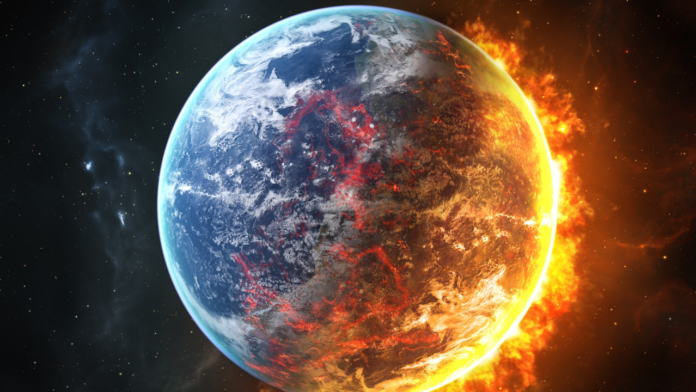

Have you ever laid back on a warm summer night, looked up at the endless stars, and wondered when will the earth end? Its a heavy thought, honestly. We live our daily lifes worrying about traffic, bills, and what to make for dinner, completely forgetting that we are riding a giant rock spinning through a pretty violent cosmic neighborhood.
Scientists have been trying to map out Earths final chapter for decades. While Hollywood movies love showing sudden apocalyptic asteroids or alien invasions, the real scientific story of how our planet dies is a bit more gradual, kinda terrifying, but absolutely fascinating.
Here is what modern astrophysics and planetary science tell us about how life on Earth will actually meet its end.
The Oceans Will Literally Boil Away (1 Billion Years)
If you think climate change right now is tough, the long term future of our solar system is much hotter. You see, our Sun isn’t static. It relies on nuclear fusion inside its core, burning through hydrogen day in and day out. As it ages, it burns hotter and brighter.
In about one billion years, the Sun will be roughly 10 percent brighter than it is today. That might not sound like a lot, but for Earth, its a total game changer.
- The increased heat will trigger a runaway greenhouse effect.
- Oceans will begin to evaporate into the upper atmosphere.
- Water molecules will get split apart by intense solar radiation, letting hydrogen escape into outer space.
Without oceans, plate tectonics will grind to a halt. Earth will slowly turn into a desert wasteland, pretty similar to how Venus looks right now. Complex life, like humans, animals, and plants, wont survive this shift. Only extremely tough micro-organisms deep underground will be able to hang on for a bit longer.
The Sun Swallows Earth Whole (5 Billion Years)
Fast forward about five billion years, and our Sun runs out of hydrogen fuel in its core. When this happens, gravity starts crushing the core inward while the outer layers expand massively. The Sun enters its “Red Giant” phase.
During this stage, the Sun will swell up to hundreds of times its current size. It will easily swallow Mercury and Venus.
As for Earth, scientists are still debating if we get completely consumed or just pushed into a burnt, melted orbit. But honestly, it doesnt make much difference for life. The surface temperatures will be hot enough to melt solid rock into oceans of lava. Earth will be nothing more than a lifeless, glowing cinder hanging in space.
Eventually, the Sun will shed its outer layers into a beautiful planetary nebula, leaving behind a tiny, cooling core known as a white dwarf.
Threat From Above: Asteroid Impacts and Supernovae
Now, what if we dont want to wait billions of years? Could something end life on Earth much sooner?
Yeah, totally. The cosmos has a few short-term curveballs it could throw at us.
Giant Asteroid Strikes
We all know what happened to the dinosaurs 66 million years ago. A space rock about 6 miles wide wiped out nearly 75 percent of all species. Larger asteroids are still floating around in the asteroid belt and outer solar system. While NASA tracks most near-Earth objects today, a surprise impact from a massive comet could trigger a global dust cloud, blocking sunlight for years and wiping out the food chain completely.
Nearby Gamma-Ray Bursts
Gamma-ray bursts (GRBs) are some of the most powerful explosions in the universe, usually caused by collapsing giant stars or merging black holes. If a GRB happened within a few thousand light-years of Earth and was aimed directly at us, it could strip away our ozone layer in seconds. Intense ultraviolet rays from the Sun would fry surface life and destroy marine ecosystems.
Supervolcanoes: The Internal Threat
We don’t just have to look at space for dangerous scenarios. Earth carries its own destructive potential deep beneath the crust.
Supervolcano eruptions—like the one sitting under Yellowstone National Park—have happened in Earth’s past. A full-scale supervolcano eruption would unleash thousands of cubic kilometers of ash into the atmosphere. This would block out sunlight for months or years, causing a “volcanic winter” that devastates global agriculture and triggers mass extinctions.
Frequently Asked Questions
When will the earth end according to science?
Life for complex organisms like humans will likely become impossible in about 1 to 1.5 billion years due to the Suns increasing heat. However, the physical planet itself will survive until the Sun expands into a Red Giant in about 5 billion years.
Can humans survive the end of the Earth?
If humanity survives long enough to develop advanced interstellar travel, we could theoretically move to other star systems or build habitats around other stars before Earth becomes uninhabitable.
Will the Earth be destroyed by a black hole?
It is extremely unlikely. Space is vast, and there are no black holes close enough to our solar system to pose a threat to Earth’s orbit.
The story of our planet is a reminder of how lucky we are to live in this brief, cozy window of cosmic history. Earth won’t last forever, but it has given us a pretty amazing place to call home for now.
If you enjoyed this article, don’t forget to leave us a comment to encourage us, and check out our other articles because you’re going to love them!