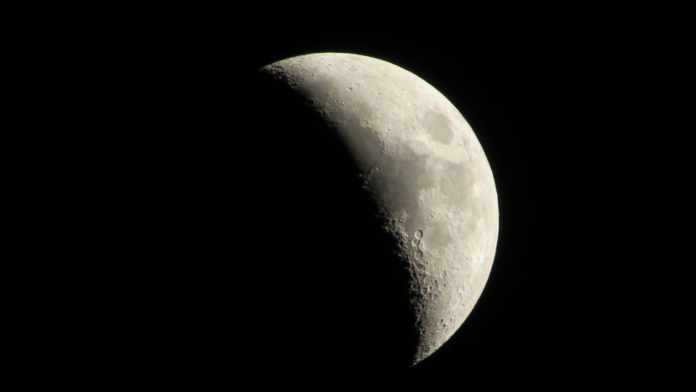

If you’ve ever looked up at the Moon and noticed that it seems to be getting bigger night after night, you’re watching what astronomers call a waxing Moon. It is one of the simplest things to notice in the night sky, but there is some pretty cool science behind why it happens.
A waxing Moon is not actually getting bigger. The Moon itself stays almost the same size throughout its orbit around Earth. What changes is how much of the Moon’s sunlit side we can see from Earth.
The Moon doesn’t make its own light. What we call moonlight is sunlight reflecting off the lunar surface. Half of the Moon is always lit by the Sun, but as the Moon travels around Earth, our view of that illuminated half changes. That’s what creates the different Moon phases we see during the month.
The waxing part of the cycle begins just after the new Moon and continues until the full Moon. During this time, the bright portion we can see grows larger each night.
And if you’ve ever heard the term waxing gibbous, that’s one of the most noticeable stages of this process.
What Does Waxing Mean?
The word “waxing” simply means increasing.
When astronomers say the Moon is waxing, they’re talking about the amount of its illuminated surface that is visible from Earth. It starts with almost nothing visible after the new Moon, then gradually becomes a thin crescent, a half Moon, and eventually a large bright disk before reaching the full Moon.
After the full Moon, the process goes in the opposite direction. The illuminated portion begins getting smaller, which is called waning.
So there is a pretty easy way to remember it.
Waxing means the Moon appears to be getting brighter.
Waning means the Moon appears to be getting darker.
The Moon itself isn’t changing shape though. It’s all about our viewing angle as it moves around Earth.
What Is a Waxing Gibbous Moon?
A waxing gibbous Moon is the phase that comes after the first quarter Moon and before the full Moon.
During this stage, more than half of the Moon’s visible face is illuminated, but it hasn’t reached full Moon yet.
This is actually one of the easiest Moon phases to spot because the Moon becomes a big bright object in the evening sky. NASA describes the waxing gibbous phase as the point when most of the Moon’s dayside has come into view and the Moon appears brighter in the sky.
The word “gibbous” might sound a little strange, but it simply describes a Moon that looks more than half illuminated but less than completely full.
So when you see a Moon that looks almost full but still has a noticeable dark section, you’re probably looking at a waxing gibbous Moon if that bright portion is increasing toward the full Moon.

The Eight Phases of the Moon
The Moon goes through eight commonly recognized phases during one complete lunar cycle.
They happen in this order:
New Moon
Waxing Crescent
First Quarter
Waxing Gibbous
Full Moon
Waning Gibbous
Third Quarter
Waning Crescent
Then the cycle starts over again.
The complete cycle takes about 29.5 days, which is why the Moon can look noticeably different from one week to the next.
The four phases with “waxing” or “waning” in their names describe the transition between the major points in the cycle. The waxing gibbous period, for example, covers the days between the first quarter and full Moon rather than being a single instant.
That’s one reason the Moon can look waxing gibbous for several nights in a row.
Why Does the Moon Wax?
The Moon waxes because it is orbiting Earth while the Earth-Moon system is also receiving sunlight from the Sun.
At any given time, sunlight illuminates roughly half of the Moon.
But the Moon is constantly moving around Earth.
When the Moon is near the new Moon position, the side facing Earth is mostly the dark side, so we can’t see much of the illuminated portion.
As the Moon moves farther around its orbit, more of the sunlit side becomes visible from Earth.
The bright area slowly grows.
That’s the waxing phase.
Once the Moon reaches the full Moon position, we can see almost the entire sunlit side facing us. After that, the illuminated portion starts shrinking again and the Moon enters its waning phases.
Nothing is actually turning the Moon’s light on and off.
The sunlight is always there.
We’re just seeing different portions of the illuminated half.
When Can You See a Waxing Gibbous Moon?
A waxing gibbous Moon is usually easy to see during the evening.
NASA notes that a waxing gibbous Moon generally rises in the afternoon, before sunset, and remains visible into the early morning hours. It can be seen for much of the night before eventually setting before sunrise.
That makes it a great phase for casual skywatching.
You don’t have to wake up at 4 a.m. or stay outside until midnight to catch it.
On a clear evening, you may notice the Moon already sitting above the horizon around sunset. As the night continues, it climbs higher in the sky before eventually moving toward the western horizon.
This is also a good time to look at the Moon with binoculars or a small telescope.
The changing angle of sunlight creates shadows along craters and mountains, especially around the boundary between the illuminated and dark portions of the lunar surface.
That boundary is called the terminator, and it can make lunar features stand out much more clearly.
Why Does the Moon Look So Different Every Night?
You might think the Moon is changing shape because sometimes it looks like a crescent, sometimes half full and sometimes almost completely round.
But the Moon isn’t changing shape.
The Moon is a sphere, and sunlight always illuminates half of it.
The difference is our perspective.
Think of holding a ball near a lamp in a dark room. Half of the ball is illuminated by the lamp, but depending on where you’re standing, you may see a full bright side, a half-lit side or just a thin sliver.
The Moon works in much the same way.
The Sun is the light source, the Moon is the ball and Earth is where we’re standing.
As the Moon moves around Earth, the angle between the Sun, Earth and Moon changes, giving us the different lunar phases.

5
Is a Waxing Moon the Same Everywhere on Earth?
For the most part, people around the world see the Moon in the same phase at the same time, because the phase is determined by the relative positions of the Sun, Earth and Moon.
But the Moon can appear oriented differently depending on where you are on Earth.
Someone in the Northern Hemisphere might see the bright part of a crescent on one side while someone in the Southern Hemisphere sees it oriented differently.
The phase is still the same.
The viewing angle is what changes.
That’s also why photographs of the Moon taken from different parts of the world can sometimes look like they’re showing slightly different versions of the same phase.
What Is the Difference Between Waxing Gibbous and Waning Gibbous?
These two phases are easy to confuse because both show more than half of the Moon illuminated.
The difference is what happens to the illuminated portion.
During a waxing gibbous, the bright portion is increasing as the Moon moves toward full Moon.
During a waning gibbous, the bright portion is decreasing after the full Moon.
So if the Moon looks almost full, you need to know where it is in the lunar cycle to tell whether it’s waxing or waning.
The timing can give you a clue too.
A waxing gibbous Moon is typically visible from the afternoon into the evening and early morning, while a waning gibbous Moon rises later in the evening and remains visible into the morning.
Why Is the First Quarter Moon Called a Quarter Moon?
This one confuses a lot of people.
When the Moon is at the first quarter phase, it looks like half of a circle from Earth.
So why is it called the first quarter instead of a half Moon?
Because “quarter” refers to the Moon’s position in its 29.5-day cycle, not the amount of the visible disk that appears bright.
At first quarter, the Moon is roughly one quarter of the way through its cycle from one new Moon to the next.
Visually, however, we see about half of the lunar disk illuminated.
After first quarter comes the waxing gibbous phase, when the visible illuminated portion continues to grow until the full Moon.
It’s a small detail, but once you understand it, the Moon’s phases make a lot more sense.
Does the Moon Actually Get Brighter When It Waxes?
From our point of view, yes, the Moon appears to get brighter.
But the Moon isn’t producing more light.
The amount of sunlight falling on the Moon remains roughly the same. What changes is how much of that illuminated surface is facing Earth and visible to us.
During a waxing crescent, only a small portion of the illuminated side is visible.
During a waxing gibbous, most of it is visible.
At full Moon, we can see almost the entire sunlit side facing Earth.
So the Moon appears to get brighter even though the Sun is doing all the actual lighting.
This is also why a full Moon can make the night sky look surprisingly bright. There is simply much more illuminated lunar surface facing us and reflecting sunlight back toward Earth.
Can You See More Details During a Waxing Gibbous Moon?
Absolutely.
A waxing gibbous Moon can be one of the best times for casual lunar observing because there is plenty of sunlight illuminating the surface while shadows still highlight many features.
The Moon has enormous craters, mountains, valleys and ancient impact basins. Some of these features are visible with nothing more than a decent pair of binoculars.
A telescope makes even more detail possible.
One interesting thing to watch is the terminator, the line separating the bright lunar surface from the dark side. As the Moon moves through its phases, that line slowly travels across the surface.
The changing sunlight creates shadows around mountains and crater walls, giving the landscape a three dimensional appearance.
The Moon can almost look like a completely different world from one night to another.

6
Does a Waxing Moon Affect the Tides?
The Moon plays a major role in Earth’s tides because its gravity pulls on Earth’s oceans.
But the strongest tidal ranges don’t happen specifically because the Moon is waxing.
The biggest differences generally occur around the new Moon and full Moon, when the Sun, Earth and Moon are more closely aligned. The gravitational effects of the Sun and Moon then work together to produce what are called spring tides.
During the first and third quarter phases, the Sun and Moon are positioned roughly at right angles relative to Earth, and their tidal effects partially counteract each other. This produces smaller tidal ranges called neap tides.
So the waxing gibbous phase sits between the first quarter and full Moon, during a transition toward the stronger spring-tide conditions that occur around the full Moon.
It’s another example of how the Moon’s changing position affects Earth in ways we can actually observe.
Why Does the Moon Rise Later Each Day?
One of the easiest ways to notice the Moon’s phases is to pay attention to when it rises.
The Moon doesn’t rise at the same time every night.
Because it is moving eastward around Earth in its orbit, Earth has to rotate a little farther each day before a particular Moon phase reaches the same position in the sky.
As a result, the Moon generally rises about 50 minutes later each day, although the exact difference varies depending on the Moon’s position and your location.
This is why a waxing crescent is often seen after sunset, a first quarter Moon is high in the evening, and a waxing gibbous Moon can already be above the horizon before the Sun goes down.
Once you start paying attention to this, the Moon becomes a pretty useful natural clock.
The Moon’s Phases Are Completely Predictable
One of the coolest things about lunar phases is that they aren’t random.
Scientists can calculate where the Moon will be and what phase it will have far into the future.
NASA’s Moon guides can even show the Moon’s phase, position and viewing conditions for individual days. The complete cycle repeats approximately every 29.5 days.
That predictability is one reason humans have used the Moon to track time for thousands of years.
Long before smartphones and digital calendars, people could look at the Moon and get a rough idea of where they were in the lunar cycle.
Different cultures developed their own calendars and traditions around these repeating changes in the sky.
So What Is a Waxing Moon?
A waxing Moon is simply the part of the lunar cycle when the illuminated portion visible from Earth is getting larger.
It begins after the new Moon and continues through the waxing crescent, first quarter and waxing gibbous phases until the full Moon.
The Moon itself isn’t growing and it isn’t producing more light.
Sunlight is always illuminating half of the Moon. As the Moon travels around Earth, our perspective changes and we see more and more of that sunlit half.
That’s why the Moon can go from a tiny crescent to a huge bright disk over the course of roughly two weeks.
Next time you look up and see a Moon that’s almost full, take a closer look at the surface. If more than half is illuminated and the bright portion is still growing toward full Moon, you’re looking at a waxing gibbous Moon.
It’s one of those everyday sights that seems simple at first but is actually a pretty amazing result of the movement of three worlds through space.