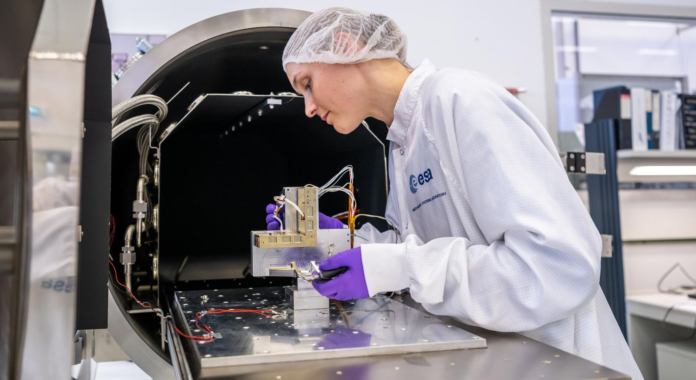

What if one of the most important things we learn about an asteroid comes from an instrument that is barely bigger than a couple of smartphones? : spc gravity
That is basically the idea behind GRASS, a tiny gravity measuring instrument that is heading toward the asteroid Dimorphos as part of the European Space Agency’s Hera mission. GRASS is designed to directly measure the extremely weak gravity on the surface of an asteroid, something scientists have never done before on an asteroid this small.
And there is a pretty wild reason this is so difficult.
On Earth, gravity is something we never have to think about. Drop your phone and it falls. Jump in the air and you come right back down. But on a small asteroid like Dimorphos, gravity is so weak that a person could almost feel like they were floating around.
ESA estimates that the gravity on Dimorphos is roughly 200,000 times weaker than Earth’s gravity. That makes measuring it a completely different kind of problem.
GRASS was built specifically for that job.

The Tiny Instrument Behind the Big Experiment
GRASS stands for Gravimeter for Small Solar System Objects.
The instrument itself is L-shaped and about the size of two smartphones placed together. So the headline about a cellphone-sized probe isn’t far off, but there is an important detail. GRASS is not a complete spacecraft. It is a scientific instrument that will be carried to Dimorphos inside the Juventas CubeSat.
Juventas is a small spacecraft that will travel with ESA’s much larger Hera spacecraft. Once the mission reaches the Didymos asteroid system, Juventas is planned to separate from Hera and perform its own observations of Dimorphos.
The CubeSat is basically a small space laboratory packed with instruments, and GRASS is one of the most interesting ones because it will actually touch the asteroid and attempt to measure its gravity directly.
That sounds simple until you realize just how tiny the gravitational pull is.
The GRASS instrument has been designed to detect incredibly small movements using thin rotating blades. The system measures changes in electrical capacitance caused by tiny movements of those blades. According to ESA, its sensitivity is equivalent to detecting movement on the scale of a single micrometre, or one thousandth of a millimetre.
Thats an almost ridiculous level of precision for something that is going to land on a rocky object millions of miles away.
Why Scientists Want to Know Dimorphos’ Gravity
You might wonder why anyone needs to measure the gravity of a small asteroid in the first place.
The answer is that gravity can tell scientists a lot about what is hidden underneath the surface.
Dimorphos isn’t just an ordinary rock floating around space. It is the smaller member of a binary asteroid system. It orbits the larger asteroid Didymos and is about 160 meters across, roughly comparable in size to the Great Pyramid of Giza.
NASA’s DART spacecraft slammed into Dimorphos in September 2022 as part of the first demonstration of an asteroid deflection technique. The impact changed Dimorphos’ orbit around Didymos.
But scientists still have plenty of questions about what Dimorphos is actually like inside.
Is it a solid chunk of rock?
Is it mostly loose material?
How much empty space is inside it?
How tightly packed are the rocks?
Those questions matter because an asteroid’s internal structure can affect how it responds when something hits it.
That is especially important for planetary defense.
If humanity ever needs to change the trajectory of an asteroid that could threaten Earth, knowing whether that asteroid is a solid body or more like a giant pile of rubble could make a huge difference.

Hera Is Going Back to the Asteroid Hit by DART
The story behind GRASS is connected directly to one of the most interesting space experiments of the last few years.
On September 26, 2022, NASA’s DART spacecraft intentionally crashed into Dimorphos.
It wasn’t an accident.
DART was designed to test whether humans could change the motion of an asteroid by hitting it with a spacecraft. The mission succeeded and changed Dimorphos’ orbit around Didymos.
But DART was only the first part of the experiment.
ESA’s Hera spacecraft launched from Cape Canaveral on a SpaceX Falcon 9 on October 7, 2024 and is now traveling toward the Didymos system. Hera is scheduled to reach the asteroid system in November 2026.
When Hera arrives, it will take a much closer look at the aftermath of DART.
And this is where the little Juventas spacecraft comes in.
A Tiny Spacecraft Will Go Where Hera Can’t
Hera is the main spacecraft, but it won’t be working alone.
It carries two small CubeSats called Juventas and Milani. ESA plans to deploy them near the asteroid system so they can get closer to Dimorphos and perform measurements that would be more difficult for the larger Hera spacecraft.
Juventas is particularly interesting because it isn’t just carrying GRASS.
It also has a low-frequency radar system called JuRa that is designed to investigate what is underneath the asteroid’s surface.
So while GRASS will be looking at gravity, the radar will be looking into the asteroid itself.
Together, those measurements could help scientists build a much better picture of Dimorphos from the outside and the inside.
And because Dimorphos is so small, even small movements of the spacecraft can reveal useful information.

5
Measuring Gravity on an Asteroid Is Not Like Measuring Gravity on Earth
On Earth, measuring gravity is pretty straightforward.
There are powerful instruments that can detect tiny variations in Earth’s gravitational field, and there is plenty of gravity to work with.
Dimorphos is a completely different story.
Its gravitational pull is incredibly weak. A spacecraft operating near the surface is dealing with a world where even small forces can matter.
Sunlight itself can push on a spacecraft.
That’s right.
Solar radiation pressure, the tiny force produced when sunlight hits a spacecraft, can become important when you’re trying to navigate around a small asteroid with extremely weak gravity. ESA has pointed out that this makes operating tiny spacecraft around Dimorphos especially challenging.
A tiny spacecraft can’t just fly over to the asteroid and park itself.
Every movement needs to be carefully planned.
Too much speed and the spacecraft could drift away. Too little control and it could hit the asteroid in the wrong way.
And once Juventas reaches Dimorphos, the plan is for it to eventually land on the surface.
That’s when GRASS gets its big moment.
What Will GRASS Actually Measure?
GRASS is designed to measure the acceleration caused by Dimorphos’ gravity directly at the surface.
The instrument contains two gravimeters positioned at right angles to each other. Because the asteroid is an irregular object and the spacecraft could land in different orientations, having two measurement directions helps the instrument reconstruct the three-dimensional gravity vector and monitor changes as it operates.
That information can tell scientists how strongly Dimorphos is pulling on the instrument.
And from there, they can learn more about the asteroid’s mass and structure.
This is important because size alone doesn’t tell you how much material an asteroid contains.
Imagine two asteroids that are exactly the same size.
One could be a dense chunk of solid rock.
The other could be mostly empty space with a loose collection of rocks held together by very weak gravity.
They could look similar from a distance but behave very differently.
Gravity measurements help scientists tell the difference.
The Weird Part About Landing on Dimorphos
Landing on a tiny asteroid is not anything like landing on the Moon or Mars.
There isn’t enough gravity to pull a spacecraft down quickly.
Instead, Juventas will have to approach Dimorphos very carefully.
The asteroid’s gravity is so weak that the spacecraft can remain near it with extremely low relative speeds. ESA says Hera itself will operate around the Didymos system at relative velocities of around 12 centimeters per second in its typical orbit.
That’s slower than a person walking.
But in space, even that can be a serious navigation challenge.
The spacecraft has to deal with the gravity of Didymos and Dimorphos, sunlight pushing against it and the complicated movement of the binary system.
The result is a place where normal intuition about flying a spacecraft doesn’t really work.
What the Tiny Probe Could Tell Us About Asteroids
If GRASS successfully makes its measurements, scientists could learn much more about the physical nature of Dimorphos.
That could include information about its surface gravity and how the gravity changes depending on location.
Combined with measurements from Hera and Juventas’ radar, researchers may be able to improve estimates of the asteroid’s mass, density and internal structure.
And that last part is a big deal.
Scientists already know that many asteroids are not simple solid rocks.
Some may have significant amounts of empty space inside. Others may be collections of broken rocks and dust held together mainly by their own weak gravity.
Understanding those differences can help scientists understand how asteroids form and how they evolve after collisions.
It could also help improve future asteroid deflection missions.

This Is More Than Just Another Asteroid Mission
The Hera mission is often described as a follow-up to NASA’s DART mission, but it is really the second half of a much bigger experiment.
DART showed that a spacecraft can intentionally change the orbit of a small asteroid.
Hera is going to investigate exactly what happened.
Scientists want to understand the crater created by DART, the material thrown into space, the mass and physical properties of Dimorphos and the way the asteroid responded to the impact.
GRASS adds another piece to that puzzle.
By measuring gravity directly at the surface, it can help scientists understand what kind of object DART actually hit.
That’s valuable because if asteroid deflection ever becomes an emergency tool for protecting Earth, knowing how an asteroid is built could be just as important as knowing where it is.
A Phone-Sized Instrument With a Very Big Job
The most interesting thing about GRASS might be how small it is compared with the questions scientists want it to answer.
The instrument is only about the size of two smartphones.
Yet it is being sent across the Solar System to land on an asteroid roughly 160 meters wide and measure gravity that is less than a millionth of Earth’s gravity.
The technology inside it is tiny, but the potential science is huge.
And this is becoming a trend in space exploration.
Spacecraft are getting smaller while their instruments are becoming more capable. CubeSats and other compact spacecraft can now perform jobs that once required much larger and more expensive missions.
Juventas is a great example of that.
It’s basically a small spacecraft carrying several different ways to study an asteroid that has already been deliberately hit by another spacecraft.
When Will We Find Out What GRASS Discovers?
As of 2026, Hera is still on its way to the Didymos system.
ESA says the spacecraft is scheduled to arrive in November 2026, after completing its deep-space journey and a second major maneuver in February 2026.
That means the most interesting part of the mission is still ahead.
Once Hera reaches the asteroid system, the spacecraft and its CubeSats will begin a complicated series of observations.
Juventas will eventually attempt its close operations around Dimorphos and deploy its instruments, including GRASS.
If everything works as planned, scientists will finally get something they have never had before
a direct gravity measurement taken from the surface of a tiny asteroid.
And that tiny measurement could help answer some very big questions about how asteroids are built and how we might one day protect Earth from them.
Why This Tiny Instrument Matters for Earth
Asteroids may look like distant pieces of rock, but they are part of the history of our entire Solar System.
They are leftovers from the material that formed the planets billions of years ago.
Studying them gives scientists a chance to understand how the Solar System developed, while studying their structure could also help us prepare for future asteroid threats.
That’s why the little GRASS instrument is more important than it first sounds.
It isn’t just measuring gravity for the sake of getting another number.
It’s helping scientists figure out what an asteroid really is.
A solid rock
A loose pile of rubble
Or something much more complicated.
We should have a much better answer after Hera reaches Dimorphos later this year.
And if a tiny instrument roughly the size of a couple smartphones can survive the trip, land on an asteroid and measure gravity that is almost unimaginably weak, it will be one more reminder that modern space exploration doesn’t always need giant machines.
Sometimes the smallest tools can answer the biggest questions.