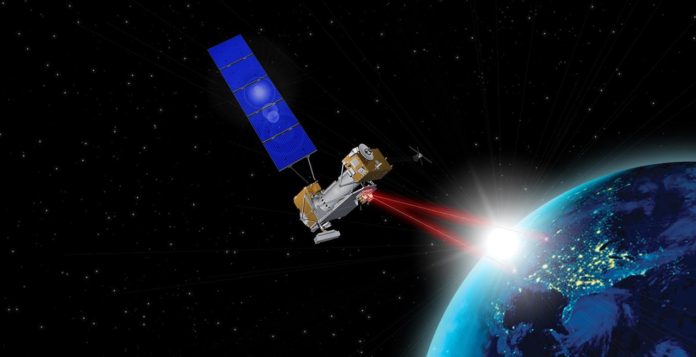

The headline sounds like something straight out of a science fiction movie. A Chinese satellite, a tiny 2 watt laser and Starlink somehow getting “pulverized” from thousands of miles away.
But the real story is a little different and honestly, it’s more interesting than the headline.
No Starlink satellite was destroyed. No Chinese satellite fired a weapon at SpaceX. What Chinese researchers actually demonstrated was a very impressive laser communication system that transmitted data at 1 gigabit per second from a satellite in geostationary orbit about 36,000 kilometers above Earth.
The experiment became a big talking point because reports compared the result with Starlink and described it as being about five times faster than typical Starlink internet speeds. That comparison needs some context though, because the two systems are not doing exactly the same job.
Still, getting a 1 Gbps laser signal through Earth’s atmosphere from that distance using only a 2 watt laser is a serious piece of engineering.
And it shows why the future of satellite communications may involve a lot more than just putting thousands of satellites into low Earth orbit.

What Actually Happened?
The experiment involved researchers led by Wu Jian from Peking University of Posts and Telecommunications and Liu Chao from the Chinese Academy of Sciences.
Instead of using traditional radio signals, the researchers used a laser to send information from a satellite in geostationary orbit down toward a receiving station on Earth.
The satellite was roughly 36,000 kilometers above the planet, which is an enormous distance for a direct communication link.
The receiving system was located at the Lijiang Observatory in southwestern China and used optical equipment to collect the very weak laser signal after it had traveled through the atmosphere.
The reported result was a stable 1 Gbit/s transmission using only a 2 watt optical signal. The work was described in research on high-orbit satellite-to-ground laser communication and published in Acta Optica Sinica.
That’s where the “Chinese satellite pulverizes Starlink” story came from.
The problem is that the word pulverizes makes it sound like a satellite was attacked.
It wasn’t.
There was no Starlink satellite sitting in the path of the laser and no physical damage involved. The laser was being used to carry data.
So if you came across a headline saying China destroyed Starlink with a 2 watt laser, thats not what happened.
Why Use a Laser Instead of Radio?
This is the part that makes the experiment worth paying attention to.
For decades, satellites have relied heavily on radio-frequency communications. Radio works well and can cover large areas, but the available spectrum is becoming increasingly crowded as more spacecraft, aircraft, phones and other systems need wireless connections.
Laser communications work differently.
Instead of sending information through radio waves, optical communication uses light, usually infrared light, to carry huge amounts of information.
The beam is also much narrower than a traditional radio signal.
That can be a disadvantage because the satellite and ground station have to point at each other with incredible precision. But it also creates an advantage because a narrow beam can carry a lot of data without spreading energy over a huge area.
NASA has been working on the same general idea for years. Its TBIRD experiment demonstrated a 200 Gbps direct-to-Earth laser communication link from low Earth orbit, showing just how much information optical systems can potentially move through space.
So China’s 1 Gbps demonstration isn’t the first time humans have transmitted data through space using lasers.
The interesting part is the combination of very long distance, low laser power and atmospheric correction.

The Biggest Problem Was Earth’s Atmosphere
Sending a laser from space sounds easy until you remember that the laser has to pass through Earth’s atmosphere.
The atmosphere is constantly moving. Different layers have different temperatures and densities, and this causes the light to bend, scatter and distort.
Imagine shining a laser pointer through a room full of hot air and trying to keep the beam perfectly focused on a tiny target miles away.
Now make the distance 36,000 kilometers.
That’s basically the problem the researchers had to solve.
The Chinese system combined two techniques known as adaptive optics and mode diversity reception, or MDR.
Together, the researchers referred to the approach as AO-MDR synergy.
Adaptive optics works by measuring distortions in the incoming light and correcting them. The system used an adaptive optical array with hundreds of tiny mirrors that could change the shape of the optical wavefront.
Mode diversity reception takes a different approach. Instead of depending on one perfect version of the signal, it collects different spatial versions of the distorted light and uses signal processing to recover the information.
The combination was designed to deal with the atmospheric turbulence that can make long-distance laser communication extremely difficult. Research published by the team reports that the system achieved stable transmission of a 1 Gbit/s BPSK signal during an on-orbit demonstration.
And thats where the real technical achievement is.
The laser didn’t need to be extremely powerful. The system needed to be extremely good at finding and recovering the information inside a weak and distorted signal.
So Did China Really Beat Starlink?
This is where things get a little complicated.
Some reports described the Chinese experiment as being five times faster than Starlink.
That sounds huge.
But comparing the two numbers directly isn’t really fair.
The Chinese demonstration involved a 1 Gbps satellite-to-ground optical link from geostationary orbit.
Starlink is a low Earth orbit broadband network designed to provide internet service to customers on the ground.
And Starlink itself already uses optical lasers.
SpaceX says each Starlink satellite contains three optical intersatellite links capable of operating at up to 200 Gbps, creating a laser-based mesh between satellites.
NASA has also demonstrated 200 Gbps direct-to-Earth laser communication from a low Earth orbit satellite using TBIRD.
So saying that China simply “destroyed” Starlink’s technology would be misleading.
What China demonstrated was something more specific.
It showed that a relatively low-power laser can send 1 Gbps of data from geostationary orbit to Earth, despite the enormous distance and atmospheric turbulence.
That’s impressive on its own.
Why 36,000 Kilometers Matters
The distance is probably the most interesting part of the whole story.
Starlink satellites generally operate in low Earth orbit, hundreds of kilometers above Earth.
A geostationary satellite sits roughly 35,786 kilometers above the equator.
That means the Chinese experiment was dealing with a communication path vastly longer than the distance used by Starlink satellites to reach users.
A longer distance normally means more signal loss and more difficulty keeping the optical beam focused.
And yet the researchers were able to recover a gigabit-per-second signal.
This doesn’t mean geostationary satellites are about to replace Starlink.
There is a major tradeoff.
The farther a satellite is from Earth, the longer it takes for information to travel back and forth.
That’s why low Earth orbit is attractive for broadband internet. The satellites are much closer to users, which helps keep latency low.
A geostationary satellite can cover a huge portion of Earth from one position, but the distance creates more delay.
So both approaches have their own strengths.
The 2 Watt Laser Is What Got Everyone’s Attention
Two watts doesn’t sound like much.
A small household light bulb can use several times that amount of electrical power.
Yet the experiment reportedly managed to use a laser with only 2 watts of optical power to transmit data from geostationary orbit to Earth.
That doesn’t mean the entire satellite only used two watts. The spacecraft obviously needs power for computers, sensors, pointing systems, communications hardware and everything else onboard.
The 2 watt figure refers to the laser transmission itself.
And this distinction matters.
The impressive part is the amount of data that could be transferred for such a relatively low optical power level over an extremely long distance.
The researchers weren’t trying to burn something with the laser.
They were trying to send information.
That is why the viral “pulverizes Starlink” description is so misleading.

Could Laser Satellites Eventually Change Internet From Space?
Potentially, yes.
Laser communication has several advantages that make it attractive for future spacecraft.
It can provide very high data rates and doesn’t rely on the same crowded radio-frequency spectrum used by many existing communication systems.
The beams can also be much narrower, which can make them harder to intercept or interfere with compared with a wide radio transmission.
But lasers have problems too.
Clouds and bad weather can interfere with optical links to ground stations. A cloud sitting between a satellite and a receiving telescope can block or scatter the light.
The pointing requirements are also brutal.
A satellite moving thousands of miles per hour has to aim a very narrow beam at a ground station that may be hundreds or thousands of miles away.
NASA has faced many of these same challenges with its own laser communications experiments. The agency says optical communications can carry much more data in a single link, but the technology requires very accurate pointing and tracking.
That means future satellite networks may not use lasers for everything.
Instead, they could combine optical links with traditional radio systems, using whichever technology makes the most sense at a given moment.
What This Could Mean for the Space Race
The bigger story isn’t really China versus Starlink.
It’s the growing competition to build the next generation of satellite communication systems.
SpaceX has built an enormous low Earth orbit network with thousands of Starlink satellites. China is developing its own large satellite constellations and is also investing heavily in optical communications, high-orbit spacecraft and other space technologies.
The United States, Europe and other countries are doing the same.
NASA has already demonstrated laser communications from low Earth orbit, the International Space Station, lunar distances and deep space. Its TBIRD system reached 200 Gbps from low Earth orbit, while the Deep Space Optical Communications experiment has pushed laser communication far beyond Earth orbit.
So this isn’t a technology that belongs to one country.
It’s becoming one of the major directions of space communications.
And the ability to move enormous amounts of information between satellites and Earth is going to matter more as spacecraft become more capable.
Modern satellites can collect huge amounts of high-resolution images, scientific measurements and other data.
Getting all of that information back to Earth is often just as important as collecting it in the first place.
The Real Meaning Behind the Viral Headline
“Chinese satellite pulverizes Starlink” is a great headline if your goal is to make people stop scrolling.
But the real science is better when you slow down and look at what actually happened.
China did not destroy a Starlink satellite.
It did not fire a weapon at Starlink.
It demonstrated a 1 Gbps optical communication link from geostationary orbit using a 2 watt laser, with a system designed to overcome atmospheric turbulence.
And when you realize the signal had to travel roughly 36,000 kilometers before reaching the ground station, the achievement starts to make a lot more sense.
It isn’t the end of Starlink.
It isn’t proof that one country has suddenly won the space internet race.
But it is another sign that satellite laser communication is becoming a serious technology, and the race to move more data through space is only getting started.
The next big question isn’t whether lasers can send data from space.
We already know they can.
The question is how fast, how cheap and how reliable these systems can become when they move from experiments into large scale networks.
That could be the part that really changes the future of space internet.