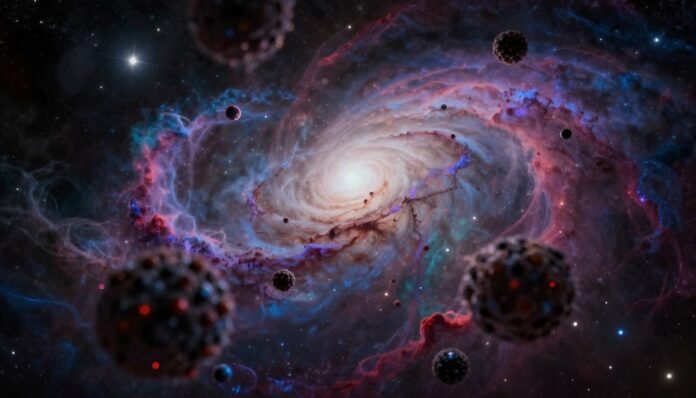

Ever thought about the space between stars? Is it really empty, or is something invisible there? The Apple TV+ series based on Blake Crouch’s novel makes us think about this. But the scientific reality is even more amazing than what TV shows can show.
Most of our universe is hidden from our sight. Scientists call this mysterious substance What Is Dark Matter?. It pulls on galaxies with gravity but doesn’t interact with light. Without it, the universe would fall apart.
In this guide, we’ll dive into the basics of this cosmic mystery. Knowing about this invisible force is key to understanding space and time.
Key Takeaways
- Dark energy and this invisible substance make up most of the universe.
- It does not emit, absorb, or reflect light, making it impossible to see directly.
- Scientists detect its presence by observing how gravity affects visible stars and galaxies.
- The concept has gained popularity through modern media like the Apple TV+ series.
- Research into this topic helps us understand the structural evolution of the cosmos.
The Cosmic Puzzle: What Is Dark Matter?
Ever wondered what makes up most of the universe? You’re not alone. Astrophysicists are still trying to figure it out. The vastness of space is mind-boggling, and what we can see is just a small part. This leads us to the big question: What Is Dark Matter?
Dark matter is like the invisible framework of the universe. It doesn’t reflect or absorb light, so we can’t see it with regular telescopes. We can only sense its presence through how it pulls on things we can see.

Scientists are puzzled by dark matter, asking It’s a mystery because it challenges our understanding of physics. Galaxies wouldn’t hold together without it. Without dark matter, the stars and galaxies we see wouldn’t be where they are.
“The universe is not only queerer than we suppose, but queerer than we can suppose.”
— Arthur Eddington
Let’s look at what makes dark matter so hard to grasp:
- Invisible Nature: It doesn’t interact with light or other forms of electromagnetic radiation.
- Gravitational Dominance: It pulls strongly, keeping galaxies together.
- Abundance: It makes up about 85% of the universe’s matter.
Exploring dark matter helps us understand the vast unknown. We’re trying to map a dark universe, seeing only the surface. Figuring out What Is Dark Matter? is key to understanding our universe’s history and future.
The History of Discovery: How We Noticed Something Was Missing
It’s amazing how our understanding of the universe began with a missing piece. Astronomers thought all mass in space was visible. But, as we got better at observing, the math didn’t add up.
Looking closer at stars and galaxies, we found something big was missing. This led to the question: Scientists started solving a huge, invisible puzzle.

Fritz Zwicky and the Coma Cluster
In the 1930s, Fritz Zwicky studied the Coma Cluster. He calculated its mass based on galaxy light. Then, he looked at how fast galaxies moved.
Zwicky found galaxies moving too fast for visible matter to hold them. He suggested a unseen mass was needed. This was a key moment in understanding تعريف المادة المظلمة.
Vera Rubin and the Rotation of Galaxies
Years later, Vera Rubin found strong evidence for this invisible substance. She studied star speeds in spiral galaxies. Stars at the edges should move slower, like planets.
But Rubin found stars at the edges moving as fast as those near the center. This showed galaxies have a huge, invisible halo. Her work changed how we see the universe.
- Visible matter can’t explain galaxy motion.
- Galaxies need extra gravity to rotate.
- The universe has much more mass than we can see.
These discoveries changed how I see the night sky. They showed us that what we see is just a small part of a vast, mysterious universe.
Gravity as Our Primary Detective
When light can’t show us the truth, gravity steps in. It reveals where hidden mass is. I see gravity as the ultimate cosmic detective. It lets me trace the influence of matter that’s invisible to our telescopes.
By watching how objects move and how light bends, I get a clearer picture of the universe’s hidden structure.

Understanding Galactic Rotation Curves
In my study of spiral galaxies, I examine how stars orbit the galactic center. According to Newtonian physics, stars at the outer edges should move slower. But, observations show that these stars move at incredibly high speeds, surprising us.
This surprise is key to understanding . It suggests that a massive, unseen halo surrounds these galaxies. Without this halo, the galaxies would fly apart. The halo’s gravity keeps everything in place, acting as a cosmic anchor.
“The universe is not only queerer than we suppose, but queerer than we can suppose.”
— Arthur Eddington
The Role of Gravitational Lensing
Gravitational lensing helps me map invisible mass. When light from a distant galaxy passes near a massive object, gravity bends and distorts it. This effect shows the presence of mass that emits no light.
By analyzing these distortions, I can figure out the total mass of the lensing object, even if it’s dark. This method lets me create detailed maps of where this mysterious substance clusters in the cosmos. It’s a powerful way to confirm that gravity is the key to unlocking the secrets of the dark universe.
Why We Cannot See It: The Nature of Invisible Matter
The most common substance in our universe is invisible to us. Stars, planets, and gas clouds are bright, but they make up only a small part of the universe’s mass. The rest is a mysterious substance that we can’t see with our eyes.
Distinguishing Dark Matter from Dark Energy
Many people mix up dark matter and dark energy. But they play different roles in the universe. I see dark matter as the cosmic glue that keeps galaxies together. Without it, galaxies would fly apart because of their fast speeds.
Dark energy, on the other hand, pushes the universe to expand faster. It’s like a force that pushes everything apart. To understand the universe, we must see dark matter and dark energy as two different things:
- Dark Matter: Helps form structures by pulling things together.
- Dark Energy: Makes the universe expand faster.
Why It Does Not Interact with Light
We can’t see this substance because it doesn’t interact with light. Unlike regular matter, dark matter doesn’t absorb, reflect, or emit light. This makes it hard for astronomers to find.
Because it doesn’t interact with light, we can’t see it with regular telescopes. We have to use its effect on visible objects to find it. This shows that dark matter is made of particles that don’t fit into our current understanding of physics.
Our tools are limited by how light works. Since dark matter doesn’t affect radiation, it’s like a ghostly presence. We can only feel its effect on stars and galaxies we can see.
The Leading Candidates: What Could It Be?
I’ve been digging into what makes up the universe, focusing on dark matter. We know it pulls things with gravity, but what is it? أبحاث المادة المظلمة are pushing our understanding. They test different ideas to find out.
WIMPs: Weakly Interacting Massive Particles
WIMPs have been a big topic in science for years. They’re heavy and interact only through gravity and the weak nuclear force. Since they don’t reflect light, we can’t see them with our telescopes.
Scientists like WIMPs because they fit into some theories of physics. They think WIMPs were made a lot in the universe’s early days. The primary advantage is they could explain galaxy distributions without new physics.
Axions: The Lightweight Contenders
Lately, axions have become more popular. They’re very light and were thought up to solve quantum chromodynamics problems. Axions are everywhere and could act like a fluid in space.
Finding axions is now a big deal in . Scientists are making super-sensitive detectors to find them. This shows how our view of the universe is always changing.
Primordial Black Holes and Other Exotic Theories
Some think dark matter could be big objects, like primordial black holes. These could have formed in the universe’s early days. They wouldn’t be atoms but could still hold galaxies together.
Other ideas include:
- Sterile Neutrinos: A type of neutrino that doesn’t interact via the weak force.
- Self-Interacting Dark Matter: Dark matter particles that collide and bounce off each other.
- Hidden Sector Particles: Particles in a “dark” force field we can’t detect yet.
Finding out what dark matter is will take more time. It might be WIMPs, axions, or something new. Each idea brings us closer to understanding the universe. The next decade will be key to solving this mystery.
Mapping the Invisible: How Scientists Visualize the Unseen
I often wonder how we can map something that doesn’t interact with light. Modern tech lets us explore dark spaces to solve ألغاز المادة المظلمة. By watching how gravity bends light from stars, scientists guess where this mystery stuff is.
Large-Scale Structure of the Universe
Looking at galaxy clusters, I see more than random groups. Dark matter pulls visible matter into certain areas over billions of light-years. This invisible scaffolding shapes the whole universe.
Without this structure, galaxies wouldn’t form as we see them today. It’s the main force that shapes the early universe’s chaos into today’s beauty. My studies show dark matter is the universe’s true designer.
The Cosmic Web Explained
Scientists call this pattern the Cosmic Web. Picture a huge, web-like network with galaxies at its nodes. This web is the universe’s skeleton, keeping everything in place.
Research on أبحاث المادة المظلمة is making our maps of this web clearer. By studying these strands, we understand how the universe grew over time. This helps us see the true size and complexity of our world.
The Search Underground: Detecting Particles on Earth
I’m exploring dark matter in the most hidden labs deep in mountains. Scientists think these places are our best chance to solve ألغاز المادة المظلمة. They believe that by being underground, they can avoid the constant space particle interference.
Deep Underground Laboratories
These labs are built in old mines or deep tunnels for natural protection. The rock above blocks most interference, helping with sensitive measurements. Some key sites include:
- SNOLAB in Canada, two kilometers down.
- Gran Sasso National Laboratory in Italy, under a big mountain.
- Sanford Underground Research Facility in the United States.
The Challenges of Background Noise
Even underground, it’s not completely quiet. Natural radioactivity from the rock can confuse signals. Scientists must work hard to isolate جسيمات المادة المظلمة from this noise.
To do this, detectors are put in huge tanks of pure water or liquid xenon. These liquids block stray radiation. The main technical challenges are:
- Removing radioactive isotopes from the detector materials.
- Telling apart dark matter signals from solar neutrinos.
- Keeping sensors cold to stay sensitive.
Every experiment is a race against time and noise. By creating these quiet spots, scientists aim to catch a clear signal. This hard work is key to making theoretical physics real.
Space-Based Observations and Telescopes
Space-based technology has opened a new window into the mysterious world of dark matter. By placing instruments above Earth’s atmosphere, I can observe the cosmos with unprecedented clarity. These advanced tools allow me to track how invisible mass influences the evolution of galaxies over billions of years.
The Role of the James Webb Space Telescope
The James Webb Space Telescope (JWST) is a powerful tool for my research into the early universe. It can detect infrared light, allowing it to see through dense clouds of dust to the first galaxies. By studying these ancient structures, I can infer the presence of dark matter particles that acted as the gravitational scaffolding for early star formation.
The data from this telescope helps me refine my theoretical models. I’m particularly interested in how these early galaxies maintained their shape despite the chaotic conditions of the infant universe. This dark matter world remains a primary focus as I analyze the light from these distant, primordial systems.
Analyzing Cosmic Microwave Background Radiation
Beyond individual galaxies, I look at the Cosmic Microwave Background (CMB) radiation to understand the universe’s infancy. This faint glow is a snapshot of the universe as it existed just 380,000 years after the Big Bang. By mapping tiny temperature fluctuations in this radiation, I can identify the gravitational imprints left by dark matter particles.
These fluctuations reveal the initial distribution of matter that eventually grew into the cosmic web. The following table highlights how different observation methods contribute to my understanding of this invisible influence:
| Observation Method | Primary Focus | Key Insight |
|---|---|---|
| JWST Infrared | Early Galaxy Formation | Structural evolution |
| CMB Mapping | Early Universe Density | Initial mass distribution |
| Gravitational Lensing | Massive Clusters | Total matter mapping |
By combining these diverse data sets, I am building a more complete picture of the universe. Each new observation brings me closer to solving the mystery of what constitutes the vast majority of our cosmos.
Alternative Theories: Is Gravity the Real Culprit?
Scientific debates get exciting when we question our basic beliefs about the world. While most scientists focus on dark matter, some think gravity might not be fully understood. They suggest that physics changes at extreme scales, not just because of invisible particles.
Modified Newtonian Dynamics (MOND)
Modified Newtonian Dynamics, or MOND, is a big alternative to dark matter. It says gravity acts differently at low speeds, like at galaxy edges. MOND changes the math to explain galaxy rotation without dark matter.
MOND fans highlight several points it gets right:
- The flat rotation curves of spiral galaxies.
- The link between a galaxy’s visible mass and its speed.
- No need for unknown particles to balance the universe.
The Debate Between Dark Matter and Modified Gravity
The debate between dark matter and modified gravity is key to science. Dark matter explains the universe’s big structure and the cosmic microwave background. But, it still hasn’t been directly found. Modified gravity theories, on the other hand, face challenges like explaining galaxy clusters.
| Feature | Dark Matter | Modified Gravity |
|---|---|---|
| Primary Mechanism | Invisible Particles | Revised Physics |
| Galactic Rotation | Explains well | Explains well |
| Cosmic Background | Strong evidence | Limited evidence |
I think this debate is crucial for advancing dark matter research. Whether it’s a new particle or a deeper gravity understanding, seeking truth is key. Both sides keep improving their theories, expanding our cosmic knowledge.
The Impact of Dark Matter on Our Understanding of the Universe
I often think about how dark matter shapes what we see. It’s like gravitational glue that holds the universe together. By studying نظرية المادة المظلمة, I learn how the universe went from chaos to order.
Galaxy Formation and Evolution
In the universe’s early days, matter was spread thin. Without dark matter, gas wouldn’t have clumped to form stars. Dark matter provided the necessary scaffolding for this process.
It created deep gravitational wells. These wells trapped gas, allowing it to condense and ignite. This led to several key developments:
- The rapid accumulation of gas into dense, star-forming regions.
- The stabilization of rotating galactic disks that we see in the modern era.
- The formation of massive galaxy clusters that serve as the building blocks of the cosmic web.
The Fate of the Universe
My research into نظرية المادة المظلمة also makes me think about the universe’s future. The total amount of matter, including dark matter, decides if the universe will expand forever or collapse.
If matter is dense enough, gravity might stop the expansion. But, current observations show the universe is expanding faster. This means dark matter is important for local structure, but other forces control the long-term trajectory of the cosmos.
Understanding this balance is key for my work in cosmology. It helps me understand the universe’s timeline from its fiery start to its cold future.
Conclusion
I’ve taken you on a journey through the vast universe to explore the mystery of the unseen. The quest for answers is a major goal in modern physics. Every new discovery brings us closer to proving the نظرية المادة المظلمة.
Looking at history and particle physics, we’re on the verge of a big discovery. Scientists at places like the Large Hadron Collider are working hard. They’re pushing the limits of what we know. Their work will soon prove the نظرية المادة المظلمة as a scientific fact.
I hope this journey has made you appreciate the hidden forces in our galaxy. The universe is full of secrets, but our curiosity drives us to find them. Share your thoughts on these mysteries or check out the latest from the James Webb Space Telescope. Your interest helps us understand our existence better.
FAQ
What is the most accurate definition of dark matter, or ما هي المادة المظلمة؟, for a beginner?
Dark matter is an invisible substance that makes up about 27% of the universe. It doesn’t emit, absorb, or reflect light. But, it pulls on visible matter, acting like cosmic glue.
How did the اكتشاف المادة المظلمة (discovery of dark matter) actually occur?
The discovery of dark matter wasn’t sudden. It was a series of observations. Fritz Zwicky noticed galaxies moving fast in the 1930s. Later, Vera Rubin showed stars at the edges of galaxies rotate fast, hinting at unseen mass.
Can you provide a simple تفسير المادة المظلمة (explanation of dark matter) versus dark energy?
Dark matter pulls things together, like cosmic glue. Dark energy pushes the universe apart. They’re both mysterious but do opposite things.
What are the current أبحاث المادة المظلمة (dark matter research) projects focusing on?
Research is happening both on Earth and in space. Detectors like LUX-ZEPLIN (LZ) search for particles. The James Webb Space Telescope and Euclid mission study its effect on light.
What are the leading candidates for جسيمات المادة المظلمة (dark matter particles)?
Scientists look at two main types: WIMPs and Axions. Primordial Black Holes are also considered.
Why are the ألغاز المادة المظلمة (mysteries of dark matter) so hard to solve?
Dark matter is hard to find because it doesn’t interact with light. I have to rely on indirect evidence, making it tough to confirm theories.
Is the Apple TV+ series “Dark Matter” based on real science?
The Apple TV+ series is science fiction. It explores the multiverse, not the real dark matter I study in physics.
What happens if the نظرية المادة المظلمة (theory of dark matter) is wrong?
If dark matter theory fails, we might look at Alternative Theories like Modified Newtonian Dynamics (MOND). But, most data still supports the invisible particle theory.