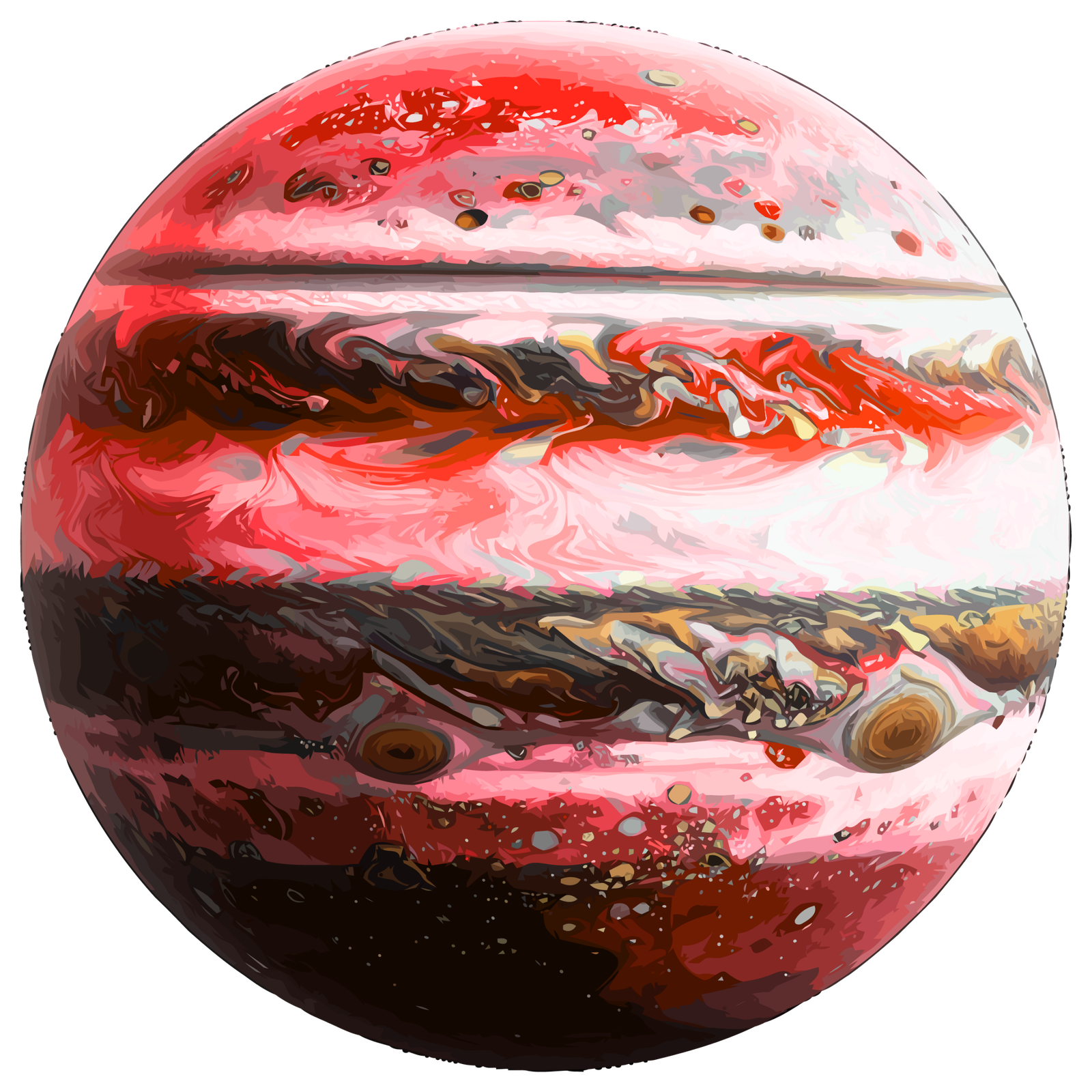
Planet Gravity Calculator
Calculate surface gravitational acceleration ($g$) for any custom or real celestial body using Newton’s Law of Universal Gravitation.
Scientific Explanation
Surface gravity ($g$) measures the gravitational acceleration experienced at a planet’s outer boundary. It is directly proportional to planet mass ($M$) and inversely proportional to the square of its radius ($r^2$).
This means if a planet doubles its mass, surface gravity doubles. However, if a planet doubles its radius, surface gravity drops to one-quarter ($1/2^2$) of its original strength!
Did You Know?
- Gravitational Constant (G): Isaac Newton determined the relationship, but $G$ was first measured experimentally in 1798 by Henry Cavendish using a torsion balance.
- Saturn’s Low Density: Despite being 95 times more massive than Earth, Saturn’s low density means its surface gravity is only 1.06 times Earth’s!
- Escape Velocity: Escape velocity is calculated via $v_{esc} = \sqrt{2 \cdot G \cdot M / r}$. Earth’s escape velocity is 11.2 km/s (approx. 25,000 mph).
Frequently Asked Questions
Planet Gravity Calculator: Calculate Surface Gravity Across the Solar System
Have you ever wondered why astronauts float so effortlessly on the Moon, or what it would feel like to stand on the surface of Mars? Gravity is that invisible force that keeps our feet planted firmly on Earth, but every planet in our solar system has a totally different gravitational pull. That’s why we created this Planet Gravity Calculator here at Galaxy Chronicle.
Whether you’re working on a physics homework assignment, writing sci-fi stories, or just curious about space science, our Planet Gravity Calculator makes it super easy to calculate gravitational acceleration ($g$) and surface gravity for any planet or moon in seconds.
How to Use the Planet Gravity Calculator
Using the Planet Gravity Calculator is really straightforward, even if you hate math:
- Pick a Celestial Body: Select any planet, moon, or dwarf planet from our pre-loaded list (like Venus, Jupiter, or Europa).
- See Surface Acceleration ($g$): The Planet Gravity Calculator instantly gives you the exact surface gravity measured in meters per second squared ($m/s^2$) and in Earth gravities ($g$).
- Custom Inputs: Want to create your own imaginary planet? Enter any custom mass and radius into the Planet Gravity Calculator to see what kind of gravity it would generate.
- Compare with Earth: Get an instant percentage comparison showing how much stronger or weaker that world’s pull is compared to what we feel every day on Earth.
The Physics Behind Planetary Gravity
A lot of people think bigger planets always have way stronger gravity, but that isn’t always the full story. Gravity depends on two main things: the planet’s total mass and its physical radius.
According to Newton’s Law of Universal Gravitation, the formula works like this:
$$g = \frac{G \times M}{r^2}$$
Because radius is squared ($r^2$) in the bottom of the formula, a planet’s density plays a huge role! For example, Saturn has 95 times more mass than Earth, but because it’s a giant, spread-out ball of gas with a huge radius, its surface gravity is actually pretty close to Earth’s—just about $1.07g$. Using a handy tool like our Planet Gravity Calculator saves you from doing all those tedious calculations manually.
Frequently Asked Questions
Why does the Moon have such weak gravity compared to Earth?
The Moon is much smaller and has far less mass than Earth. Its surface gravity is only about $1.62 m/s^2$, which is roughly $16.6\%$ of Earth’s gravity. That’s why Apollo astronauts could jump so high in their heavy space suits!
Can I use this Planet Gravity Calculator for fictional planets?
Yeah, absolutely! Just toggle the custom mode, plug in the mass and size of your hypothetical alien world, and the Planet Gravity Calculator will handle the rest.
Does a planet’s gravity affect its atmosphere?
Definitely. Stronger surface gravity helps a planet hold onto lighter gases like hydrogen and helium, which is why gas giants have massive atmospheric layers while smaller bodies like Mercury lose their atmospheres into space.