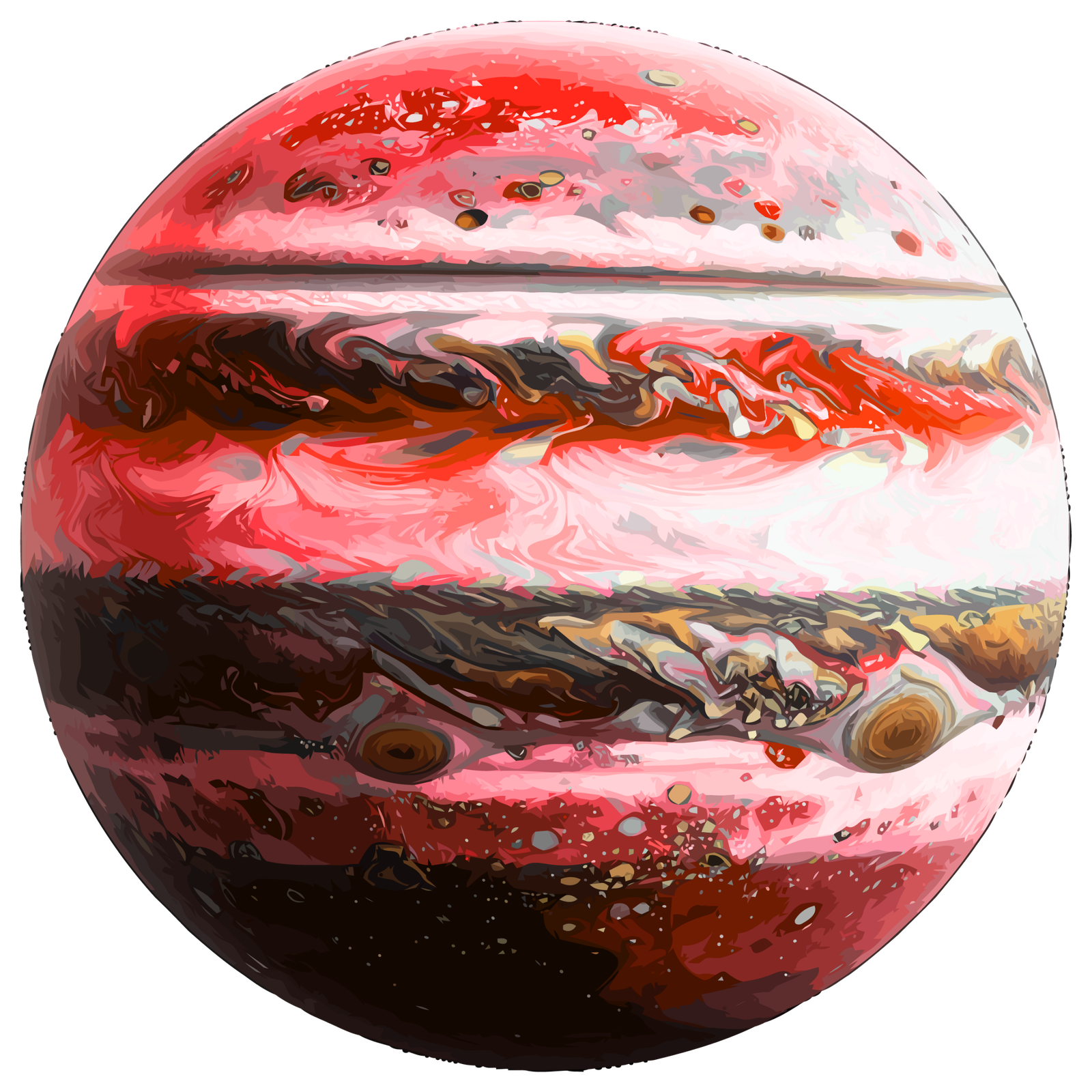
Weight on Planets Calculator
Discover how much you would weigh across the Solar System based on official NASA surface gravity data.
Scientific Explanation
Weight is a measure of the pull of gravity on an object’s mass. While your mass remains constant anywhere in the universe, your weight changes depending on the gravitational force of the celestial body you are standing on.
Weight is calculated using Newton’s Second Law of Motion: W = m × g, where m is mass and g is local gravitational acceleration (Earth = 9.807 m/s²).
Did You Know?
- Gas Giants: Gas giants like Jupiter don’t have a solid surface. Surface gravity is calculated at the cloud tops where atmospheric pressure equals 1 bar (same as Earth’s surface).
- Mass vs. Radius: Uranus is 14.5 times more massive than Earth, but because it is much larger in radius, its surface gravity is actually lower than Earth’s!
- Moon Walk: The Moon has only 16.5% of Earth’s gravity, making jumping six times easier.
Frequently Asked Questions
Weight on Planets Calculator: How Much Would You Weigh on Other Worlds?
Step on a bathroom scale on Earth, and it shows your weight based on our planet’s gravitational pull. But if you were standing on the dusty red plains of Mars or floating in the dense clouds of Jupiter, that number on the scale would change completely! That’s exactly why we created this Weight on Planets Calculator here at Galaxy Chronicle.
Ever wondered if you could jump super high on the Moon or if Jupiter’s gravity would crush your scale? Our Weight on Planets Calculator gives you an instant readout of what you’d weigh across the entire solar system.
How to Use the Weight on Planets Calculator
Using the Weight on Planets Calculator couldn’t be simpler:
- Type In Your Weight: Enter your current weight in pounds (lbs) or kilograms (kg) into the calculator box.
- Instant Cosmic Breakdown: The Weight on Planets Calculator automatically calculates your exact scale weight for all eight planets, the Moon, and even Pluto.
- Switch Units Easily: Easily toggle between imperial and metric units depending on what you prefer.
- Mass vs Weight Explanation: Learn the key physics difference between how heavy you feel versus how much actual mass you’re made of.
The Science: Why Weight Changes While Mass Stays the Same
A lot of people confuse mass and weight, but they’re actually two totally different things in physics! Your mass is just the total amount of matter or “stuff” inside your body, and that never changes no matter where you travel in the universe.
Weight, on the other hand, is the measurement of how strongly gravity pulls down on your mass. Since every planet has a different mass and radius, their gravitational pulls vary wildly.
For example, if you weigh 150 lbs on Earth, the Weight on Planets Calculator shows you’d weigh only about 25 lbs on the Moon because its gravity is just $16.6\%$ as strong as Earth’s. But if you stepped onto a platform at the top of Jupiter’s clouds, that same body would weigh a whopping 379 lbs! Using our Weight on Planets Calculator makes exploring these cosmic gravity shifts super fun and easy to understand.
Frequently Asked Questions
Does this Weight on Planets Calculator work for both pounds and kilograms?
Yeah! You can enter your weight in lbs or kg, and the Weight on Planets Calculator will convert everything into your chosen unit across all planets.
Why would I weigh less on Uranus than on Earth even though Uranus is way bigger?
Great question! Even though Uranus is much larger than Earth, it’s mostly made of light gas and ice, so it’s not very dense. Plus, its larger radius pushes its outer layer farther away from its center of mass, making its surface gravity actually a bit weaker than Earth’s ($8.69 m/s^2$ compared to Earth’s $9.81 m/s^2$).
Can I calculate my weight on dwarf planets or moons?
Yes! We included Earth’s Moon and Pluto in the Weight on Planets Calculator so you can see how light you’d feel on smaller rocky bodies in our solar system.