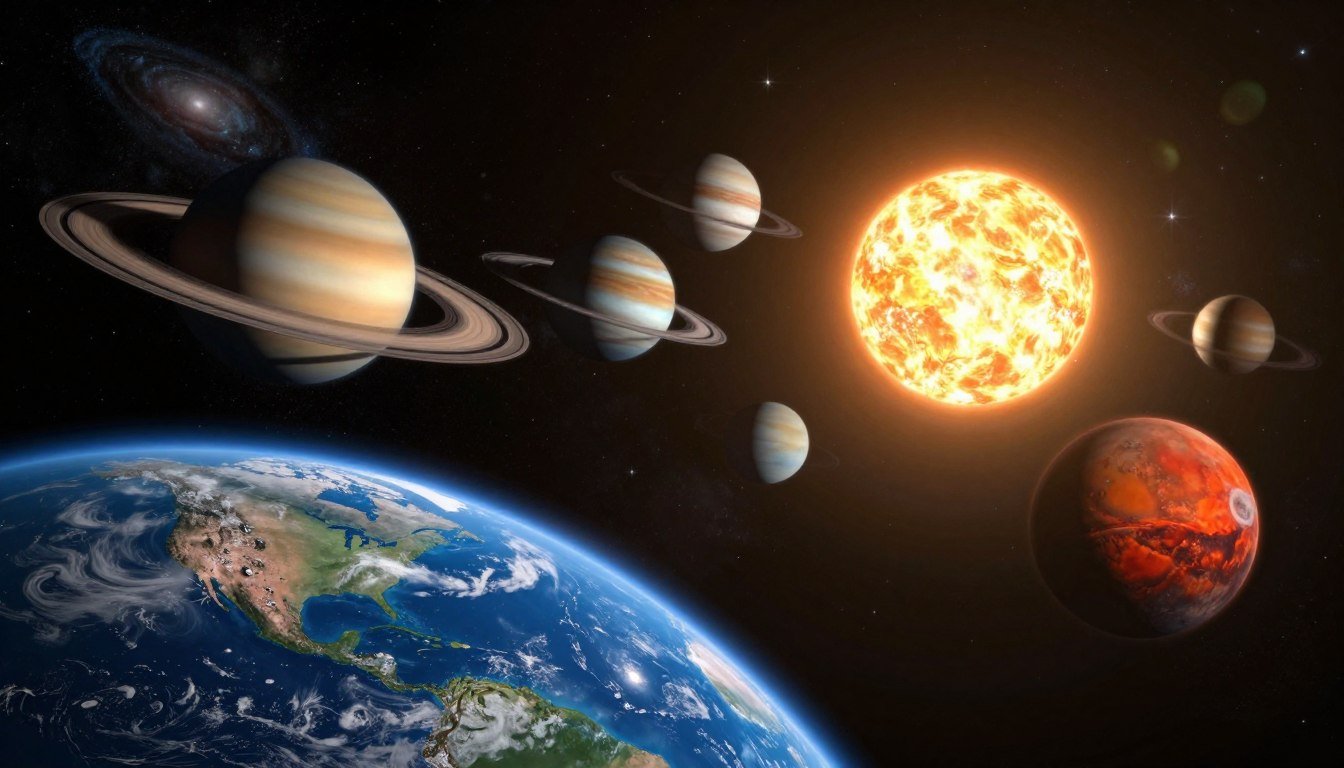

Ever wonder how our vast cosmic neighborhood came to be? Many people gaze at the night sky without realizing they’re looking at a dynamic, gravity-bound family of celestial bodies.
Learning astronomy basics helps us understand our place in the universe. Our home, Earth, formed about 4.6 billion years ago from a massive, swirling cloud of gas and dust.
This group of planets, moons, and debris works together as one unit, held by the sun’s strong pull. By learning what is the solar system? a complete guide, we can explore the amazing history of our space. Let’s start this journey to discover the secrets of our origins.
Key Takeaways
- Our cosmic neighborhood originated 4.6 billion years ago.
- It began as a giant interstellar molecular cloud.
- Gravity acts as the primary force binding all celestial objects together.
- The sun serves as the central anchor for every planet and moon.
- Mastering these concepts provides a foundation for deeper space exploration.
Defining Our Cosmic Neighborhood: What Is the Solar System? A Complete Guide
Ever wondered about our cosmic backyard? What is the solar system? a complete guide shows us a vast, organized neighborhood around a star. It’s not just random rocks and gas. It’s a structured environment that has grown over billions of years.

The Structure of Our Planetary System
Our solar system has a clear hierarchy starting with the Sun. The Sun makes up more than 99% of the mass, holding everything together. Around it, we find different objects in specific zones based on their makeup and distance.
The inner area has small, rocky planets. The outer parts are home to big gas and ice giants. Beyond that, there’s a vast area with icy debris and dwarf planets. This setup keeps the solar system stable, with each part playing a key role.
| Region | Primary Composition | Key Characteristics |
|---|---|---|
| Inner System | Rock and Metal | High density, few moons |
| Outer System | Gas and Ice | Low density, many moons |
| Distant Frontier | Icy Debris | Cold, sparse, and vast |
How Gravity Holds Everything Together
Gravity is the invisible force that keeps our neighborhood together. It’s the main force guiding how objects move in space. The Sun’s huge mass pulls on all objects around it.
This pull keeps planets in stable orbits, not letting them escape into space. Balance is crucial, as planets’ speeds counteract the Sun’s pull. Without this balance, the solar system wouldn’t be the organized place we see today.
The Sun: The Heart of Our System
At the center of our cosmic neighborhood is a massive, glowing sphere. It controls the rhythm of everything around it. This star is so big that it holds 99.8% of the total mass of our solar system.
Because of its huge size, it pulls everything with a strong gravitational force. This keeps planets, moons, and asteroids in their orbits.

The Role of the Sun in Sustaining Life
The Sun is the main source of light and heat for all orbiting bodies. On Earth, it drives all life processes. Without its warmth, our complex ecosystems would not exist.
“The Sun, with all those planets revolving around it and dependent on it, can still ripen a bunch of grapes as if it had nothing else in the universe to do.”
Galileo Galilei
Plants use this light to make food through photosynthesis. This is the base of our food chain. It shows how vital the importance of the sun is for life.
It’s the engine that powers our world.
Understanding Solar Energy and Its Impact
The Sun does more than just light up our world. It drives our planet’s climate. It heats the atmosphere and oceans, creating weather patterns and ocean currents.
These currents move nutrients and regulate temperatures globally.
By studying solar energy, scientists learn how our star affects our system. Understanding the importance of the sun helps us predict climate changes. It also protects our technology from solar flares.
Our star is the heartbeat of our home in space.
The Inner Planets: Rocky Worlds Close to Home
Our journey starts with the inner planets, solid, rocky worlds unlike the gas giants. These four planets are the closest to the Sun. They are made of silicate rocks and metals, with hard, cratered surfaces we can study today.
Mercury: The Scorched Messenger
Mercury is the smallest planet near us. It orbits the Sun in just 88 Earth days. Its surface, like our Moon, is heavily cratered and lacks a thick atmosphere to keep heat in.
Venus: The Hottest Planet
Venus is often called Earth’s twin because of its size and density. But, it’s a hostile environment with a thick, toxic atmosphere. This atmosphere traps heat, making Venus the hottest planet, with temperatures that can melt lead.
Earth: Our Unique Blue Marble
Earth is special because it’s the only known world with life. Its perfect distance from the Sun allows for liquid water, essential for life. A protective atmosphere and strong magnetic field shield us from harmful solar radiation, making Earth unique.
Mars: The Red Planet and Future Exploration
Mars has always fascinated humans with its red, iron-oxide surface. It has massive volcanoes and deep canyons, bigger than anything on Earth. Scientists are exploring Mars, hoping to find signs of past water or life.
The Asteroid Belt: The Great Divide
The asteroid belt is a vast, silent area in our solar system. It lies between Mars and Jupiter. It’s filled with millions of celestial bodies in the solar system, each different in size and makeup.
What Are Asteroids Made Of?
Asteroids are like the leftover building blocks from the early days of our solar system. They are mostly made of silicate rock, similar to Earth’s crust. But, some are made of metallic iron and nickel.
These rocky pieces range from tiny dust to huge bodies hundreds of miles wide. Without atmospheres, their surfaces show scars from billions of years of collisions. Scientists study these celestial bodies in the solar system to understand how planets formed.
The Formation and History of the Belt
Why didn’t these rocks form into one big planet? Jupiter’s massive gravity is the reason. When the solar system was young, Jupiter’s gravity kept the debris apart.
So, the material stayed scattered in a stable orbit around the Sun. Over time, these celestial bodies in the solar system were broken into smaller pieces by countless impacts. This history gives us a glimpse into the chaotic start of our cosmic home.
The Gas Giants: Massive Worlds of the Outer System
As we move past the asteroid belt, we meet the giants of our solar system. These massive worlds are unlike the rocky planets inside. They are mostly made of hydrogen and helium, with deep, thick atmospheres.
These giants rule the outer regions with their huge gravity and complex systems. They have dozens of moons and weather patterns that are breathtaking in scale. Their size makes them some of the most dynamic objects around our Sun.
Jupiter: The King of Planets
Jupiter is the clear giant of the outer neighborhood. It’s so big that over 1,300 Earths could fit inside it. This planet’s massive gravity affects many smaller bodies in our solar system.
Jupiter’s atmosphere is known for its intense, long-lasting storms. The Great Red Spot, a massive storm, has been seen for centuries. Jupiter also has a diverse collection of moons, showing the complexity of our cosmic backyard.
Saturn: The Jewel of the Solar System
Saturn is famous for its stunning ring system. These rings are made of countless ice and rock particles, orbiting the planet in a beautiful display. Like Jupiter, Saturn is a gas giant, mostly made of light gases.
Saturn is more than its rings; it has extreme winds and hidden wonders. Scientists study these planets in our solar system to learn how they formed. Each discovery sheds light on the mysterious nature of these massive, gaseous worlds.
The Ice Giants: Distant and Mysterious
We explore the icy outer reaches of our solar system to find the ice giants. Uranus and Neptune are different from the gas giants closer to the Sun. They are made mostly of water, ammonia, and methane, creating a thick, icy layer.
Learning about these planets in our solar system shows us the variety of environments beyond the Sun’s warmth. Their unique mix of elements tells us about the early days of our cosmic neighborhood.
Uranus: The Tilted Planet
Uranus is the most unusual planet in our solar system. It spins on its side as it orbits the Sun. This extreme tilt causes long-lasting seasonal changes.
One pole faces the Sun directly, while the other stays dark for years. This fascinating characteristic makes Uranus a key area of study for those interested in our solar system’s planets.
Neptune: The Windy Frontier
Neptune is at the edge of the major planets’ orbits, with a deep blue color. It’s a cold, dark, and windy world that remains mysterious. Scientists are especially curious about its stormy atmosphere.
Neptune has the fastest winds in our solar system, over 1,200 miles per hour. These winds create massive, dark storms that move across the planet. Below is a table comparing Uranus and Neptune.
| Feature | Uranus | Neptune |
|---|---|---|
| Axial Tilt | 98 Degrees | 28 Degrees |
| Primary Color | Pale Cyan | Deep Blue |
| Max Wind Speed | 560 mph | 1,200+ mph |
| Discovery Year | 1781 | 1846 |
Beyond Neptune: Dwarf Planets and the Kuiper Belt
The outer reaches of our neighborhood hold wonders that challenge our definition of a planet. While the major planets dominate the inner and middle regions, the area past Neptune is home to unique celestial bodies in the solar system that remain largely mysterious. This cold, dark frontier serves as a time capsule for the early history of our cosmic home.
Pluto and the Classification of Dwarf Planets
For decades, Pluto was considered the ninth planet, but our understanding shifted significantly in 2006. The International Astronomical Union established new criteria for what defines a planet, leading to the reclassification of Pluto as a dwarf planet. This change highlights how our knowledge of various celestial bodies in the solar system continues to evolve as we gather more data.
To be a planet, an object must orbit the Sun, be spherical, and have cleared its orbital path of other debris. Because Pluto shares its neighborhood with many other icy objects, it does not meet the final requirement. Despite this, it remains one of the most fascinating celestial bodies in the solar system to study.
The Vast Expanse of the Kuiper Belt
Beyond the orbit of Neptune lies the Kuiper Belt, a massive ring of icy debris. This region acts as a reservoir of ancient material left over from the formation of our neighborhood billions of years ago. Scientists believe that these celestial bodies in the solar system hold the keys to understanding how our planetary family first came together.
The belt is populated by thousands of small, frozen worlds that orbit the Sun in a distant, slow dance. These objects are often composed of methane, ammonia, and water ice. Studying these celestial bodies in the solar system helps researchers map the chaotic history of the outer reaches.
| Dwarf Planet | Discovery Year | Primary Composition |
|---|---|---|
| Pluto | 1930 | Rock and Ice |
| Eris | 2005 | Rock and Methane Ice |
| Haumea | 2004 | Rock and Water Ice |
| Makemake | 2005 | Methane and Nitrogen Ice |
Comets and Meteors: The Wanderers of Space
While planets get most of our attention, comets and meteors are the real wanderers of our solar system. These fascinating objects roam through space, sometimes showing up as bright flashes in our sky. They are some of the most captivating celestial bodies in the solar system, always on the move across vast distances.
The Origin of Comets in the Oort Cloud
Comets are called “dirty snowballs” because they’re made of frozen gases, dust, and rock. Most come from the Oort Cloud, a huge, spherical shell at our solar system’s edge. This area holds billions of icy leftovers from our sun’s early days.
When a comet is pushed out of its orbit, it starts a long trip to the inner solar system. As it gets closer to the sun, the ice vaporizes, creating a glowing atmosphere and a spectacular tail that points away from the sun. These celestial bodies in the solar system give us a glimpse into our world’s early days.
Meteor Showers and Earth’s Atmosphere
Sometimes, we see a beautiful light show called a meteor shower. This happens when Earth goes through the trails left by comets as they orbit the sun. As these tiny particles hit our atmosphere, they burn up, making bright streaks of light in the sky.
Even though these particles are just a grain of sand, they create an amazing sight. They are pieces of larger celestial bodies in the solar system, connecting us to our cosmic past. Watching a meteor shower is a truly magical experience that shows us the constant motion beyond our atmosphere.
The Significance of the Solar System in Our Understanding of the Universe
Our local cosmic neighborhood is a vital blueprint for understanding the universe. By studying the planets and moons around our Sun, we learn how they form and change over billions of years.
This significance of the solar system is huge. It acts as a nearby lab for scientists. They can test theories about gravity, atmosphere, and geology without traveling far.
Why Studying Our Neighborhood Matters
Studying our area is key for predicting Earth’s future. By looking at Venus’s climate shifts or Mars’s dry landscape, we see how atmospheres can change. This helps us understand our own planet’s possible futures.
This knowledge also helps us find potentially habitable environments elsewhere. Knowing what life needs on Earth helps us search for similar signs on other planets.
Comparing Our System to Exoplanetary Systems
Astronomers have found thousands of exoplanets, giving us context for our system’s uniqueness. These discoveries show our solar system is just one of many in the universe.
By comparing our home to these alien worlds, we see that planetary systems vary greatly. This wider view is key to understanding the universe’s true nature.
| Feature | Solar System | Exoplanetary Systems |
|---|---|---|
| Primary Star | Single Sun | Often Binary or Multiple |
| Planet Types | Rocky and Gas Giants | Super-Earths and Hot Jupiters |
| Habitability | Earth-centered | Highly Variable |
| Stability | High | Often Chaotic |
A History of Solar System Exploration
Exploring our solar system has gone from a dream to a reality. This journey has changed how we see our place in the universe. Looking back, we see huge tech leaps that got us here.
Early Telescopic Discoveries
Astronomers used their eyes and simple lenses before machines went to space. Galileo Galilei’s telescope changed the sky view. He saw Jupiter’s moons and Venus phases, showing the Earth isn’t the center.
These early views laid the foundation for modern astronomy. Scientists mapped planet movements with better precision. This curiosity led to wanting to explore beyond Earth.
Modern Space Probes and Robotic Missions
The space age brought a new era of outer space exploration. We started sending robots to visit distant worlds. These missions give us detailed images and data we couldn’t get before.
Voyager 1 is a key milestone. Launched in 1977, it’s the farthest human-made object. It carries our message to the stars.
Now, solar system exploration keeps advancing with better rovers and orbiters. These robots are our eyes and ears on other moons and planets. Each mission brings us closer to understanding our cosmic neighborhood.
Essential Solar System Facts Every Beginner Should Know
To master astronomy basics, you must first debunk common space myths. Many see our neighborhood through science fiction, which often distorts reality. Learning the truth reveals the true beauty of our cosmic world.
Common Misconceptions About Space
One myth is that the asteroid belt is a crowded, dangerous place. But in reality, it’s vast and mostly empty. You could fly a spacecraft through it without hitting a single asteroid.
Another myth is that planets are close together. But they are actually millions of miles apart. Knowing these solar system facts is key for space science beginners.
“The universe is under no obligation to make sense to you.”
Neil deGrasse Tyson
Scale and Distance in the Solar System
To understand our neighborhood’s size, we use the Astronomical Unit (AU). One AU is the average Earth-Sun distance, about 93 million miles. This is crucial for astronomy basics when exploring our system’s edges.
Space’s emptiness is hard to picture. If the Sun were a front door, Earth would be a marble 300 feet away. This shows why space travel is such a big challenge for us.
Remembering these solar system facts helps you grasp our planetary home’s scale. The vast gaps between worlds are not just empty space. They are key to our solar system’s design.
Conclusion
Our journey from the Sun’s heat to the Kuiper Belt’s cold shows a vast, connected neighborhood. This cosmic landscape holds secrets that shape our understanding of existence.
NASA and private companies like SpaceX are getting us closer to these mysteries. They turn distant lights into worlds we can explore.
You now know the basics of our solar system’s scale and complexity. Look up at the night sky and stay curious about the James Webb Space Telescope’s findings.
The story of our solar system is still unfolding. New discoveries await those who look up and wonder. Share your love for astronomy to keep exploration alive for others.
FAQ
What is the solar system? A complete guide to its boundaries?
The solar system is our cosmic neighborhood. It includes the Sun and all objects bound to it by gravity. This includes eight major planets in our solar system, their moons, dwarf planets like Pluto, and smaller celestial bodies like asteroids and comets. It stretches from the Sun to the icy Oort Cloud.
What is the importance of the sun within our planetary neighborhood?
The importance of the sun is huge. It makes up about 99.8% of the total mass of the system. Its gravity keeps planets in orbit, and its light and heat support life on Earth and drive weather patterns on other planets.
How many planets in our solar system are there, and how are they categorized?
There are eight official planets. They are divided into inner, rocky planets (Mercury, Venus, Earth, Mars) and outer giants. The outer system has “Gas Giants” Jupiter and Saturn, and “Ice Giants” Uranus and Neptune. The Asteroid Belt separates the inner and outer regions.
What are some essential solar system facts regarding distance?
To grasp space’s vastness, astronomers use the Astronomical Unit (AU). It’s the average distance from Earth to the Sun—about 93 million miles. One surprising fact is that space is mostly empty. For example, Jupiter is massive enough to hold 1,300 Earths but is still hundreds of millions of miles from its nearest neighbors.
How has outer space exploration changed our view of the planets?
A: Outer space exploration has turned distant lights into real worlds. Thanks to NASA missions and the Voyager 1 probe, we’ve seen Saturn’s rings, Jupiter’s Great Red Spot, and Neptune’s blue methane clouds up close.
What is the significance of the solar system in modern astronomy?
The significance of the solar system is huge. It’s a blueprint for the universe. By studying our system, scientists learn about other stars and exoplanets. It’s a key lab for astronomy basics, teaching us about atmospheres, geology, and life elsewhere.
Why is solar system exploration still focused on Mars?
A: Solar system exploration still focuses on Mars because it’s the most Earth-like planet for humans. Robots like the Perseverance Rover are searching for signs of life, helping us understand if Mars was once like Earth.
What are the astronomy basics for identifying objects in the night sky?
To start with astronomy basics, know the difference between stars and planets. Planets shine steadily, while stars twinkle. Knowing the significance of the solar system‘s ecliptic plane helps find planets against distant constellations.